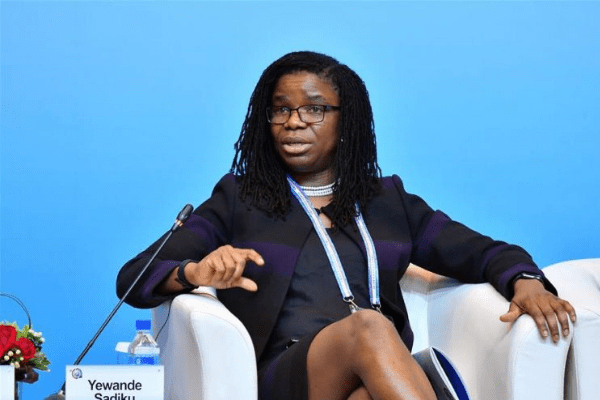
Nigerian Investment Promotion Commission (NIPC) says Nigeria will negotiate future international investment agreements using a set of parameters that will ensure a balance between investors’ interests and the developmental objectives of the country.
NIPC’s executive secretary/CEO, Yewande Sadiku, made this remark as lead speaker at the Symposium on International Investment Law and Practice in Honour of Late Professor Michael Ayo Ajomo, held at the Nigerian Institute of Advanced Legal Studies (NIALS), University of Lagos.
In her presentation titled ‘Contemporary trends in Investment Law and Policy – Lessons for Nigeria’, she observed, “It is true that Nigeria has challenges, but when we are going into a negotiation that is not the toga that we wear, the toga that we wear is the toga of a country that is the 26th largest economy in the world and is estimated by 2050 to be the 14th largest; the toga of a country that is the 7th most populous country in the world and is estimated that by 2050 would become the 3rd most populous country.”
The executive secretary said, “In many parts of Europe and in the West the median age of the population is north of 45 years while the median age in Nigeria is 18.4 years. The difference between young people and old people is that they are mobile,” adding, “That young people are mobile physically and they are also familiar with mobile devices.”
Also at the symposium, a book was unveiled titled – “Law of International Investment: Essays in Honour of Professor Michael Ayo Ajomo.” The book was reviewed by Professor Yinka Omorogbe, attorney-general and commissioner of justice, Edo State. In her review, she said the book was a collection of 12 chapters dealing with topical issues in international investment law and practice.
She also said the strategic choice of chapter topics captured contemporary investment issues and that the simplicity of the writing style and clear presentation of ideas by all chapter contributors made reading and understanding of issues discussed in the book easy for stakeholders such as foreign investors, policy makers, legal practitioners, academics and research students.
Robert Clarke, a senior advocate of Nigeria, in presenting the book said the book deserved accolades, stating that the country’s economy was in need of foreign investments, noting the impact foreign investments had on the development of countries like Singapore, Malaysia and Vietnam.
According to Clarke, the contributors put together their thoughts that would aid foreign investors in understanding Nigeria’s investment laws and policies, investment incentives, taxation and dispute resolution mechanisms.