|
Getting your Trinity Audio player ready...
|
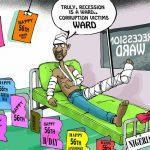
Nigeria turned 56 Saturday, but few gifts were exchanged among well-wishers whose pockets had dried up amid a lull in economic activity, the worst in 25 years.
Gross Domestic Product (GDP) annual growth rate in Nigeria averaged 4.07 percent from 1982 until 2016, reaching an all-time high of 19.17 percent in the fourth quarter of 2004 and a record low of -7.81 percent in the fourth quarter of 1983.
GDP had grown at a steady rate in excess of seven percent per annum for the past decade and within this time, Nigeria leap-frogged South Africa as Africa’s largest economy.
But the nation has fallen from grace since then.
Economic output contracted by 0.36 percent and 2.06 percent in the first and second quarters of 2016 respectively, thereby confirming Nigeria in recession.
The contraction was spurred primarily by a fall in oil production by almost half, which proved even more lethal to the economy than a slump in prices.
Oil is the country’s biggest foreign exchange earner and accounts for 80 percent of government revenue; hence cheap oil was always going to be a problem.
“Even at that, Nigeria’s economy had no business sliding into recession, but a myriad of delayed policy responses has led us this far,” Ayo Fashina, a director at Lagos-based investment firm, Chapel Hill Denham told BusinessDay.
A motley crew of analysts had called on monetary policy makers in the wake of plunging oil prices to let their guards down on naira defence which they said was unsustainable.
This didn’t happen, and in the period, foreign capital fled, eroding Nigeria of the much needed dollars to sustain a consumption pattern that gulped N1.5 trillion on food imports yearly.
Fuelled partly by dollar shortages, inflation touched double digits as authorities held on to the currency peg; but it wasn’t long till they succumbed to the yearnings of foreign investors.
Sixteen months later, they owned up to the fact that the peg was simply unrealistic after the external reserves had plummeted to less than $26 billion, which was equivalent to roughly six months of imports.
It was greeted by cheers, when on June 20; Nigeria embraced liberalisation and threw in the towel on the peg, even though a lot of damage had been done.
At the last Monetary Policy Committee meeting, the ten-man committee voted to leave benchmark interest rates at 14 percent, after hiking it by 200 basis points from 12 percent at July’s meeting.
Godwin Emefiele, Governor of the CBN, said rates had to be positive to lure investors who had remained at bay even after liberalisation, despite calls from the fiscal authorities to ease borrowing costs and encourage credit flow.
Unemployment had gone on to break the required threshold and the misery index touched 49.7 percent, ignited by companies shutting down operations or at best, shaving almost half of their work force.
5,726 jobs were created in the first quarter, but 8,764 jobs lost, according to state statistics body, the National Bureau of Statistics (NBS).
Nigeria’s 36 states which had relied on federation account allocations were cash strapped and government workers went months without pay.
The governor of Imo state went as far as announcing a three-day work week for civil servants, telling them to farm for the other two days, as salaries waned.
Infrastructure was in tatters and the capital controls presented the perfect opportunity to dump Nigeria.
Within this time, Nigeria relinquished its positions as Africa’s largest economy and crude producer to South Africa and Angola respectively.
Nigeria’s fiscal account went from a surplus to a deficit of 2 percent of economic output last year, according to Ecobank. That comes after years of running a surplus of between 2-6 percent.
“In Nigeria, economic activity is now projected to contract by 1.8 percent in 2016, as the economy adjusts to foreign currency shortages as a result of lower oil receipts, low power generation, and weak investor confidence,” according to the IMF.
It is two weeks since the Aug. 31 revelation by the NBS that the country is in recession and business leaders say Nigeria’s economic managers are in denial and are not responding adequately to the plethora of economic woes and public alarm over a lack of effective plan or communication about how to climb out of the rut.
Nigeria’s record expansionary budget was passed on May 6, but is yet to have the intended impact on economic activities.
Revenues have fallen and it seems tapping a pool of debt capital is the only hope to implement the N6.1 trillion budget.
The Federal Executive Council approved borrowing plans of $4.5 billion last month but lawmakers are yet to give a nod.
LOLADE AKINMURELE