The Federal Executive Council (FEC) on Wednesday approved the revised Medium Term Expenditure Framework (MTEF) for 2020-2022 as well as amendment to the 2020 budget.
Zainab Ahmed, minister of finance, budget and national planning, who disclosed this after the first ever virtual FEC meeting presided over by President Muhammadu Buhari, said the approval followed the memo by her ministry submitted to the council during the meeting.
The new approved MTEF contains key parameters including new oil price benchmark of $25 per barrel, crude oil production of 1.94 million barrels per day and an exchange rate of N360 to $1.
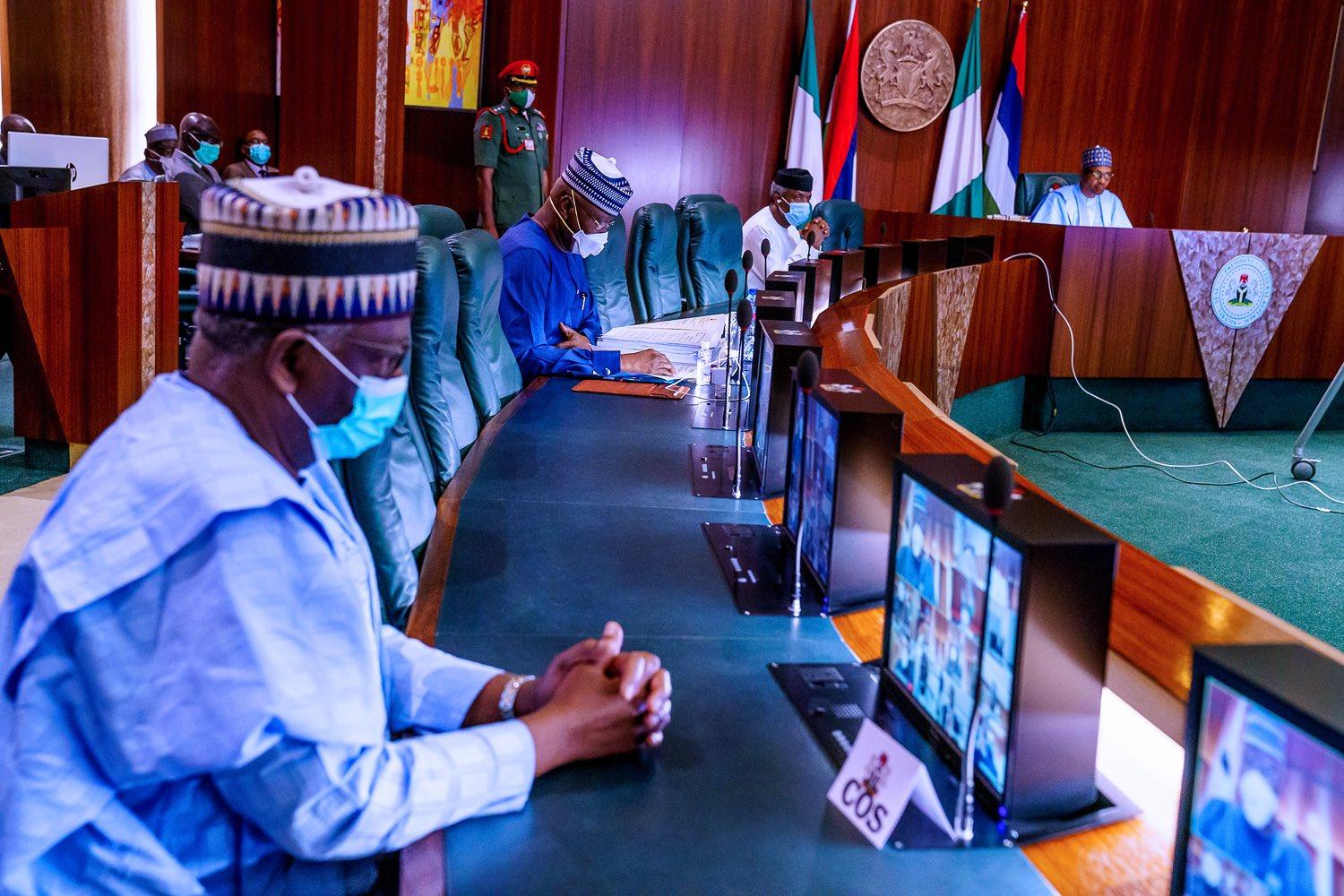
The FEC meeting was held via teleconferencing, where only ministers that had memoranda to present were physically present at the Villa, while other ministers joined from their various offices.

“The revised budget is now in the total sum of N10.523 trillion, a difference of just about N71.5 billion when compared to the approved budget” which was passed by the National Assembly in December 2019, Ahmed said.
“This is because, as we cut down the size of the budget, we also have to bring in new expenditure previously not budgeted, to enable us adequately respond to the COVID-19 pandemic. This will include a revenue of N5.158 billion, with a deficit of N5.365 trillion to be financed by both domestic as well as foreign borrowing.
“The foreign borrowing we are doing for 2020 are all concessionary loans from the IMF, which has already been approved and has crystallised, from the World Bank, Islamic Development as well as Afreximbank,” she said.
Ahmed said there will also be some drawdown of previously committed loans for major ongoing projects to be drawn from both exiting facilities as well as some special accounts with the approval of Mr. President and the National Assembly, and also revenue expected to be realised from privatisation.
“So the borrowing, the multilateral loans drawdown coming from special accounts and coming from the privatisation will fund the fiscal deficit of N5.365 trillion that we have in the proposed amendment of the 2020 budget,” she said.

The finance minister announced that the Federal Government also has request for another $80m loan on behalf of Ebonyi State government from the Islamic Development Bank. The loan, she said, would be for the construction of Abakaliki Ring Road project.
“We also got approval today for the Nigeria Customs Service to purchase boats which are manufactured here in Nigeria for its surveillance and anti-corruption activities on the maritime waters,” she said.
FEC also approved N47 billion for the power sector to add additional 40 megawatts of electricity to the national grid, as well as N683 million for the purchase of 19 operational vehicles for the Nigeria Ports Authority (NPA).
Sale Mamman, minister of power, said the 40 megawatts would be evacuated from Kashimbilla Dam in Taraba State, where it is currently being generated. It would boost power supply in Taraba and Benue States as well as the entire North-East region of the country.
“The Council approved the ministry’s memo for the revised estimated total cost for the augmentation of the subsisting contract in the sum of N47,235,303,821.90 to provide additional critical power grid infrastructure for the full evacuation delivery and utilisation of 40 megawatts, currently being generated from Kashimbilla, via Takum, Wukari and Yandev, to the national grid,” he said.
Sabo Nanono, minister of agriculture and rural development, announced that FEC also approved a loan of $1.2bn for the ministry for the purposes of agricultural mechanisation that will cover about 632 local government councils plus 140 processing plants.
“This is going to be a major revolution in the agricultural sector like we have never seen before. I think the executive council has done the right thing and has approved this,” Nanono said.
“The key to mechanisation is the establishment of 632 tractor serving centres across the country. These serving centres will constitute tractor hiring skill, IT and admin office and a chemical workshop and store for storing inputs for agriculture and even output arising from agricultural sector,” he said.
He stated that the key to the tractor hiring skill is that “every tractor will have a tracking system so that wherever it is working in this country, you will know at your fingertips where it is working and which area it has covered and how much revenue it’s getting”,
The serving centres, he said are going to be privately owned by the indigenes of those local governments.
“So it is imperative for everybody now to key into this programme. It is going to be a competitive bid that will involve selection in terms of your experience in agriculture, your finance position, your investment of between N10 to N70 million,” he said.