|
Getting your Trinity Audio player ready...
|
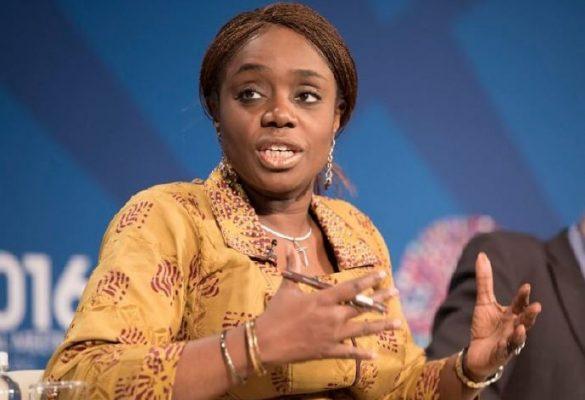
Following the completion of a billion dollar Eurobond issue, Nigeria is set to borrow from the World Bank and China to fund a range of infrastructure projects. CNBC Africa spoke to Nigeria’s Finance Minister Kemi Adeosun about the government’s borrowing program and the economic recovery growth plan and why Nigeria is not considering an IMF loan. BusinessDay’s Lolade Akinmurele followed proceedings.
Why Nigeria is not considering an International Monetary Fund (IMF) loan?
For us, the IMF is the last lender of resort when you have a balance of payment problem. Nigeria doesn’t have a balance of payment problem per say, it has a fiscal problem instead, which is that its major revenue source, oil, has lost so much value.
First of all, there has been a loss in price then a loss in quantity. So the challenges between a balance of payment problem and a fiscal problem are different.
What the IMF does is that they give you programs of reforms; however, we are already doing as much reform as any IMF program will impose on us.
So my questions are what an IMF program will bring that we are not already doing. What measures will be introduced that are not in place already.
Nigerians want to take responsibility for their future and we must have home grown, home designed programs of reforms that Nigerians take ownership of, because they are painful reforms and when you go through these adjustments in your economy. Based on this, I think our reforms have got to be home grown. When we take these responsibilities upon ourselves and it succeeds, then we are able to say we succeeded.
I am not saying the IMF is bad, but I’m saying right now, we don’t see the need. We feel since this is a mess Nigerians created one way or the other, we must also solve it ourselves.
Likelihood of raising sufficient debt for budget spend
There are two issues here, we have a deep domestic capital market and that’s where funds are going to be tapped first and then we supplement it with money from the external market.
I think the subscription of our Eurobond shows that there is appetite for Nigeria so I don’t have any concerns with our ability to raise money in the external capital market. I like the flexibility that it gives us, it means if our fiscal issues improve we can pay down or put a sinking fund together towards paying up. But we think there are adequate funds to fund all we need.

When to expect full details of Economic Recovery and Growth Plan
That is for the minister of budget and national planning to answer. However I have seen it and I know it is being fine-tuned and I’m sure imminently, we will get it.
Asset privatisation still on the table
Of course, we have to look at all the options. When you have a fiscal challenge and a budget funding gap, you have got to look at all the options.
If you have idle assets, which we do have some, that can be realised or put to better use you must look at that option. We are continuing to consider all options including asset realisation. But the talk about specific assets, no, but the asset sale as a principle, absolutely yes.
Whether ERGP provides details of specific assets to be sold
I am not sure the extent to which the details will go. I cannot speak to that; but what I am saying is that realising under-utilised assets that can add value is always an option.
Rising oil prices and economic impact
I get concerned when people talk about oil, because that is what put us in this position. There is an over reliance on oil yet it is only 10 percent of our GDP.
The question I would like you to ask me is how non-oil revenue is looking. That is the most important revenue because it is the most stable revenue. Non-oil revenue is improving steadily and fiscal policies to drive revenue are beginning to yielding fruits.
In terms of oil, production is back up and we are very grateful for that the oil price is favourable but not stable and I think we should be very careful how we are getting excited about rising oil prices.
Increasing non-oil revenue is one of the most difficult things to do. It is where a lot of energy is being exerted. So far, the Federal Inland Revenue Service (FIRS) has enrolled about 825,000 new tax payers or tax payers. There is a lot going around tax mobilisation.
Oil is only 10 percent of our economy; the question is why the other 90 percent of our economy contributing so little. That is really the challenge that we are trying to fix and there is a lot of wok going on with the FIRS and Customs Agency for better reconciliation and collection and there is a lot going on in the third tier which is the independent revenue coming in from the various agencies to get them paying the operating surpluses that they generate. For me that is much more exciting than higher oil prices.
Kind of growth anticipated in non-oil revenue
As I said, growing non-oil revenue is much more difficult to do.
You can wake up tomorrow and the oil price has changed and your revenue has also changed. That is easy and exogenous because we don’t control it. The ones we do control are the ones that are much harder to do. For many years Nigerians got used to not paying tax. We have a six percent tax to GDP ratio, one of the lowest in the world. Ghana is 15 percent and South-Africa is around 26 percent.