Nigeria and Niger Republic on Thursday agreed to strengthen security surveillance along their common borders to ward off rampaging terrorists within the Lake Chad region.
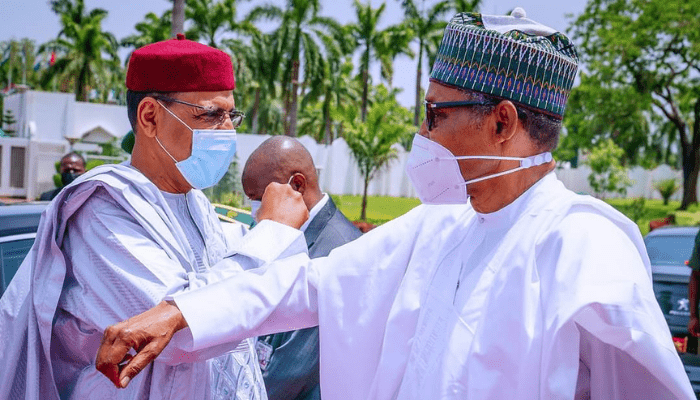
President Muhammadu Buhari and the Nigerien President, Mohammed Bazoum, met at the Presidential Villa, Abuja as part of the one-day state visit to Nigeria by the Nigerien leader.
President Bazoum, who spoke with State House journalists after the meeting, said both leaders discussed the rising insecurity in the Lake Chad region and strategies for strengthening stability in the sub-region.
The relations between Nigeria and Niger are considered crucial to Niger Republic regarded as the world’s poorest country and which has been battling with jihadists

Only recently, the Nigerien leader was reported to have freed “terrorist chiefs” from jail, including members of Boko Haram, in a move that was expected to reconcile the dreaded insurgents with the country’s government.
President Bazoum, who disclosed that he identified “nine terrorist chiefs”, said he was advised to free the prisoners”
The prisoners were held in the southern town of Kollo and the high-security Koutoukale prison.
The release of the insurgents led to a surge in criminality along the Niger borders with Nigeria being at the receiving end, as the country witnessed the invasion of terrorists through the forests in Zamfara, Yobe into Niger and Kaduna States in Nigeria.
Bazoum commended President Buhari for helping his country to “deal with the economic and the security situation in our countries in a manner that we push these issues to be of mutual benefit to Niger and Nigeria.

The visit coincided with the operation that took place jointly in the Lake Chad Basin region where the multinational joint task force engaged the terrorists.
Read also: NGX reiterates commitment towards fostering Nigerian capital market growth
Nigeria has been playing the big brother roles funding entirely the operations of the multinational joint task force.
Bazoum said the “operation is meant to help in addressing the security challenges that both of our countries are facing. I want to reiterate my recommendation and thank President Buhari, who because of his support this operation is going on and will continue in future
“On economic issues, we discussed the Kano-Katsina-Maradi railway project and this project is an infrastructure that will integrate the economies of Nigeria and Niger. And so I’m here to thank President Buhari for his effort at ensuring that this project has taken off and I hope that it will be sustained because this project will radically change trading between the two countries.”
He disclosed that both leaders also discussed “the gas pipeline in the sense that gas and oil now have become an issue in world politics and economy.
The multinational joint task force is a security model initiated by countries that are facing the same kind of security challenges.
The Nigerien President proposed that the model be replicated in countries of the Sahel, Mali, Niger, Burkina Faso, among others.
“The model has allowed us in the Lake Chad Basin region to address a common threat and we are satisfied with the situation because it has allowed us to contain security challenges in our countries.
Governors of the states neighbouring Niger Republic, Zamfara, Borno, Kebbi and Jigawa attended the meeting hosted by President Buhari.
Speaking, Governor Bello Matawale of Zamfara said his state had to change strategy by engaging a joint task force with the Nigerien security forces to win the war against insurgency.
“Those of us that share borders with Niger Republic, have a joint task force between the Nigerian security and Nigerien security, which have provided some logistics and cash for them in order to ease their operation.
“We share information about bandits that are coming from either Niger, or Nigeria and we alert the Nigerien security to monitor and push them so that we can collectively fight these criminals. So this is what we are doing day at night.
Governor Babagana Zulum of Borno State, revealed that those who surrender, among others, have succeeded in reducing the insurgency situation in Borno State by about 80 percent.
“We also became resilient enough to fight them. Involvement of civilian JTF, community resilience, enhancing peace building, social cohesion and stability are some of the things that we need to do in order to reduce insurgency,” said Zulum.