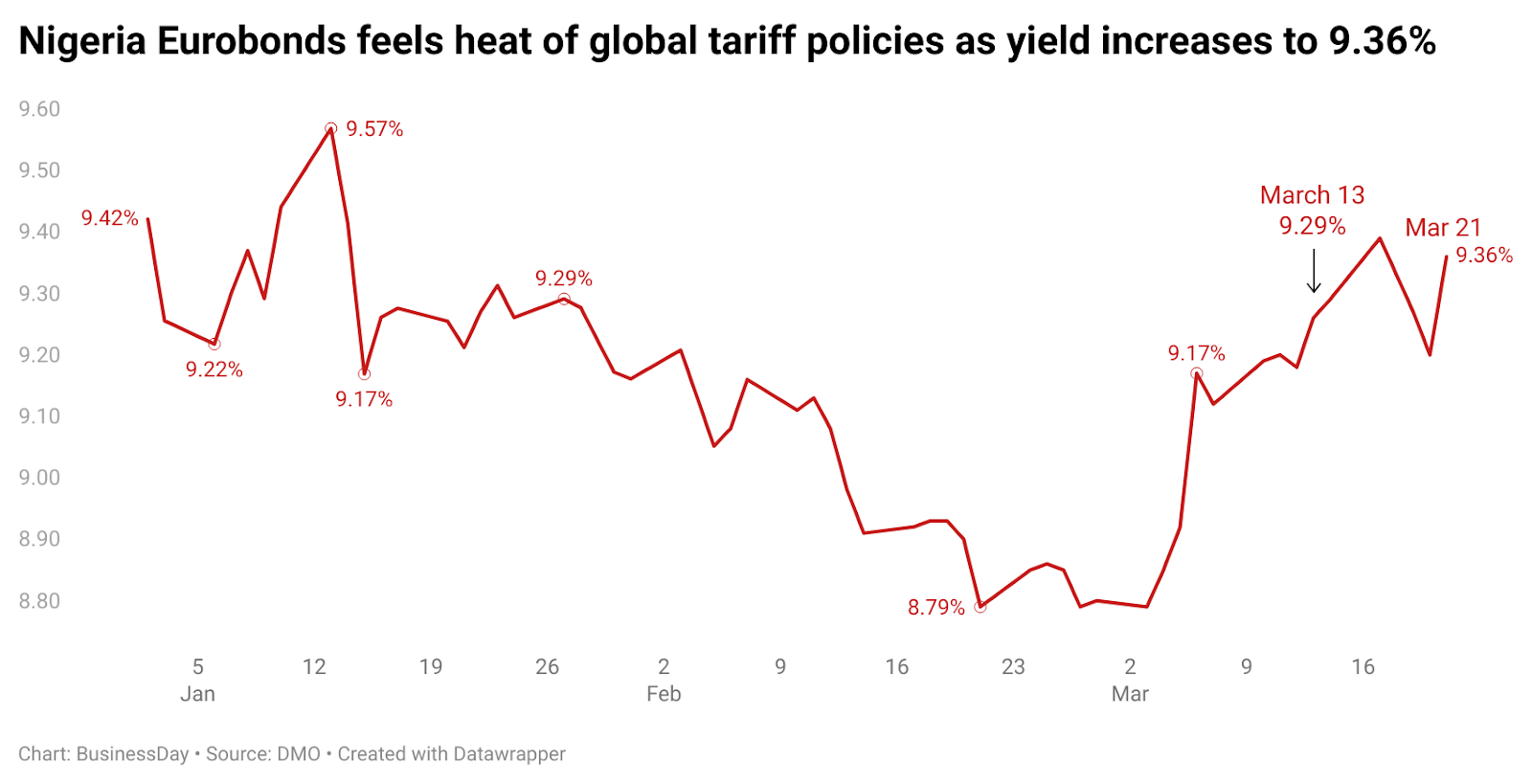
The yields on Nigerian Eurobonds climbed last week as foreign investors retreated in reaction to the U.S. Fed’s unchanged interest rates and a general move away from riskier assets.
“The downturn was primarily driven by sustained risk-off sentiment toward African assets and the Federal Reserve’s decision to maintain interest rates, which could have triggered capital flight to safer assets,” analysts at Meristem said.
As a result, the average Eurobond yield rose by seven basis points week-on-week, settling at 9.36 percent on Friday last week, from 9.29 percent in the previous week according to data from the Debt Management Office (DMO).
Most of the sell-offs were seen on the mid-curve bond.

At last week’s policy meeting, the U.S Fed maintained its benchmark interest rate at 4.25 percent-4.50 percent.
After the Fed’s decision, the S&P 500, a stock market index tracking the stock performance of 500 leading companies finished in the green on Friday and avoided four straight weekly losses.
Although the American stock market has regained its momentum, many investors are flocking to better-performing markets such as Europe and China and this is due to uncertainty around Trump’s tariff policies.
So far this year, the S&P 500 has lost 3.6 percent, while the Europe Stoxx 600 has gained 8.3 percent.
Investors are finding bargains nearly everywhere else. Markets around the world are trading at near-record discounts to the U.S., and the price-to-earnings ratio of companies in the Stoxx Europe 600, a stock index of European stocks over the past year is around 18.7, while it is 24.6 for the S&P 500, according to Dow Jones Market Data. The Hang Seng Index’s ratio is less than 13.

Nigeria’s equities market is missing out on this run, as it experienced bearish sentiments most of this month, with a year-to-date return of 2.6 percent.