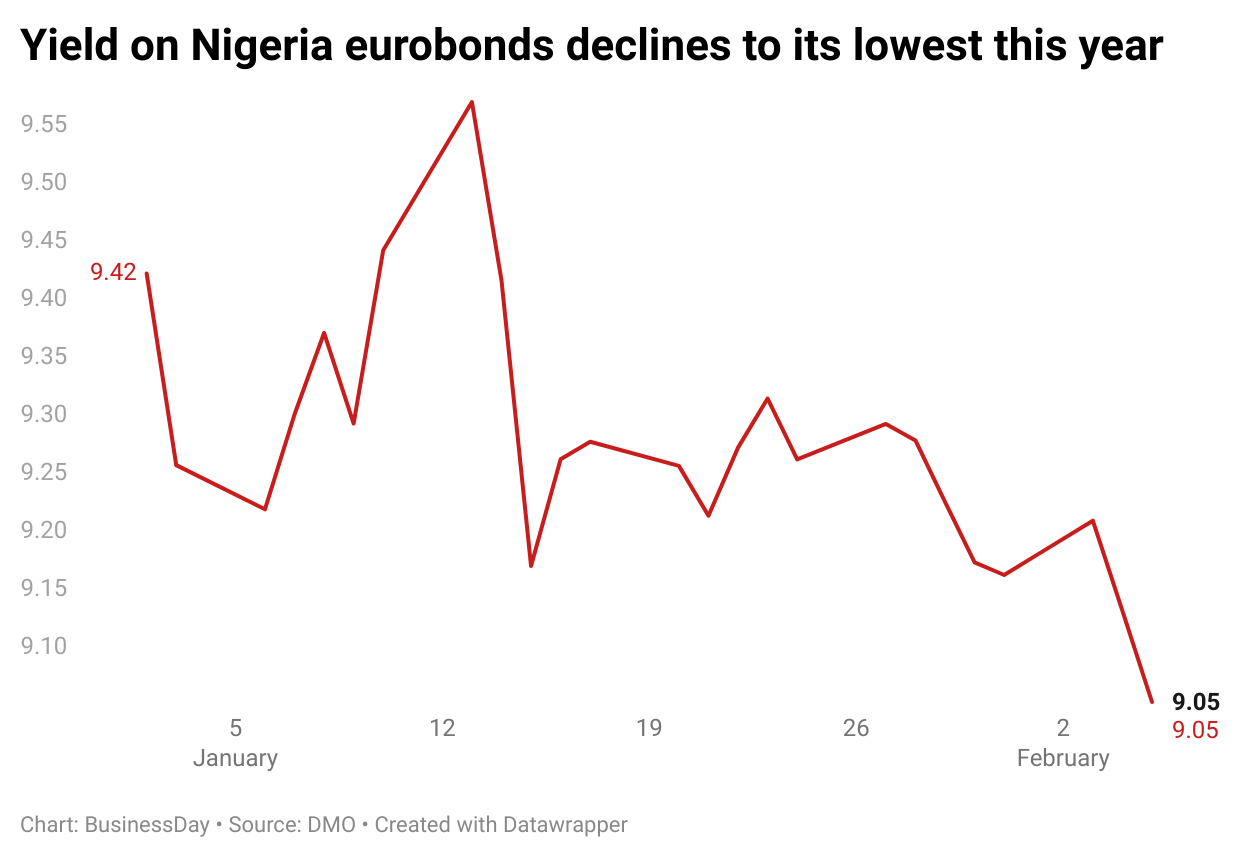
The yields on Nigerian Eurobonds fell to their lowest in 2025, last week, as they continue to attract significant foreign investor interest driven by improving economic prospects and moderation in yields internationally.
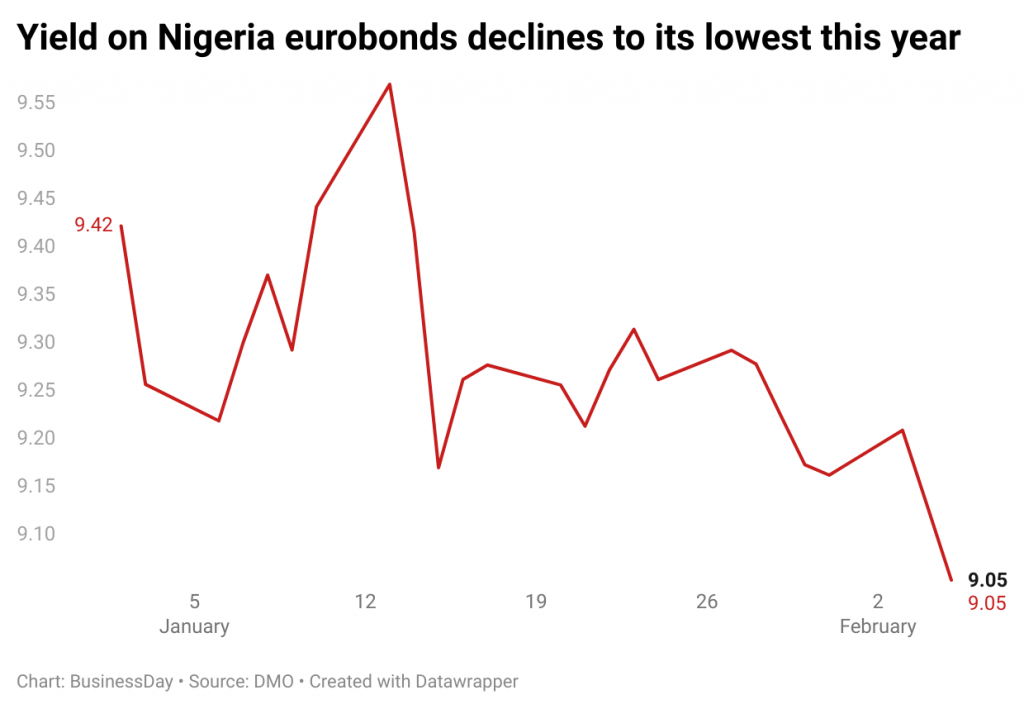
Average yields on Nigerian Eurobonds declined to 9.05 percent on February 5, the lowest in 2025, signaling higher buying interest by foreign portfolio investors.
“The price of Eurobonds have been increasing and the yields falling because of the prospect of better economic conditions in Nigeria,” Matilda Adefalujo, fixed-income analyst at Meristem said.

The average price of Nigerian Eurobonds increased to $92.95 from $91.53.
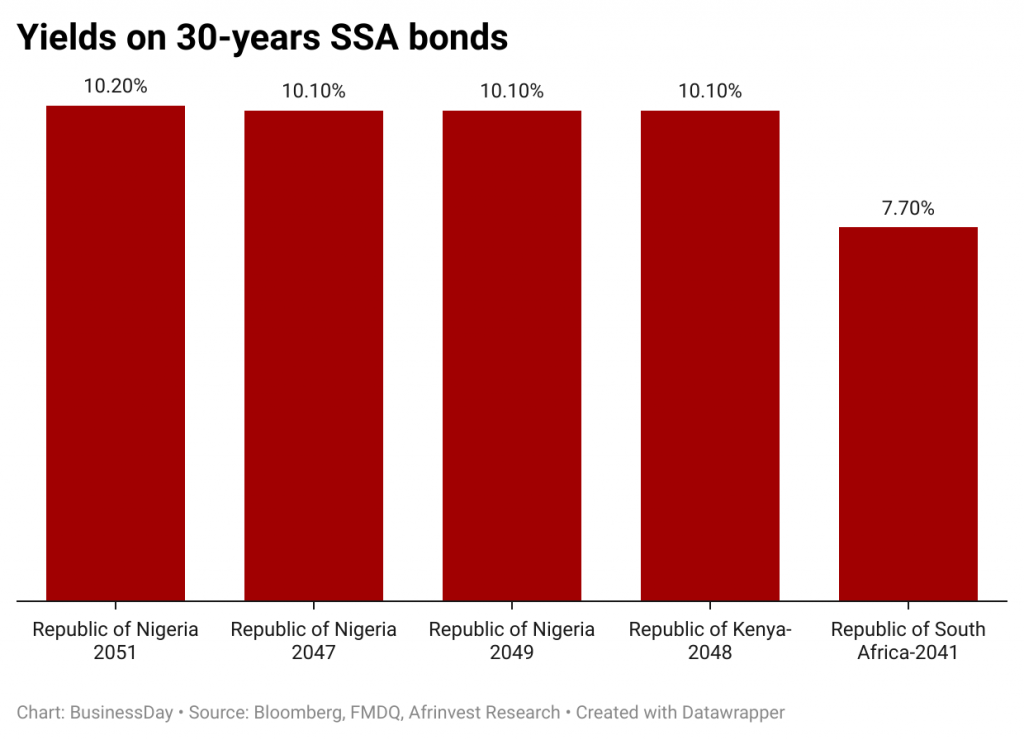
A similar trend was observed in the SSA Eurobonds market, as average yields decreased by two basis points to 8.7 percent.
“The positive sentiment was mostly driven by investors’ interest in a duo of Kenya’s 2018 instruments (-0.3 percent and -0.1 percent), and a duo of Ivory Coast’s 2024 instruments (-0.5 percent apiece),” analysts at Afrinvest said.
Olaolu Boboye, head of research at CardinalStone said that the reason yields declined across Nigeria and other SSA markets last week was because yields moderated internationally as there is now a bit of clarity concerning Trump’s direction especially about trades and tariffs.

Last week, Scott Bessent, Treasury Secretary said the Trump administration is more focused on keeping Treasury yields low rather than on what the Federal Reserve does.
While in the past President Donald Trump has implored the Fed to cut its benchmark rate, Bessent said Wednesday that the current strategy is using the levers of fiscal policy to keep rates low.
The Fed left the key interest rate unchanged at its January meeting, in a range of 4.25 percent to 4.5 percent, hitting pause after a string of cuts late last year.
This alongside the stability of the naira and other reforms taken by the current government have increased confidence in Nigeria’s treasuries.
Some of the reforms, which includes more transparent pricing of the dollar through the introduction of Electronic Foreign Exchange Matching System (EFEMS) launched in December last year, and higher interest rates on treasury bills, attracted dollar inflows and helped stabilise the naira after a period of turbulence.
Last week, the Eurobonds market saw a mixed performance with a bullish tilt.
Strong investor demand early in the week drove average yields down to 9.23 percent (from 9.47 percent at the start).
However, late-week selloffs reversed some gains, pushing yields back up to 9.31 percent. Despite this, yields declined marginally by one basis point week-on-week.
Investor interest was broad-based across the yield curve, with shorter-dated maturities experiencing the sharpest declines.
This was driven by increased buying interest in short-dated maturities such as NOV-25, NOV-27, SEP-28,and MAR-29.