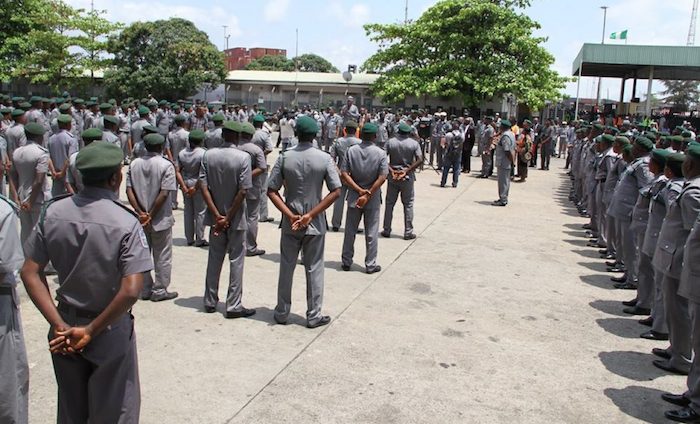
The Nigeria Customs Service will need to raise N6.4 trillion by December to meet its N10 trillion revenue target for 2025 after the agency reported a collection of N3.6 trillion in the first half of the year.
The Service announced that between January and June 2025, it collected a total of N3.6 trillion as revenue. Though this is higher than the 2.7 trillion it recorded during the same period last year, it is a long way from the N10 trillion revenue target it was given for 2025, which is almost half the target for the previous year
Customs will now need to do what it hasn’t done before and generate the revenue for an entire fiscal year in only six months.
The federal government, early this year, gave the Service a revenue target of N6.58 trillion for 2025, which was raised in June to N10 trillion by the Senate.

Since then, the Service has made a spate of decisions to meet this target by year end, including a recent rollout of its Unified Customs Management System, B’Odogwu, designed for streamlined trade facilitation, phasing out manual clearance.
The rollout, which seeks to plug finance leakages, underdelivered for industry players who constantly complained of glitches that the Customs has been racing to fix.
The Service also revived its four percent charge on goods’ Free on Board (FOB) value to replace the one percent CISS and 7 percent charge on its duties.
Read also: Customs revenue hit N1.3T, in Q1, 2025, on back of Tinubu’s reforms
In addition to these, Abdulahi Maiwada, national Public Relations Officer of Customs, disclosed the arrival of six modernised scanners to ports, including an FS6000 model “to boost non-intrusive inspection.”

This is in addition to the “procurement of an Electronic Cargo Tracking System equipment, setting up of the Centralised Image Analysis System in Abuja, reinforcement of cybersecurity architecture, operationalisation of a multi-channel help desk, onboarding of additional stakeholders, and delivery of targeted capacity-building programmes.”
In July, 223 Nigerian companies that imported goods into the country without full duty payment under the Temporary Admission Permits (TAP) were given 21 days to fulfil the terms of their agreement by Customs or face penalties, including bond invocation.
The Service asked the defaulters to “regularise their importation status by either applying for a valid extension, re-exporting the items under Customs supervision, or converting the goods to home use,” or face the penalties.
Meanwhile, Muda Yusuf, chairman of the Centre for Promotion of Private Enterprise (CPPE), had cautioned that the high revenue target would likely drive up the cost of cargo clearance and compound inflationary pressures.
According to him, the hike in revenue target will “worsen the plight of businesses under pressure from foreign exchange volatility, high energy costs, and weak purchasing power.”
“Because as the Customs struggle to meet this target, it is the businesses and citizens that will pay for it ultimately,” he said.
There is optimism, however, about the target’s feasibility.
Wale Edun, chairman of the Nigeria Customs Service board and minister of finance, the National Public Relations Officer of the service, said the first half figures surpassed the projected revenue for the first half of the year by N390bn, urging the Service to continue efforts.