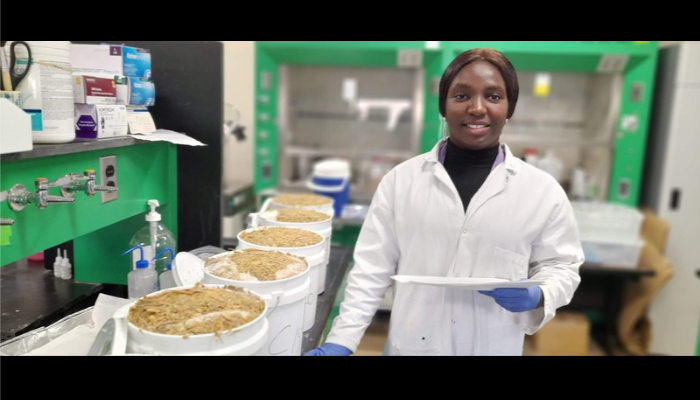
Chika C. Anotaenwere, a Nigerian scholar currently pursuing a doctorate degree in the US, is pioneering a groundbreaking advances in the field of animal nutrition. Her recent research explores the utilization of spent mushroom substrate (SMS), specifically the Pleurotus ostreatus species, as a viable component of feed for beef and non-lactating dairy cows. In this exclusive interview with BusinessDay’s JOHN SALAU, Anotaenwere share some of her findings and how the innovative research is at the forefront of developing eco-friendly feed options that promise economic benefits. Excerpts:
Food security is currently a huge challenge in Nigeria, with the herder/farmers clash across the Middle Belt. How can Nigeria leverage agricultural byproducts for sustainable livestock feeding?
The field of animal nutrition plays a critical role in achieving food security by ensuring that livestock are provided with nutritionally adequate and economically viable diets. In Nigeria, where climatic, socio-political, and economic factors, such as the persistent herder-farmer conflicts, disrupt feed supply chains, it becomes imperative to identify alternative feed resources. Agricultural byproducts present a sustainable solution. These byproducts are abundant, cost-effective, and, if properly processed, can supply essential nutrients to ruminants while reducing competition between human and livestock food sources. Their integration into livestock diets reduces feed costs and contributes to environmental sustainability by minimizing waste accumulation.
As an animal nutrition scholar; can you walk us through your academic findings in relation to Nigeria’s agricultural value-chain?

My recent study focused on the innovative use of spent mushroom substrate as a silage additive to improve the nutritive value and fermentation quality of corn silage. The results demonstrate that incorporating SMS into ruminant feeding systems can significantly enhance the economic utility of underexploited agricultural waste.
In the context of Nigeria, this approach promotes a circular agricultural economy by transforming mushroom production waste into a valuable feed resource. It also aligns with the nation’s ongoing efforts to implement waste-to-wealth strategies, offering an environmentally sustainable and economically viable solution to the feed supply challenges facing the livestock sector. By integrating SMS into livestock diets, this innovation has the potential to strengthen interconnections within the agricultural value chain, improve feed cost-efficiency, and contribute to more resilient and sustainable animal production systems.
Read also: Making Millions from Mushroom Farming
You said earlier that your research adopted an innovative methodology. Can you speak more to the utilization of spent mushroom substrate (SMS) for this study and its likely contribution to future studies?
Yes, my research introduced an innovative approach by incorporating Pleurotus ostreatus–based spent mushroom substrate (SMS) into corn silage production to enhance its nutritive and fermentative properties. The utilization of SMS, an agricultural byproduct often discarded after mushroom cultivation, demonstrated significant potential in altering silage fermentation characteristics, improving fiber digestibility, and modifying volatile fatty acid (VFA) profiles.

These modifications are crucial for optimizing silage quality as a feed resource for ruminants. Specifically, the study found that SMS can effectively replace up to 50 percent of traditional corn silage in the diets of beef and non-lactating dairy cows without compromising feed quality.
This innovative methodology highlights the potential of SMS as a sustainable feed additive that can reduce reliance on conventional feed ingredients while promoting circular use of agricultural residues. The findings contribute to the growing body of knowledge on sustainable livestock feeding systems and lay a strong foundation for future research focused on unraveling the mechanisms behind these effects and refining SMS inclusion levels for targeted nutritional outcomes. Ultimately, this approach holds promise for enhancing feed efficiency, reducing environmental impact, and advancing precision livestock nutrition, especially in resource-constrained places.
How will your findings help in meeting the increasing food demands of a growing global population while mitigating environmental impact?
With the global population projected to reach 9.7 billion by 2050, there is an urgent need to increase animal productivity without expanding the environmental footprint. My findings contribute to this goal by demonstrating that agro-industrial byproducts like spent mushroom can improve feed efficiency and reduce enteric methane emissions—a major greenhouse gas. Enhanced feed efficiency means that less feed is required per unit of animal product, which can directly translate into lower land use, less deforestation, and improved feed conversion ratios. Furthermore, the methane reduction aligns with global climate targets thereby contributing to a sustainable and climate-smart livestock sector.
What is the contribution of your findings towards sustainable livestock management in Nigeria?
The study offers a practical and scalable model for sustainable livestock management by valorizing local waste materials. In regions like Nigeria, where the cost of conventional feed ingredients such as soybean meal and maize is high, using spent mushroom substrate as a partial replacement provides an economically feasible option for farmers. It also promotes resilience against supply shocks. Moreover, the reduced environmental emissions from methane suggest that livestock farmers can maintain or even increase productivity while reducing their ecological impact. Ultimately, this can support national initiatives aimed at sustainable agriculture and contribute to Nigeria’s food and nutritional security agenda.
On the back of your findings, how can scientific innovation in the livestock value chain lead to practical solutions for economic and environmental challenges?
Scientific innovation, particularly in feed formulation and waste utilization, is essential for transforming the livestock sector into a more sustainable and inclusive industry. Innovations like the spent mushroom substrate silage model help reduce the cost of feed, one of the largest input expenses in animal production. They also enable the conversion of waste into value-added products, supporting environmental conservation efforts. If adopted widely, such innovations can lower barriers to entry for smallholder farmers, promote local agribusiness development, and reduce Nigeria’s dependency on imported feed ingredients. Policies that incentivize research–industry linkages, subsidies for byproduct utilization, and knowledge dissemination will be key in achieving this transformation.
In line with your findings, how can Nigeria better manage her agricultural waste and improve the cost-effectiveness of animal feed production?
Nigeria can manage agricultural waste more effectively by developing structured collection, storage, and processing systems that allow for the integration of agro-wastes like spent mushrooms, cassava peels, and crop residues into livestock feeding. Investments in rural feed-processing centers, public-private partnerships, and farmer cooperatives can improve economies of scale. Research institutions should be supported to develop region-specific feeding guides for byproducts, and extension agents can help bridge the knowledge gap. By doing so, the nation can significantly reduce post-harvest losses and enhance the affordability and availability of quality livestock feed, especially in rural and peri-urban areas.