…Warns against internet fraud
The Nigeria Deposit Insurance Corporation (NDIC), has admonished Secondary School Students to imbibe the culture of earning and savings as well as financial intelligence, to ensure a secured financial future.
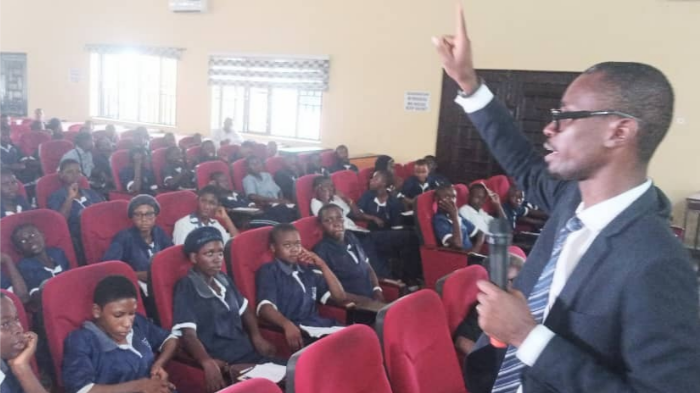
The NDIC gave the admonition during a financial literacy sensitization of students of Community Secondary School, Okoro Nu-Odo, in Obio-Akpor LGA of Port Harcourt, the Rivers State capital. It is said to be part of the corporation’s efforts to create awareness and educate depositors in Nigeria on their rights. It is also to educate depositors on seps to take in the event of bank failure as well the role of NDIC in ensuring financial protection in Nigeria.
Admonishing the young scholars, Alfred Ajah, a senior manager in Communications and Public Affairs Department of NDIC, who made one of the presentations at the seminar, urged the students to cultivate the habit of drawing practical financial plans and effective budgeting to secure a stable financial future.

He warned all students and teenagers in the country against stealing, gambling, or internet fraud, stating that they were not acceptable means of making money. He said these breach the laws of the land and cannot guarantee financial success.
Ajah also acquainted the participants with the importance of financial literacy which he said would help them to understand and effectively use various financial skills such as personal financial management, savings, budgeting, and investing. These, he stated, were skill sets that provide the knowledge of how money works in the world. He assured that it is the gateway to a secured financial future.
Ajah further charged the students and others in attendance to share the knowledge of the functions and activities of NDIC to others especially parents and the elderly at home.
He admonished them to save their money with the banks as they are registered by the CBN and the NDIC for safe recovery in the event of distress in the financial institution.
NDIC was created in 1988 on the recommendations of the Central Bank of Nigeria (CBN), and commenced operations in March the following year with the charge to ensure deposits in all financial institutions.

It is believed that the NDIC is the only insurance company in Nigeria saddled with the task of deposit insurance.
In his key speech, Adefemi Shaba, a principal manager and zonal controller NDIC Port Harcourt office, stated that the ownership of NDIC lies 60% with the CBN and 40% with the Federal Ministry of Finance.
Shaba identified the functions of NDIC to include safeguarding the interest of depositors to ensure that they no do not suffer loss occasioned by the failure of banks and financial institutions as was the case earlier in the country.
He also identified the supervision or oversight duties of the activities of banks as one of the core services of the corporation. He said this is aimed at ensuring that no financial institution engages in activities detrimental to depositors and the financial system in the country.
This, he said, is necessary to provide stability and sanity in all financial institutions for the overall good of the nation’s economy, emphasizing that the various departments in the NDIC, working as a team, remain committed to the discharge of their professional duties. It involves providing the needed protection for depositors and assisting financial institutions where the needs arise, he said.
On his part, Peter Chimenenum, an assistant director, who represented the Permanent Secretary, Rivers State Ministry of Education, commended the NDIC for the sensitization of the students, describing it as a rare privilege and an avenue that has provided financial literacy to the students, which according to him, are battling with an era filled with financial recklessness.
Chimenenum, who also tagged the sensitization as a ‘Catch-them-Young’ approach by the NDIC, charged the participants to apply the various financial skills and principles taught at the event to enhance financial stability and freedom in the future.
He also appealed to NDIC to extend the sensitization to other secondary schools in the State as students are in dire need of financial education, especially in this age plagued with the get-rich-quick syndrome.
Some of the students expressed gratitude to NDIC for exposing them to the rudiments of financial literacy and assured the organizers of the event that the knowledge and skills will be put to judicious use.