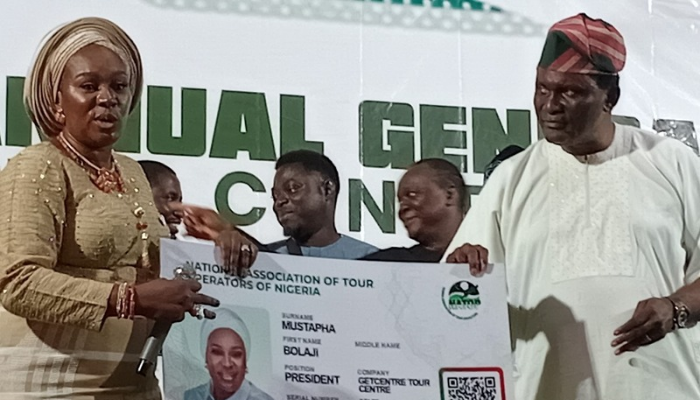
As part of its ongoing efforts at ensuring professionalism among members and sanity in the tour business, the Nigeria Association of Tour Operators (NATOP) has launched a unified identity card.
According to Bolaji Mustapha, president, NATOP, the intentional initiative will help in curbing fraud cases and also identify real tour operators.
The ID card, which was launched during the association’s annual general meeting (AGM) in Akure, Ondo State, comes with special features that would help to improve tour business and get rid of quacks.

Mustapha also spoke on some of the key features of the new ID card, saying: “The card will each come with a special code, the ISO number that we have generated. It will help members to authenticate their membership. It will be easy to cross check with the secretariat and if you scan the ISO number with the bar code, it will go directly to our secretariat and reveal the identity of the card holder because the bar code is directly linked to the website. So, in that way, we can easily identify our members. That is like an authentic proof of membership and members do not need to carry their certificates everywhere.
There are also some hotels that we have discount arrangement with if they are able to show their identity card as members. Even if the hotels want to crosscheck, they will just check the ISO number. They can also use their phone and scan the barcode on arrival; it will display all the details of the members and confirm if they are genuine.”
She also used the opportunity to call for the need for registration and standardization in the tourism industry, to help in kicking out those who do not have genuine business.
“Looking at it from a wider perspective in the tourism industry, while I would not subscribe to violence on the issue of registration of hotels and tourism industry personnel, we need to sit down and understand that there has to be regulation and standardization. It affects some people in one way or the other. It is also affecting our industry.
“Some people are intruding and also taking our work, people who are not in this business. One of the reasons that I am fighting a particular bank is that I have not seen what the bank has done for the industry. It has been giving money like loans to improve business. Is that not their work? They are not genuine. Instead they went to form an agency competing with us. They formed a tour company and took one of our members to teach them what we are doing. And you came from an angle and studied all of our systems, and then you created a portal. You are using tour operators to load their tours on the portal but when a client books, you don’t give it to them. You execute the job yourself. If it is a tour company that loads something on, maybe, Booking. Com, at the back up, you will know that it is so. In this case, there are no traces that lead the package to you. If you load on the portal, they might not even call you as the owner of the package to tell you to come and execute a job that came through the package.

They take the job and do it. Even if you go to the portal and book, it will come to you. It does not show on the portal. It shows their packages. It is wrong. What are they doing to help the tour operators? When did the bank become a tour agency?”
Mustapha explained that because the tourism industry is not well regulated and standardized, many with dubious motives flock into the industry to dupe unsuspecting members of the public: “There is a woman that has been disturbing that she wants to become a member because she wants to get a recommendation letter to enable her carry some children out of the country. They now insist that she needed a clearance letter. She was referred to FTAN, which then referred her to NATOP. If they did not do that, she would have gone. I asked her if she was a tour operator, she said no. I asked her to bring two guarantors from the association that can vouch for her; she said she does not have anybody. She works with a ministry.
“Because of travelling out, people are being duped. There are cases of N25 million, N100 million and so on. They will collect the money and will not do the job. That is what the new ID card will help curb.”