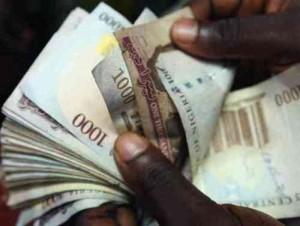
The average naira/dollar exchange rate at the Nigerian Autonomous Foreign Exchange Market (NAFEM), depreciated by 49.60 percent in three months, according to a report by the Central Bank of Nigeria (CBN).
The CBN’s economic report for the third quarter (Q3) 2023 revealed that the naira/dollar exchange rate was N764.82/US$ in Q3 2023, compared with the N511.23/US$ in the second quarter (Q2) 2023.
Nigeria relies heavily on oil exports for foreign currency earnings. However, recent fluctuations in global oil prices and production challenges have reduced income, decreasing the supply of dollars in the Nigerian economy.
Imports of essential goods and services continue to rise, increasing demand for dollars to pay for them. This creates an imbalance in the foreign exchange market, pushing the price of dollars up and putting downward pressure on the naira.

According to the report, net foreign exchange inflow to the economy stood at US$8.22 billion in the review quarter. Foreign exchange inflow to the economy increased by 1.6 per cent to US$16.34 billion from US$16.09 billion in Q22023.
Foreign exchange inflow refers to the entry of foreign currency into a country’s economy. It’s like receiving money from outside one’s own country. Any transaction increases the amount of foreign currency available in the country.
When a country sells goods and services to other countries, it receives payment in foreign currency, boosting the inflow. Other sources of inflows include foreign direct investment (FDI), Diaspora remittances and foreign aid.
Foreign exchange inflow through the Central Bank increased to US$6.37 billion from US$5.41 billion in the preceding quarter. Inflow through autonomous sources, however, decreased to US$9.97 billion from US$10.68 billion in the preceding quarter.
The report further stated that foreign exchange outflow through the economy rose by 9.7 per cent to US$8.12 billion, relative to US$7.40 billion in the Q2 2023. Outflow through the CBN increased by 13.1 per cent to US$7.20 billion from US$6.37 billion in the preceding quarter. Autonomous outflow, however, fell by 11.0 per cent to US$0.92 billion against the US$1.04 billion in the preceding quarter.

Consequently, net foreign exchange inflow to the economy decreased by 5.4 per cent to US$8.22 billion as against the US$8.69 billion in the preceding quarter. Net inflow through autonomous sources also fell to US$9.04 billion from US$9.64 billion in the preceding quarter. Net outflow of US$0.82 billion was, however, recorded through the Bank, compared with the net outflow of US$0.96 billion in the preceding quarter.
The report noted that the external reserves remained well above the international benchmark for import cover. The external reserves stood at US$32.79 billion at Q32023, relative to US$33.75 billion in Q22023. The level of external reserves could cover 6.3 months of import for goods and services or 8.7 months of import for goods only.
A disaggregation of the external reserves showed that a holding by the CBN was US$28.84 billion, the Federal Government US$3.95 billion, and the Federation held a balance of US$0.66 million. In terms of currency composition, the US dollar was US$24.81 billion (75.7%); Special Drawing Rights US$4.42 billion (13.5%); Chinese Yuan US$3.17 billion (9.7%); British Pounds US$0.21 billion (0.6%); Euro US$0.17 billion (0.5%); while other currencies accounted for the balance.
NAFEM is the market trading segment for investors, exporters and end-users that allows for FX trades to be made at exchange rates determined based on prevailing market circumstances, thus ensuring efficient and effective price discovery in the Nigerian FX market. The Central Bank of Nigeria established the NAFEM via a circular dated April 21, 2017.