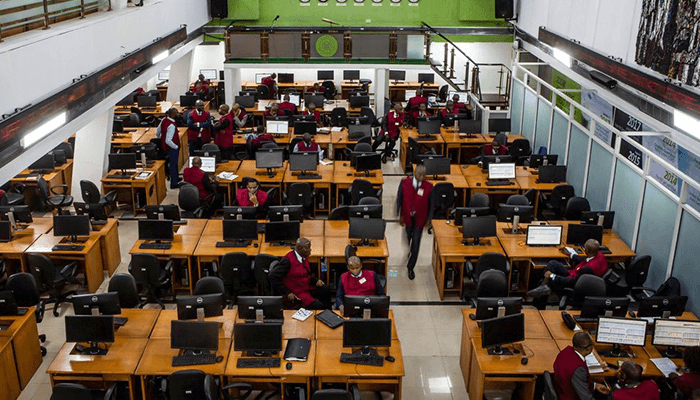
The Nigerian stock market has entered a historic super-cycle, recording an unprecedented N8.14 trillion gain in just five trading sessions to February 20.
This meteoric rise has pushed the total market capitalisation to N125.164 trillion, marking one of the most explosive periods of wealth creation in the history of the Lagos bourse.
Driven by a liquidity tsunami following pension fund reforms and stellar corporate earnings, the All-Share Index (ASI) which breached the 194,000-point milestone rose by 6.95 percent in five trading days to Friday, reaching 194,989.77 points.
The market’s new highs as seen in the performance indicators as at close of trading on Friday compared to preceding weekend when both indicators closed at 182,313.08 points and N117.027 trillion respectively.

Seventy-one equities appreciated in price during the review week, lower than 79 equities in the preceding trading week. Forty-one equities depreciated in price, higher than
27 equities in the preceding week, while 36 equities remained unchanged, lower than 42 recorded in the preceding week.
Market analysts point to a perfect storm of factors fueling this rally on the NGX to include: a strategic shift by Pension Fund Administrators (PFAs) following the raising of equity investment limits and massive repricing in heavyweights like Dangote Cement and MTN Nigeria, alongside excitement over anticipated mega-listings like the Dangote Refinery.
This is in addition to a firmer Naira which has renewed foreign investor appetite, with international participation hitting levels not seen in nearly two decades.
The Monetary Policy Committee (MPC) will hold its first meeting in 2026 on February 23 and 24. Both domestic and international economic developments are expected to inform the Committee’s decision.
“As fixed-income yields continue to moderate, risk assets become relatively more attractive. Lower rates would likely encourage more allocation of funds into the equities market, particularly as investors search for stronger real returns.

“As such, to extend this bullish run in the equities market, we believe the monetary authority might tilt towards a rate cut,” Meristem research analysts said.
All other indices finished the review trading week higher with the exception of NGX Growth index which depreciated by 15.06 percent while the NGX Sovereign Bond index closed flat.
The market saw a total turnover of 7.662 billion shares worth N252.566 billion traded in 345,118 deals by investors on the floor of the Exchange, in contrast to a total of 4.652 billion shares valued at N193.326 billion that exchanged hands preceding week in 286,751 deals.
The Financial Services Industry (measured by volume) led the activity chart with 5.625 billion shares valued at N113.599 billion traded in 129,729 deals: thus contributing 73.41 percent and 44.98 percent to the total equity turnover volume and value respectively.
The Services Industry followed with 493.131 million shares worth N5.866 billion in 30,396 deals, and the Oil and Gas Industry, with a turnover of 425.657 million shares worth N35.742 billion in 23,136 deals.
Trading in the top three equities: FCMB Group Plc, Access Holdings Plc and Zenith
Bank Plc (measured by volume), accounted for 3.594 billion shares worth N69.147 billion in 33,802 deals, contributing 46.90 percent and 27.38 percent to the total equity turnover volume and value respectively.
While investors look toward Monday market outcome, the primary driver will be whether the aggressive institutional rebalancing and high-conviction buying seen throughout the review week can be sustained, according to Lagos-based Vetiva Research analysts.
“Investors will likely be watching for any signs of profit-taking following a period of rapid appreciation across various asset classes”, the analysts said, while adding that the prevalence of stocks hitting their maximum daily price limits on Friday suggests that momentum-driven strategies are still very much in play, “which could continue to provide a strong cushion for the benchmark index in the coming sessions”.
As the bulls maintain their grip on Customs Street, the market is setting a new global benchmark for performance in 2026, with year-to-date returns already exceeding 25 percent.