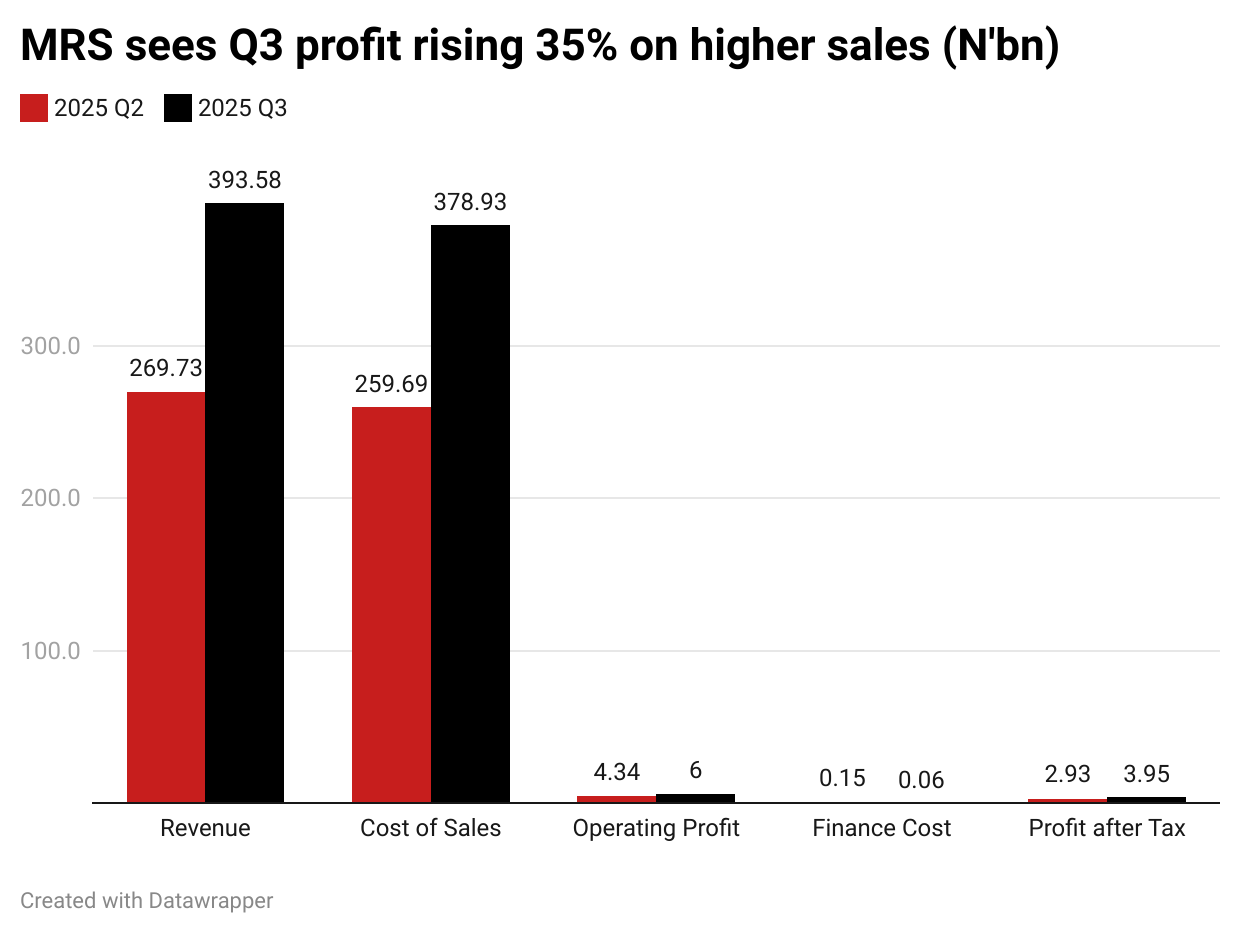
MRS Oil Nigeria Plc forecasts a 35 percent increase in third-quarter profit as the fuel marketer expects stronger revenue and lower finance costs to offset rising operating expenses.
The Lagos-based company projects net income of N3.95 billion for the three months through September 2025, compared with N2.93 billion a quarter earlier, according to a financial outlook seen by BusinessDay and available at the Nigerian Stock Exchange.
Revenue is expected to surge 46 percent quarter-on-quarter to N393.6 billion, driven by higher product volumes and stable domestic demand amid continued market deregulation.
Gross profit is projected to climb to N14.65 billion, from N10.04 billion in the second quarter, while operating profit is forecast at N6 billion, up 38 percent. Finance costs are expected to decline by over 60 percent to N58.6 million, providing a cushion against rising operating expenses, which are projected to increase to N8.91 billion from N5.70 billion.

The company expects earnings per share to rise to N11.53, up from N8.54 in Q2, while pre-tax profit is forecast at N5.9 billion. Tax charges are projected at N1.95 billion.
Cash flow from operations is expected to improve modestly, with net cash generated from operating activities estimated at N4.03 billion, up from N3.45 billion the previous quarter. However, investment-related outflows are forecast to deepen, reaching N5.63 billion, compared with N4.98 billion in Q2.
As a result, cash and cash equivalents are projected to decline slightly to N4.62 billion from N4.69 billion at the end of the previous quarter. The company is not forecasting any new financing inflows during the period.
Profit attributable to shareholders is forecast at N2.37 billion, while non-controlling interests are expected to earn N1.58 billion, reflecting the company’s joint venture and subsidiary structure.
The outlook comes as downstream oil marketers in Nigeria continue to face margin pressure from elevated import costs and naira volatility. While MRS expects topline strength to persist in the near term, analysts caution that rising administrative expenses could weigh on future margins.