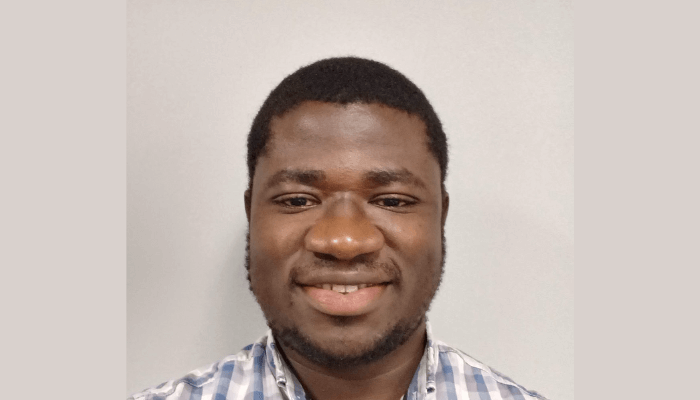
Growing up in Lagos, Nigeria, Victor Agboli often found himself wondering why malaria spread so differently during the rainy season. Why did some families fall sick over and over, while others hardly seemed affected?
“I would ask myself if it had to do with mosquito nets, stagnant water near the house, or how often people cleaned and fumigated their rooms,” he recalls. “Looking back, I realize those questions were my first steps toward causal inference. I was trying to connect everyday habits with health outcomes, without knowing it was statistics.”
That early sense of curiosity has grown into a career built on numbers and evidence. Today, Agboli is a Ph.D. researcher in Biostatistics at the University of Florida, where he combines mathematics, statistics, and large-scale data analysis to address pressing public health challenges. His work focuses on developing novel statistical methods for analyzing complex health data to improve public health, inform policy, and save lives.
Building foundations across continents
Agboli’s academic path reflects both resilience and ambition. He earned his bachelor’s degree in Mathematics and Statistics at the University of Lagos, where the training was strong in theory but thin in data resources.

“In UNILAG, I had limited data issues. We had no data to test the theory or see the beauty through real-world applications,” he says. “We could prove theorems and derive equations, but that was often where it ended.”
A move to Atlanta for his master’s degree in Mathematics at Georgia State University changed that. There, he finally gained access to large-scale U.S. health databases and began to see how statistical ideas could shape real-world practice.
“It was the first time I could directly connect what I had learned in classrooms in Nigeria to real data, using US cancer registries, vaccination records, and national health surveys,” he recalls. “That’s when I realized the true power of statistics to guide public health decisions.”
Before graduate school, Agboli built his skills across several industry roles in Nigeria. At Evolve Credit, he researched loan products and creditworthiness, developing a deeper understanding of how data can inform financial decisions. He then joined Babban Gona as a Business Intelligence Analyst, where he created automated dashboards and improved data systems, making operations more efficient and boosting productivity.
At Bamboo, a Nigerian fintech startup, Agboli utilized analytics to study customers’ investment behavior, gaining insights that led to the development of new products, such as Bamboo Fixed Returns, and supported the expansion into Ghana and South Africa.

In the U.S., Agboli joined GlaxoSmithKline (GSK) as a Data Analytics Intern, where he focused on cybersecurity and resilience. He developed analytical tools to track risks and model potential threats, providing the company with stronger systems to anticipate problems before they escalated.
These experiences, spanning finance, agriculture, and health, showed him both sides of data. Strong analysis could drive growth and protect systems, while weak practices often create inefficiencies or leave organizations exposed. That contrast shaped his commitment to advancing statistics and applying it responsibly across fields.
“I’ve always seen statistics as more than numbers,” he says. “It’s about bringing order to complexity, telling stories with data, and guiding decisions that touch people’s lives.”
Today, at the University of Florida, Agboli is pursuing a Ph.D. in Biostatistics with a focus on developing new statistical methods for high-dimensional data used in public health research, a growing challenge in the era of big data. His academic work is closely tied to his role as a Research Statistician at the Malcolm Randall Veterans Affairs (VA) Medical Center in Gainesville, where he applies these methods to real-world studies.
At the VA, he analyzes complex clinical trial data, builds models for research on post-traumatic stress disorder (PTSD), sleep disorders, and non-invasive brain stimulation, and collaborates with investigators to design rigorous protocols, work that directly improves care and outcomes for U.S. veterans. He also develops statistical plans for multimillion-dollar NIH and VA grant proposals, ensuring studies meet the highest standards for scientific and regulatory review.
“Each stage of my journey shaped me differently: theory in Lagos, industry practice in Nigeria, applied data in Atlanta, and now method development in Florida,” he reflects. “Together, they made me a better researcher who values rigor but never loses sight of practical, human impact.”
The human side of data
Agboli’s work at the VA brings him close to one of the most vulnerable populations in the U.S.: veterans living with traumatic brain injuries, PTSD, and chronic sleep disorders.
His role, though statistical, is closely tied to patient outcomes. “Behind every dataset are real people,” he said. “When I analyze data on sleep quality or brain imaging, I remind myself that the numbers represent someone’s parent, child, or neighbor.”
One of the projects he supports involves testing transcutaneous vagus nerve stimulation (tVNS), a non-invasive approach aimed at improving sleep among veterans with PTSD. “Sleep might sound basic, but for veterans with PTSD, it’s a daily struggle,” Agboli said. “My role is to make the treatment randomization efficient and ensure the data are analyzed with rigor, so the results are trustworthy and meaningful.”
For him, the work is about more than numbers. “If evidence can prevent wasted resources and improve lives, that’s the difference I want to make,” he said.
Mentorship beyond borders
Beyond research, Agboli is deeply committed to teaching and mentorship. He believes that the future of statistics, data science, and public health in Africa depends on opening doors for young scholars and building sustainable pipelines of talent.
“Nigeria is full of talent,” he said, “but many students don’t have the resources or opportunities to explore their potential fully.”
Agboli adapts his teaching style to fit the audience. For undergraduates, he uses everyday examples, such as weather forecasts and the likelihood of needing an umbrella, to make abstract probability concepts easier to understand. For graduate students, he connects theory directly to health research, showing how methods translate into impact. “My goal is for students to stop seeing statistics as just formulas and start seeing them as a way of thinking critically about the world,” he explained.
For him, teaching naturally extends into mentorship. He works to guide young scholars not only in mastering technical skills but also in understanding how statistics can drive solutions to real problems. “It is about helping students connect the numbers to people’s lives,” he said.
Looking forward
Agboli’s vision is to help Nigeria strengthen its public health system by training young researchers in modern statistical methods and improving how health data are collected and analyzed for vaccination programs, disease surveillance, and health planning. “If better evidence can guide better policies, then lives can be saved,” he said. From Lagos to Florida, Agboli’s path reflects a lifelong belief that statistics can turn evidence into action that saves lives.