|
Getting your Trinity Audio player ready...
|
In a continent where car ownership often requires years of savings, mobility company MAX is taking a different route, helping commercial riders own Electric Vehicles (EVs) through a subscription-based model, thereby reducing the burden of outright purchase.
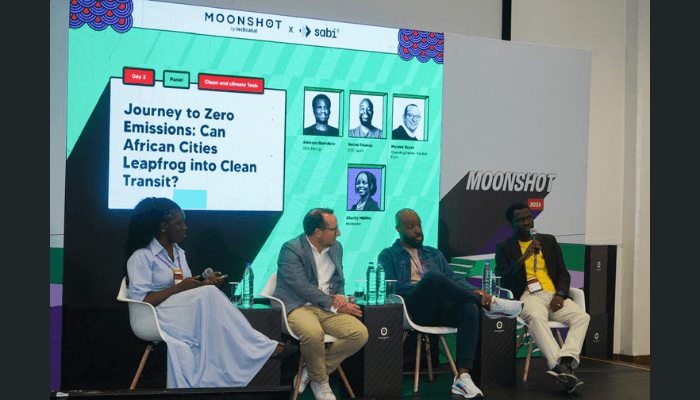
Adetayo Bamiduro, co-founder and CEO of MAX, disclosed this during a Moonshot panel discussion titled “Journey to Zero Emissions: Can African Cities Leapfrog into Clean Transit?”
He explained that MAX offers an electric vehicle subscription package that makes EVs accessible and affordable to riders, known as Champions. “For a small regular fee, customers get access to our EVs for a period of time, while paying the subscription fee towards eventual ownership. They don’t need to buy the vehicle or worry about upfront costs,” said Adetayo Bamiduro.
Read also: MAX unveils bold plan to scale EV financing, infrastructure across Africa

MAX’s target customers are commercial riders such as last-mile couriers, delivery riders, and taxi drivers, people who rely on mobility to earn a living but often struggle to afford vehicles of their own. “Our focus is on providing drivers with practical, affordable EVs and the services they need to operate,” Bamiduro added.
Few years ago, EVs were almost non-existent in Africa, but MAX paved the way with the M1, its pioneering electric motorcycle, the first in the Nigerian market. Today, that number stands between 70,000 and 100,000 EVs across the continent.
“Though this represents a small share of Africa’s 250 million vehicles, it is growing steadily. We are about two orders of magnitude behind, but most of those EVs are in Nigeria, Ghana, Rwanda, and South Africa, showing how fast the market can grow when conditions are right,” Bamiduro said.
One reason EVs are becoming more viable in recent years is the steady fall in battery and manufacturing costs. Bamiduro attributes this to years of investment in China’s battery and solar industries, which have made EV production cheaper worldwide.
Read also: MAX first solar-powered battery swap station to transform clean mobility

“Batteries, solar, and vehicle manufacturing are all cheaper now. In some cases, EVs and petrol vehicles are nearing price parity in Nigeria,” he added.
Lower prices, combined with MAX’s subscription model, could make EVs more accessible for thousands and eventually millions of small operators and delivery fleets across the country. For MAX, solving affordability is only half the challenge. The company is also building the ecosystem, from solar-powered charging points to trained technicians.
“Standard, swappable batteries would be a game-changer,” Bamiduro noted.
Through its subscription model, MAX is lowering the entry barrier for thousands and soon millions, of mobility workers. It is an ambitious move, one that could make owning an EV as simple as signing up for a subscription. Each plan also includes value-added services such as insurance, vehicle licensing, health coverage, and emergency support, creating a truly holistic mobility experience.