…Seplat revives 10 idle wells, boosts output 167%
…Aradel’s investing cashflow up 341.5%
Nigerian energy companies are capitalising on international oil majors’ divestment to expand their own capacities and strengthen foothold in the nation’s hydrocarbon sector, BusinessDay’s findings have revealed.
For decades, the Nigerian oil and gas sector was largely dominated by international oil companies (IOCs), often regarded as giants with deep pockets and technical expertise.

However, a significant shift is underway, fuelled by IOC’s divestments and the burgeoning ambition of local Nigerian oil firms.
These indigenous companies are not merely filling the void left by departing IOCs; they are actively seizing the opportunities presented by divestment deals to significantly grow their oil output, revitalise dormant assets, and ultimately reshape the energy landscape of Africa’s most populous nation.
Read also: Aradel vs Seplat: Who was the better performer in Q1 2025?
Seplat Energy’s moves
Seplat Energy’s acquisition of ExxonMobil’s onshore assets in Nigeria for $1.28 billion has positioned the company as a dominant player in the domestic oil sector. The deal, finalised in December 2024, included 11 oil blocks, 48 oil and gas fields, three export terminals and five gas processing facilities.

One of Seplat’s immediate strategies is to revive over 400 idle wells previously drilled by ExxonMobil. With only about 200 of the approximately 600 wells in operation, Seplat plans to invest up to $320 million in 2025 to rejuvenate these dormant assets. This initiative aims to increase daily production from 50,000 barrels to 120,000 barrels within six months.
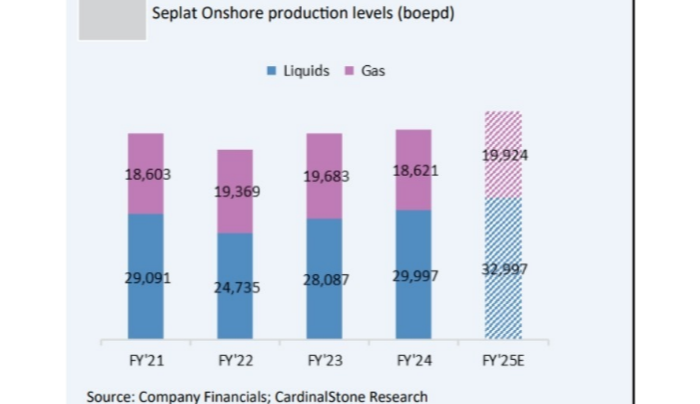
BusinessDay found that the group’s average daily production surged 167 to 131,561 bpd in the first quarter (Q1) of 2025, up from 49,258 bpd in the same period of 2024.
Profit after tax for the quarter was $23.3 million, compared to a $1.9 million loss in the first quarter of 2024.
“The 2025 has started positively for Seplat; production has been strong, showing the benefit of the continuous drilling programme, investment in asset integrity and the availability of multiple evacuation routes,” Roger Brown, chief executive officer of Seplat Energy, said in Seplat’s latest financial results.
Brown added, “Our assets are high quality, and while we will remain agile to the prevailing oil price environment, our business plan is designed to be robust at lower oil prices and our gas revenues, which are largely delinked to oil prices, provide long-term stability for the business. We are committed to our plan of growth and maximising value for our stakeholders”.
Data sourced from Seplat Energy’s latest results showed Seplat’s programme to resume production from idle wells across the license commenced during the period.
“At period end, approximately 11, 000 boepd gross production capacity has been reinstated from the idle well restoration programme. This has been achieved from 10 idle wells that could be accessed directly from certain existing platforms,” Seplat Energy said.
The company added, “The jack-up barge has now moved to well work activities and commenced well interventions after the period end. Combining both platform and well work barge activities, we are now targeting production restoration work on over 50 of the idle well inventories in 2025.”
Analysts at Cardinal Stone are anticipating a notable uplift in natural gas liquids production from Seplat’s newly acquired assets, with volumes expected to rise to 4,164 bpd in line with management guidance.
“This growth will be supported by the planned installation of the East Area Project (EAP) Inlet Gas Exchanger (IGE)—a critical processing unit already fabricated, with offshore installation currently underway. The project is scheduled for completion in Q3’25 and is expected to boost gross JV natural gas production by 8–10 kboepd,” three analysts at Cardinal Stone said.
Read also: Nigeria LNG set for 12% gas supply boost on Seplat deal
Aradel’s investments
Aradel Holdings, formerly known as Niger Delta Exploration and Production Plc, has also capitalised on divestment opportunities to expand its operations. In October 2024, Aradel listed its shares on the Nigerian Stock Exchange, becoming the country’s largest oil and gas company by market capitalisation.
The company reported a revenue of N199.9 billion in the Q1 of 2025, up 97.6 percent from N101.1 billion last year, and a profit after tax of N34.2 billion, up 55.3 percent from N22 billion year-on-year.
The revenue surge was propelled by a 222.3 percent jump in crude oil export earnings, which accounted for 71.1 percent of total revenue.
Crude oil revenue soared to N142.1 billion from N44.1 billion in Q1 of 2024 as production levels rose, supported by improved operations of the Trans Niger Pipeline (TNP) and reduced losses. The company also credited its Alternative Crude Evacuation (ACE) system for boosting sales, with crude oil volumes hitting 1.2 million barrels, up from 0.39 million barrels in the Q1 of 2025.
Refined products contributed N53.3 billion, a 6.2 percent increase from N50.2 billion in the Q1 of 2024, driven by a 26 percent rise in sales volume to 75.5 million litres.
However, gas revenue fell by 35.5 percent to N4.4 billion due to pipeline disruptions affecting production.
“Aradel’s Q1, 2025 performance is in line with our desire to build on the momentum that the Company generated in 2024,” Adegbite Falade, chief executive officer of Aradel Holdings Plc, said.
Falade added, “The increase in crude production (and attendant revenues) was because of more volumes from the additional wells drilled, and the continued extended well test at the Omerelu Field. We expect an improvement in Q2, 2025.”
Aradel also explained it earmarked $20 million in restricted cash toward the acquisition of Chappal Energies, reinforcing its strategic ambitions in the domestic energy sector.
The $20 million allocation was confirmed in Aradel’s cash flow report, where it noted a significant increase in restricted cash as part of preparations for the Chappal Energies acquisition, a transaction aimed at deepening its asset base and production capacity in Nigeria’s energy market.
Net cash flow used in investing activities was N72.5 billion, up 341.5 percent.
“This increase is mainly driven by cash-financed investment in Renaissance amounting to N20.9 billion in Q1 2025, further acquisition of financial assets amounting to N26.7 billion and capital expenditure of N29.1 billion,” Aradel said.