



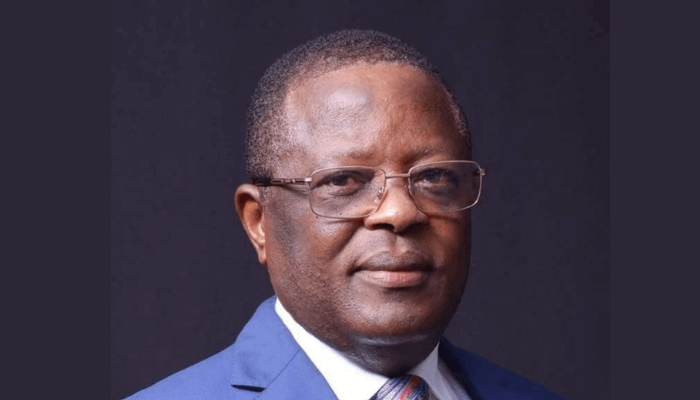
On incremental basis, calls are intensifying on David Umahi, the minister of works, to take urgent action on Lagos-Benin Expressway as more motorists and passengers get trapped in the ditches and gullies that dot almost the entire stretch of the expressway.
The trapped motorists and passengers as well as sundry road users have appealed to the minister to fix the failed portions of the road, especially a portion of a bridge along the Isoko axis of the expressway which, from all indications, is a disaster waiting to happen.
A viral video trending online shows the portion of the bridge with all the iron component exposed, jutting out and crying for attention. The video also shows a fallen truck near the failed portion of the bridge which caused serious traffic snarl that lasted several hours at the weekend.
One of the stranded motorists in the video called out Umahi, telling him to prioritise his road projects, and wondering why the minister is busy wasting time and money on some projects that did not have any immediate impact on the lives of the people or the economy of the country.

The motorist was particular about the Lagos-Calabar Coastal Expressway which, to him, is not as economically viable as most federal highways, including the Lagos-Benin Expressway, yet a lot of efforts and resources are being invested in the coastal highway.
“I wonder why Umahi is focusing on the construction of the Lagos-Calabar highway and abandoning the failed portion of the Lagos-Benin Expressway which many Nigerians use daily for economic activities due to its direct route to Lagos, the economic hub of the country,” the stranded passenger said.
Continuing, the passenger, who did not mention his name, said, “this is a failed portion of a bridge on the Lagos-Benin Expressway, yet our minister is busy constructing the Lagos-Calabar Expressway, a road to nonsense.
Read also: Dilapidated road, illegal checkpoints threaten businesses along Lagos-Benin corridor
Do you know how many trucks pass here? If you know the number of trucks trapped here, that means the economy of Nigeria is affected because of the goods in the trapped trucks cannot be transported. The fallen truck is lucky that it did not fall into the river.”

The Lagos-Benin Expressway is not an isolated case as there are many other collapsed federal roads, including the nearby Benin-Asaba Expressway which also has made movement from that axis to either Western or Northern part of the country pretty difficult.
Many other Nigerians have questioned the immediate economic sense in the construction of the Lagos-Calabar Coastal Highway on which the government is committing N15 trillion.
Some Nigerians have argued that this money is enough to fix almost all the federal highways that in deplorable condition across the country. Johnson Chukwuma, a civil engineer, who commented on the Benin-Asaba Expressway, wondered how much it would cost to fix it.
“A fraction of the almost N4 trillion Tinubu wants to spend on repairing the Third Mainland Road in Lagos, or just 0.5 percent of the $28 billion paid to Hitech, the contractor handling the construction of the Lagos-Calabar Highway, can fix this road,” he reasoned.
The federal government announced recently plans to repair the Third Mainland Bridge, disclosing that it was considering either repairing or building a new one at the cost of N3.8 trillion and N3.6 trillion, respectively.
Umahi has, however, said that the announced costs were the figures which a contractor submitted to the government as per quotation for repairing or rebuilding the bridge.
Meanwhile, the 11.8-kilometre bridge built between 1976 and 1990 by the military government was repaired recently at a cost of N21 billion, meaning that it will cost the government 180 times more money to carry out fresh repair work on the bridge.





