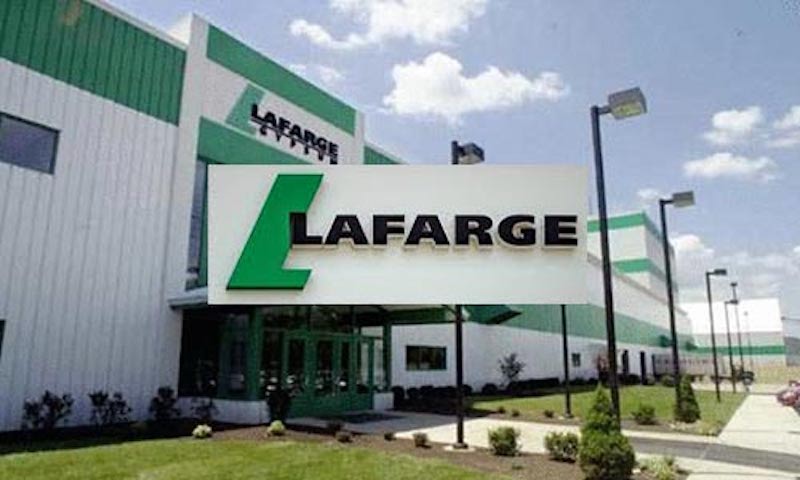
Lafarge Africa has delivered a stunning performance in the first half of 2025, posting a net income of N132.7 billion. This marks a remarkable 352 percent increase compared to N29.4 billion recorded in the same period last year.
This sharp rise in profitability is largely credited to a 75 percent surge in revenue, as the company’s topline rose to N517 billion in H1 2025, up from N295.6 billion in H1 2024. The earnings report, based on the group’s unaudited financials, reflects not only strong sales momentum but also a more efficient operating structure.
Sales outpace cost growth
Lafarge Africa’s revenue growth far outpaced its cost of sales, which grew by 50 percent year-on-year to N221.2 billion, compared to N147.9 billion in the previous year. As a result, the group’s gross margin expanded by 7 percentage points, rising from 50 percent to 57 percent.

Read also: Nascon’s profit more than triples to N16bn in first half
The improvement suggests that the company is becoming more efficient in managing its production and distribution costs, even in an inflationary environment. Gross margins at this level signal that Lafarge is keeping more of each naira it earns, translating sales growth directly into stronger profits.
The biggest story in this earnings report is perhaps the dramatic leap in operating performance. Lafarge Africa posted an operating profit of N199.7 billion, pushing its operating margin up to 39 percent, a leap of 1,700 basis points from the 16 percent margin recorded in H1 2024.
This significant gain has spurred conversation across the industry about the company’s internal cost controls and operational reforms. A key factor contributing to this success is Lafarge’s transition to CNG-powered trucks through its haulage partner, ABC Haulage. This switch has helped cushion the impact of rising fuel and mining costs, even as distribution-related expenses rose by 37 percent to N63.7 billion, up from N46.6 billion a year earlier.
Record-Breaking Q2 Performance

The second quarter of 2025 marked a historical high for Lafarge Africa, with quarterly revenue reaching N268.6 billion, the highest in its history. This represents a 70 percent year-on-year growth over N157.8 billion in Q2 2024.
While operating expenses during the quarter grew by 61 percent to N56.3 billion, the company’s profitability remained intact. The biggest contributor was a sharp decline in finance costs, which fell by 89 percent to N1.3 billion, from N12.1 billion in Q2 2024. This provided a significant boost to after-tax profits, which soared to N84 billion, representing a 248 percent increase from the N24.2 billion recorded in the same quarter last year.
Asset base crosses N1 trillion Mark
Lafarge’s strong financial performance has been matched by substantial growth on the balance sheet. As of June 2025, the group’s total assets surpassed N1.03 trillion. This was driven partly by capital expenditure of N28.9 billion, which helped push non-current assets up to N619.2 billion, from N576.5 billion at the start of the year.
Inventories rose by 11 percent to N115.8 billion, while cash reserves dipped slightly by 12 percent, ending the period at N210 billion, still a robust figure. The drop in cash was due to outflows tied to debt repayment and dividend distribution, but the group’s cash-generating ability remained strong.
Lafarge Africa’s liquidity profile has also seen notable improvement. The group fulfilled about N81.6 billion in contractual obligations, bringing contract liabilities down to N130.8 billion from N212.5 billion at the start of the year.
This deleveraging significantly improved the group’s current ratio, which now stands at 1.04, a metric that puts it ahead of its rivals. For comparison, Dangote Cement’s current ratio is 0.74, while BUA Cement’s stands at 0.93.
This liquidity edge is reinforced by Lafarge’s high cash reserves, especially given that the company did not take on any new borrowings during the first half of the year. Instead, it paid down N1.7 billion in loans and distributed N83.8 billion in dividends yet ended the period with N210 billion in cash.
Lafarge Africa’s cash ratio of 0.53 at the end of H1 2025 shows it is in a stronger short-term liquidity position than its peers. In comparison, Dangote Cement’s was 0.11 and BUA Cement’s was 0.33, highlighting Lafarge’s better ability to meet immediate obligations with cash on hand.
Read also:Aradel’s half-year profit rises to N146bn on increased oil output
Cash flow sees big gains
One of the standout metrics in Lafarge’s H1 2025 results is its net operating cash flow of N82.6 billion, a massive 340 percent jump from the N18.8 billion recorded in H1 2024.
After accounting for capital expenditure, the group closed the half-year with a free cash flow (FCF) of N53.7 billion. While this figure trails Dangote Cement’s N707.9 billion, it is a meaningful recovery from a negative FCF of N9.03 billion in the previous year. The improvement in cash generation underscores the effectiveness of the company’s operational and financial discipline over the past year.
Lafarge Africa finds rhythm in 2025
Lafarge Africa’s H1 2025 performance presents a company that is not only growing but maturing operationally and financially. From record net income and expanding margins to better liquidity and reduced liabilities. The cement maker has executed disciplined financial management while resisting the urge to over-leverage in a volatile economy.
Its focus on fuel efficiency, cost control, and cash discipline is beginning to show real dividends, literally. The company has demonstrated that consistent strategy and operational clarity can still deliver outlier results. And if the first half is any indication, Lafarge Africa is on course for one of its strongest years yet.
Investors have been watching the company closely. After closing July 30 at a share price of N151, the stock has now posted a 116 percent year-to-date gain. Its market capitalisation has also crossed the N2.4 trillion mark, as the company inches closer to a $2 billion market cap.