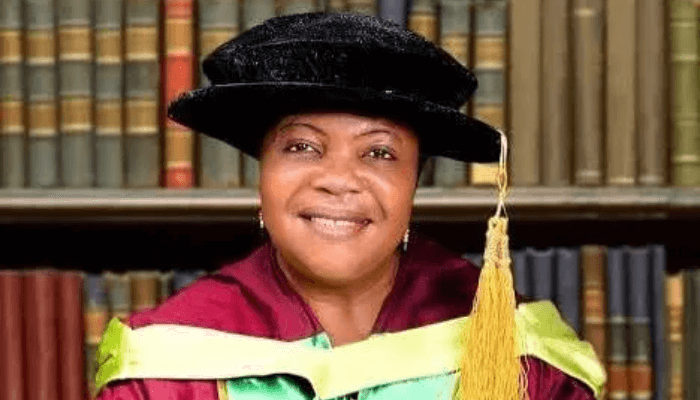
When news broke that Ladi Sandra Adamu, the first professor of broadcasting in Northern Nigeria, had died aged 67, the shock rippled far beyond Ahmadu Bello University. For decades, she stood at the centre of media education in the region, shaping not just classrooms but the very identity of broadcast journalism in the North.
Her colleague, Muhammad Hashim Suleiman, confirmed her death on Wednesday, ending a remarkable career that spanned journalism, academia and public service.
Read also: Stories that breathe: How Literature captures the pulse of lived experience
Early life in a cosmopolitan Nigeria
Born on July 17 1958, in the barracks in Yaba, Lagos, Adamu often spoke warmly of a childhood spent across Lagos, Kaduna and Enugu. She described those years as a vibrant mix of cultures and friendships.

Her father served as the RSM at Mogadishu Barracks, a role that afforded the family the stability and comfort.
Then came the Civil War. “The family was scattered at the initial stage only for us to regroup when the situation stabilised,” she recalled in an interview with The Nation. Those experiences, she said, shaped her understanding of identity, belonging and the need to communicate across divides.
A northern scholar with a global education
Adamu attended Queen Amina College in Kaduna before pursuing Mass Communication in the United States. She earned a bachelor’s degree in broadcast journalism from Columbia College, Hollywood, specialising in radio and television, and a master’s degree in film at Loyola Marymount University in Los Angeles.
She further trained at City University London and later obtained a postgraduate diploma in Development Studies from the Golda Meir Mount Carmel Institute in Haifa, Israel. Her academic journey ended at ABU Zaria, where she earned a PhD in Conflict Communication — becoming the first Nigerian scholar to specialise in the field.

A broadcaster shaped by newsroom grit
Before the titles and professorships, Adamu was a journalist chasing deadlines. In the early years of her career, she worked as a Public Relations Officer at the Nigerian Consulate in Atlanta, Georgia, before returning home to join the Nigeria Television Authority in Jos as an announcer and presenter.
Her next stop was Kaduna, where she served as Deputy Editor with the Democrat newspaper. She oversaw women, children and entertainment pages while navigating the intense pace of a newsroom that demanded precision and clarity.
The turning point: From newsroom to classroom
Her switch to academics in 1999 was not planned. She was persuaded by the late Joe De Goshie to help build the young Mass Communication Department at ABU. That move would define the rest of her life.
“My former colleagues referred to me as a classroom journalist,” she said, a title she wore with pride. Her practical background allowed her to teach with a firmness grounded in experience.
The first professor of broadcasting
In 2014, after years of publications and teaching, her postgraduate students began urging her to pursue a professorship in broadcasting. She did and succeeded. Her promotion was backdated to October 2017, marking her the first professor of broadcasting in Northern Nigeria, and according to available records, the only one at the time.
She coordinated ABU Campus FM for 10 years, mentored thousands of students and lectured widely, including at Bayero University Kano, Kaduna State University and Plateau State University.
An advocate of unity and northern identity
Though she hailed from Plateau State, Adamu described herself culturally as Hausa, a reflection of the environment that raised her. She often spoke of the Northern identity as one shaped not by ethnicity but by shared history and experience.
“Where you grew up is more important than your ethnic background,” she said. It was a worldview that influenced her teaching, research and interactions with students.
Read also: UK regulator says BBC’s Gaza documentary broke broadcasting rules – Reuters
Her intellectual legacy
Adamu delivered her inaugural lecture, The Spider in the Web: Digitalisation of Conflict Reporting in a Pluralistic Nigerian Society, to an audience that included the Plateau State deputy governor.
In that lecture, she dissected how journalists, readers and actors in conflict all function as “spiders” weaving threads of information. She distinguished between digitisation and digitalisation, urging journalists to embrace accuracy, context and ethical reporting in the digital age.
“We are all ‘spiders’, weaving different threads along the complex system of the Nigerian society, even as we communicate such complexities… Sometimes, it seems insignificant, but like the intricacies in the web of a spider, our experiences are forever part of our system.”
Her body of work includes more than 60 academic publications and over 2000 global citations. She was a fellow of the African Council of Communication Educators and the Institute of Management Specialists.
Adamu was more than the first professor of broadcasting in Northern Nigeria. She was a builder of institutions, of ideas and of people.