|
Getting your Trinity Audio player ready...
|
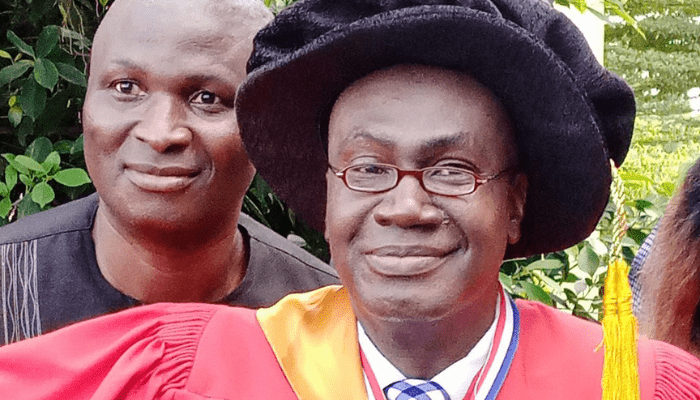
The notion that journalists are their on hardest critics seemed to prove true last week when a mass communications scholar and professor in the Rivers State University passed a vote of no confidence in his research outcome.
The Professor, Godwin Bassey Okon, concluded that the journalism profession has failed to lead Nigerians to wage a war for social change.
He told his audience made up of applauding journalists and information officers that the old order asking news writers not to editorialise has died, but it is now time for opinions, perspectives and advocacy right in the news reporting flow. Most newspapers had left such opinions in articles and features.
The Communications expert also called for a funding window to support credible media practitioners to set up media houses that can give new verve to independent journalism to create social change.

Okon, dean of the social sciences, in the Rivers State University (formerly University of Science and Technology, UST), says the situation where government contractors and politicians owned media houses and dictated to professional journalists what to write or not was the bane of what he called media inertia in today’s Nigeria.
He stated these in research findings in his 118-page inaugural lecture series 70 of the RSU where he said the inertia had led to failure to spark social change in Nigeria.
He suggested that the funding window can come with low interest to enable owners of media houses to also be journalism professionals.
In the lecture titled: ‘Advocacy, Paradigms: Unbundling the Albatross of Journalistic Inertia in Nigeria,’Okon made a case for interpretative news reporting to eliminate perspectives. He said there is now media passivism instead of media activism, and said this is the failure to interpret the news for the masses.
Throwing away existing practice where news must be straight without opinion which the universities taught over the years, the professor said such theory was for the developed world. He urged news writers to interpret and help the Nigerian masses to understand the issues in the news and decide to act. He also called for interrogation of facts of a story.

Read also: Google partners UNESCO to support African journalism
He said advocacy slant in news reporting helps to mobilise public opinion and this leads to social change. It has bandwagon effect, he said.
Okon went on: “There are four theories of the press, and many say they are for the developed world. They have gone beyond the basic worries of good governance and accountability.
“Developing worlds such as Nigeria need development journalism. When the media merely report what happened without helping the masses to interpret and take action, the media would be deemed to be in a state of inertia. That is what the findings of this research have posited. Inertia is the bane of the Nigerian media.”
He mentioned factors for this state of inertia of the media to include editorial policies. He gave examples thus: whereas the BBC stated clearly that it must act independently at all times on the side of the citizens, the News Agency of Nigeria (NAN) declared in its mission statement that it must at no time oppose the government and must align with the government of the day.
He also mentioned the fear of danger to media houses that seem to oppose the government of the day. Media ownership is also affecting what a medium reports.
He made recommendations thus: “Media owners must evolve editorial policies that dwell on international best practices and bring their systems into the mainstream
“Journalism must be perceived as the hope of the masses and lifebuoy of every organic society. This will attract respect and hope from the masses. Seeing journalism as a practice full of landmines and dangers as exemplified by the bombing of Dele Giwa does not attract best hands to the profession. The practitioners must play by the ethics and those who do so must be respected and used as models to attract the right construction of the profession. This way, sustainable development becomes second index.
“Media ownership must be anchored on excellence without compromise. There should be a separation of journalistic ideals from personal aggrandizement. Media ownership should no longer be seen as means of political actualisation but as a tool for safeguarding societal ideals. Politics and journalism do not mix. Soft loans can be provided for practitioners of excellent journalism to set up media houses and pay back gradually.
“Mentorship rules the world and every industry. Role models through a demonstration of dexterity, character and integrity must be seen for emulation. If these qualities come in proper mix, then men of character and integrity must be seen or singled out for emulation.
The ideal of society is to create an enabling environment for the actualisation of human potentials. Journalism is the conveyor belt of that ideal. Journalism as a profession loses its verve when it is enmeshed in a contraption of mediocrity, docility and complacency.
These negativisms no doubt create an atmosphere where the society sails on as rudderless ship. In the face of this, it becomes most pertinent to establish a framework that dissolves these negativisms into a wimple while enthroning sound practices that can at best engender egalitarianism. This is the beauty of journalism as practised in an atmosphere that is completely devoid of bibliotherapeutic inertia.”
The Vice-Chancellor, NlerumOkogbule, who commended Okon, said he knew the inaugural lecturer to be a wordsmith with very big command of English Language.
“He has shown that we must go with communication. He has drawn attention to the nexus between advocacy and journalism. He has harped seriously on the need for mentorship in the practice of journalism and lamented its absence in today’s society. The problem is even in academics. We wonder if those to be mentored are even ready.”
The VC announced plans to begin to give plaques to those who deliver inaugural lectures. “Later, numbers would be pinned on them so people can know the difference between those who have done that and those yet to deliver theirs”.