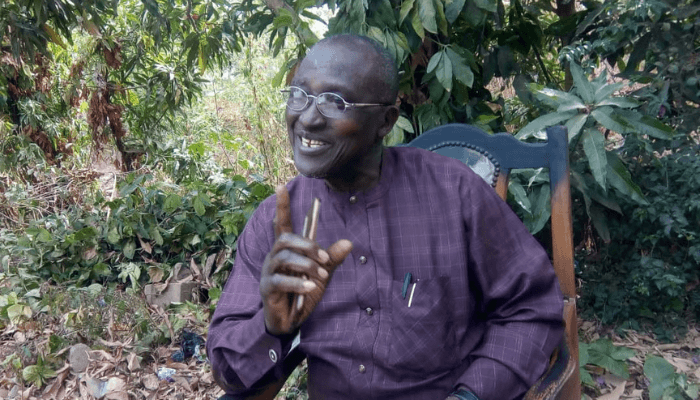
Davou Zang, represented Plateau Northen senatorial district in the fourth Senate from 1999 to 2003, In this Exclusive interview with NATHANIEL GBAORON in Jos, he said that the creation of more states in Nigeria would bring development, expansion, and opportunities for more Nigerians to serve the country politically. The elder statesman and APC chieftain among other things also called on Nigerians to learn to adjust to the policies and programmes of President Bola Tinubu’s administration, saying the benefits are numerous. Excerpts:
Nigerians are yearning for the creation of more states in the country. As a stakeholder, a former senator, and an elder statesman who knows this country well, what value will the creation of more states bring to Nigerians?
Thank you so much. I appreciate the question. What value will it bring to Nigeria? The simple answer is: development. Why do I say development? From my understanding and experience in Nigeria’s government structure, the current setup is not adequate to develop Nigeria at the pace we desire. If we create more states—for instance, if Plateau is divided into two, with a northern part and a central-southern part—and assuming we have the resources, this would definitely bring more hands into governance. That would ease development and help satisfy the yearnings of the people, as more development would be evenly spread.
In the past, people have felt that Nigeria is moving too slowly. But in my view, it’s not just about the system—we lack the manpower to build Nigeria quickly. Soon, Nigeria will be 65 years post-independence. We can’t compare ourselves to countries like France or the United States, which have had over 200 or even 400 years of nation-building. So, if new states are created and more local governments established, and with the Supreme Court affirming local government autonomy, each unit will strive to meet the needs of its people. That, to me, is the proper channel for development. Speaking specifically for Plateau, we want to retain the name “Plateau State” and not be given any new or strange name, even if the state is divided. We’ve been known as Plateau for a long time.

On the issue of local government autonomy, it’s been almost a year or so since the Supreme Court made its pronouncement. Have you seen any changes?
To my mind, nothing much has changed. Even though elections have taken place here in Plateau and other states, I don’t think the autonomy is truly working yet. You know how government bureaucracy especially the executive functions. Nothing moves fast. I believe they’re still putting mechanisms in place to implement it. The problem is, most of us are allowing anxiety to take over, and we’re not being patient. In fact, I recently read that Lagos submitted a request to the National Assembly to convert their development areas into full-fledged local governments. That’s a signal that something is likely to happen. Since the start of this democratic era, no new states have been successfully created. Only during earlier regimes did we see the creation of regions. But I believe this present dispensation could be different, and that would be good for the nation.
You’re a strong member of the All Progressives Congress (APC), the ruling party in Nigeria at the moment. There has been a wave of defections from the PDP and other political parties to the APC, raising fears that Nigeria might become a one-party system. Is Nigeria ready for that?
Well, if we’re talking about readiness, let’s ask: are we even ready for democracy? Look at China, they have a one-party system, and it works for them. If we want a one-party system to work in Nigeria, it can. The problem is that we just want to create commotion. For me, it’s a matter of trying something and seeing how it works. In the First Republic, we had multiple parties. The Second Republic had five major parties. The Third Republic was a mix of military and civilian leadership. Now, in the Fourth Republic, it’s fully civilian. If it turns out we move toward a one-party system, then what? For example, in 2015, when the APC took over, many of us believed President Buhari’s government favored people from the CPC faction. Now people are saying the current government favors the ACN group. That’s what happens in politics. So even if you’re in the APC and bring people from the PDP along with you, it causes tension. But it’s still the same thing. If we want the system to work, we must agree to make it work. If we don’t, we’ll keep going in circles. There’s nothing wrong with trying a new model. A one-party system might just work.
Nigerians, especially those in the North Central states like Plateau, Benue, and Nasarawa, are concerned about growing insecurity. These states are agrarian areas, and people can’t go to farms due to banditry. Are we not heading for a serious food crisis?

It’s unfortunate that a nation like Nigeria is being brought to a standstill by insecurity. To truly tackle it, I believe every state or homogeneous society should have its own security structure. This central security system isn’t working it allows people to take advantage. If Plateau had its own police force, do you think outsiders would come here and cause problems so easily? No. The military can still be national, but policing should be localized and independent. That’s the only way it will work. It’s unfortunate that we’re entering a new farming season and people are afraid. But let’s hope, with what the government has promised and some of what we’re seeing in places like Zamfara there will be improvements. We pray for unity and for a fruitful harvest so people can return to their farms without fear.
The Nigerian economy is tough. Many families are hungry. What advice would you give to the government to ease the burden, especially concerning food insecurity?
The solution depends on wisdom and understanding. We’ve chosen democracy. But in that, are we capitalists, socialists, or communists? We’ve opted for a capitalist democracy. That means people must think and act to develop themselves. Unfortunately, for a long time, Nigeria has operated under a mindset where the government is expected to do everything. Now, the government can’t do everything. So what happens? People cry for palliatives. But who are we giving palliatives to? With all the looting, mistrust, and corruption we’ve seen, how can you expect the system to work?Everyone blames the government. But as one of our elders used to say, have you ever seen birds flying in the sky crash into each other? There’s space for everyone. People say, “I’m a graduate,” but what did you learn in school; Can you create something, improve something? When I studied in the U.S., they taught me to be an employer, not an employee. That mindset is what we need. If we instill that in our young people, the sky’s the limit. The system is faulty. We must build a society where the youth are taught practical skills, self-reliance, and innovation. Otherwise, we’ll keep going in circles.
Some say government policies are hurting small businesses. Do you agree?
I agree and I also disagree. Some government policies are not helpful. Take, for instance, the N-Power program under Buhari. It taught skills. But the attitude of the recipients didn’t change. They still believed they could get rich overnight. Many want to become millionaires without building capacity. I’ve seen systems in countries like the U.S., where small businesses thrive because of strong financial support systems, mentoring, and trust. If you can’t manage ₦1 million, how do you expect to handle ₦1 billion? It’s like school you start from Primary One and grow. Many Nigerians don’t want to go through that process. They want to jump straight to the top, and that’s why they fail. Most Nigerian businesses are viable. They fail because of mismanagement and lack of accountability. But in a well-structured corporate entity, the business survives even if the founder dies. Nigerians must understand these differences and begin to build with that knowledge.
By the end of this month, the Tinubu administration will be two years in office, What’s your assessment?
Let me tell you something, I’m one of those who appreciate what is happening. In my opinion, despite all the sabotage, they are doing well. Our problem in Nigeria is mindset. If it’s not you in charge, then nothing is right. Councillors, governors, nobody is ever right. Every season is different. You can’t compare this year’s rain with last year’s. The rain is late, and people are already panicking. We must be patient. We need to reset our mindset. The bible says “A double-minded man is unstable in all his ways.” That’s Nigeria’s problem our mindset is not aligned for progress. Like my pastor always says, “Overtaking is allowed in Christ. A U-turn can help you achieve God’s purpose.” So if you think you know it all, slow down. This country belongs to all of us. Let’s work together to build it.