|
Getting your Trinity Audio player ready...
|
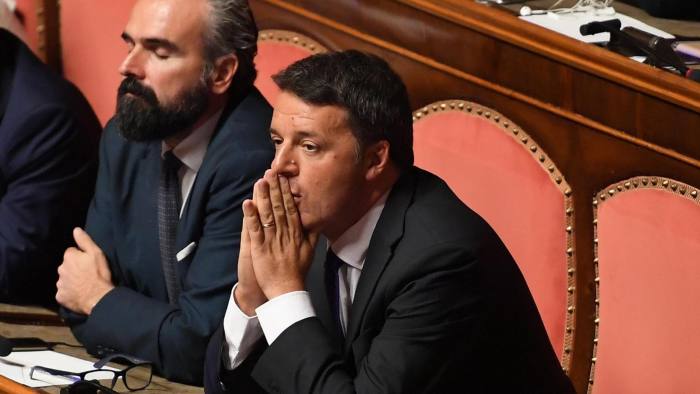
Italy’s former prime minister Matteo Renzi is splitting from the centre-left Democratic Party to create a centrist political movement, shifting the balance of power inside the country’s fragile two- week- old coalition government.
Mr Renzi said he would continue to support the PD’S coalition with the Five Star Movement. But he is expected to take about 30 lawmakers into his new party, weakening the influence of PD leader Nicola Zingaretti, and could topple the government if he withdrew his support.
Leaving the PD is a gamble for the 44-year-old senator, at a time when his popularity — and that of the political centre — is low.
Polls show a majority of voters still split their support between the anti- immigration League and anti-establishment Five Star Movement — the two parties whose populist coalition collapsed in August.

“I have decided to leave the PD and build, together with others, a new house to do politics in a different way,” Mr Renzi wrote in a Facebook post that referred to internal divisions in the party. “After seven years of friendly fire I think we should take note that our values, our ideas, our dreams cannot be the subject of daily internal quarrels.”
PD figures criticised Mr Renzi, saying his move would increase the risk of an election that could usher the League, under its popular former interior minister Matteo Salvini, back into power.
Dario Franceschini, PD culture minister and party grandee, compared Mr Renzi’s actions to the split between Italian liberals that allowed the dictator Benito Mussolini to to take power in the 1920s, arguing that his actions would only strengthen the country’s far right.
But Mr Renzi said he told Prime Minister Giuseppe Conte that he believed a new party would broaden the appeal of the government.
In an interview with La Repubblica, Mr Renzi said he was not trying to undermine Mr Zingaretti. “I do not have a personal problem with Zingaretti, and nor does he have one with me,” he said.

Mr Zingaretti said he regretted the split, calling it “an error”.
Sofia Ventura, a political-science professor at the University of Bologna, said the government’s survival would now depend in part on Mr Renzi.
“But both parties do not have an incentive to go to elections, so that could mean it lasts for longer than people expect,” she said.
A survey of political pollsters conducted by the Corriere della Sera newspaper predicted that a new Renzi-led centrist party could win the support of between 3 per cent and 8 per cent of voters.
Mr Renzi, who has low approval ratings among Italian voters but retains influence inside the PD, was the driving force in urging the party to agree a tie-up with Five Star following the collapse of the last coalition government.
Enrico Letta, another ex-pd prime minister and rival of Mr Renzi, said splitting the party “was without logic” and called for “unity and humility”.
Paolo Gentiloni, another ex-pd prime minister and recently appointed EU economics commissioner, defended the party. “Today it is one of the strongest and most forward-looking European progressive parties. In such difficult times, let’s keep it tight,” he said.