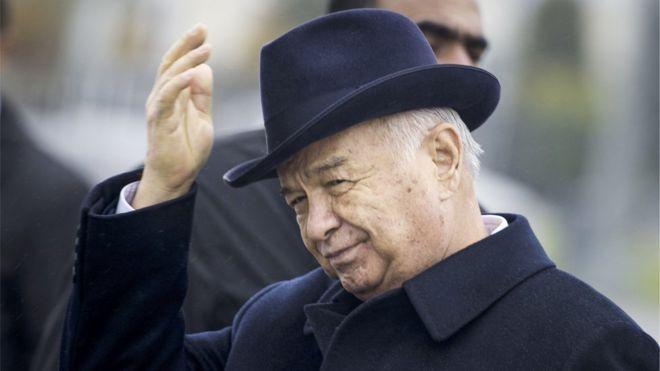
The body of Uzbekistan’s President Islam Karimov has arrived in his home city of Samarkand ahead of his funeral.
Thousands lined the streets. His death at 78 was confirmed by the government on Friday, six days after he was taken to hospital suffering from a stroke.
Karimov, one of Asia’s most autocratic leaders, ruled for 27 years, and was accused by human rights groups of harshly repressing dissent.
Saturday’s funeral comes amid uncertainty over who will succeed him.

However, the event in Samarkand – Karimov’s home city – will be overseen by Prime Minister Shavkat Mirziyoyev, seen as a potential successor.
Three days of mourning are being observed.
The official announcement of Islam Karimov’s death came on Friday night. But Turkey’s PM had sent condolences to Tashkent hours earlier – live on television – saying that the Uzbek leader had already died.
The Georgian president soon followed suit. The government in Tashkent has now released a medical report saying that Karimov suffered a massive stroke last weekend and never regained consciousness. He died on Friday after his heart stopped for a second time, the statement says, and a team of doctors – including foreign specialists – could not resuscitate him.
Islam Karimov ruled for more than a quarter of a century, without naming a successor, so his death could well spark a struggle for power behind the scenes.

When Soviet leaders died, people would check who led the funeral commission for a clue as to who would take over. That could make Mr Mirziyoyev the man to watch. But, for Uzbekistan, all this is unprecedented and uncertain.
‘Immense pain’
On Saturday a funeral cortege carried the president’s body to Tashkent airport. Video footage showed thousands of people along the route, many throwing flowers at the procession.
At the airport, his wife Tatyana Karimova and younger daughter Lola Karimova-Tillyaeva, dressed in black and wearing headscarves, were shown in tears as the coffin was loaded on to a plane for the flight to Samarkand.
They were greeted at Samarkand by Mr Mirziyoyev. Police there have cordoned off the centre of the city.
Karimov’s other daughter, Gulnara, once seen as a possible successor, is believed to be under house arrest.
News of Karimov’s death was finally confirmed after several foreign leaders and diplomatic sources reported it on Friday, following days of rumours that he had already died.
Reports from diplomatic sources suggested several regional leaders were making plans to visit Samarkand for the funeral, with Prime Minister Dmitry Medvedev expected to represent Russia.
US President Barack Obama said in a statement the US remained “committed to partnership with Uzbekistan, to its sovereignty, security, and to a future based on the rights of all its citizens. for the people of Uzbekistan”.
Expressing his condolences in a statement (in Russian), Russian President Vladimir Putin described Mr Karimov as a statesman “who had contributed to the security and stability of Central Asia” and who would be a “great loss for the people of Uzbekistan”.
President Putin addressed his message to Uzbek senate leader Nigmatulla Yuldashev who, under the constitution, becomes acting president pending early elections.
Mr Yuldashev is unlikely to fill the presidential role more permanently, analysts say. Mr Mirziyoyev has been in office since 2003 and his deputy, Rustam Azimov, is also seen as a key player.
Ms Karimova-Tillyaeva, posted a black square on Instagram with the words: “He left us… I choose my words and cannot believe it myself…”
‘Repression unchallenged’
A United Nations report has described the use of torture under Mr Karimov as “systematic”.
The late leader often justified his strong-arm tactics by highlighting the danger from Islamist militancy in the mainly Muslim country, which borders Afghanistan.
Anna Neistat, a senior director of research with Amnesty International, told the BBC the late leader had repressed dissent unchallenged by the international community.
“For years and years Karimov was shutting down any type of opposition, throwing in jail anybody who he believed could challenge the regime,” she said.