Despite the huge opportunities and market potential, investors are still holding back on investment in the Nigerian property market because of the slowdown in the economy and the significant decline in consumer purchasing power. Concerns on government’s anti-graft war also persist.
The size of Nigeria’s housing market, according to a recent research report by Northcourt Real Estate, is estimated at $179.2 billion which is a pointer to the high investment opportunity and potential in the market, but investors are not jumping at this opportunity because of low demand, among other factors.
BusinessDay had in an earlier report, noted that household Final Consumption Expenditure, which consists of expenditure, including imputed expenditure, incurred by resident households on individual consumption goods and services has been falling since 2015.
Nigeria’s economy has recorded four straight quarters of negative growth to the end of March 2017 for which data is available, while average income in the country fell by about 18 percent in 2015 to $2,550 per annum, from over $3,000 in 2014, according to World Bank estimates.

Besides, investment in the market, especially at the high end, has also been impacted heavily by government’s anti-corruption fight which has been enhanced by the whistle-blowing programme. This has reduced the willingness of big property investors to spend or invest.
Ayo Ibaru, Director, Real Estate Advisory at Northcourt, notes that the effect of this is an increased level of caution on spending by moneybags. “Willing partners to big transactions are harder to find. Real estate market players are now picky in the kind of clients they do business with and potential tenants now insist on knowing the landlords of space being considered for lease”, he says.
“The market has seen evacuation, locking up and labelling of several properties as taken over by the anti-corruption agency. This has created significant fear in highbrow locations, where such has been prevalent and this cannot not be disconnected with higher vacancies and lowered prices”, Ibaru noted, adding, “the few prospecting buyers or renters, now carryout longer and more elaborate due diligence on properties before transacting and demand a discount for the risk”.
Whistle-blowing has reduced the frequency and value of investments and this is because, according to Kemi Adeosun, the Minister for Finance, “whistle-blowing has made every Nigerian a detective”. This has contributed significantly to the high vacancy rate in highbrow locations in Ikoyi in Lagos, where as at June this year, was estimated at 34 percent, and 25 percent in Katampe, Abuja.
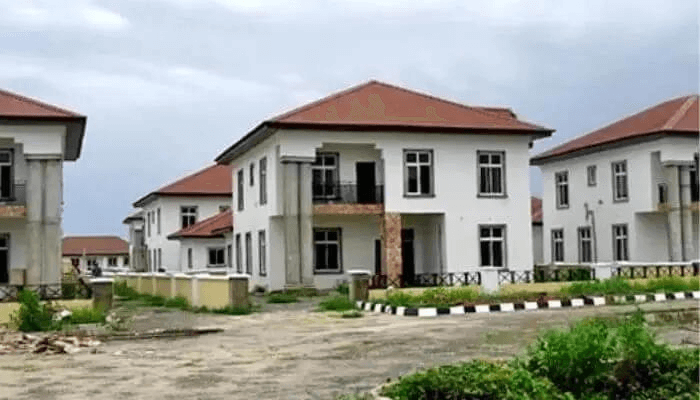
“Some of these empty houses are considered political risks and, in the federal capital, Abuja, some of the owners have abandoned their mansions and would not want to be associated with them because they don’t want government’s watchdog to come after them”, said an analyst who did not want to be named.

High residential vacancy rate is more pronounced in the traditional big cities where the market has been slowing. But on the contrary, in the mid market areas, vacancy rates are not quite as high and are even lower in low-priced locations.
Surulere in Lagos and Lugbe in Abuja recorded the lowest vacancy rate at 4 percent apiece, as at June this year. Other mid-market locations with low vacancy rates include Magodo GRA, 7 percent; Yaba, 6 percent; Woji in Port Harcourt, 7 percent; Gwarimpa and Wuse 2 in Abuja recorded 4 percent apiece.
Apart from highlighting the shift in household preference in response to challenging economic conditions, this emphasises the big affordability problem with housing and a mismatch between available supply and demand. “This also shows that smaller houses, such as one or two-bed apartments, are less likely to stay vacant than a four-bed detached house”, Ibara says.
In spite of the risks and improved investment climate in some other cities such as Enugu, Kaduna, Ogun, Akwa Ibom, etc, Abuja, Lagos and Port Harcourt remain top considerations for real estate investors. These cities account for as high as 65 percent of all the activities in real estate and, according to a report by the National Bureau of Statistics, Lagos has the highest amount of real estate activities at 37 percent, followed by Abuja, with 22 percent and Port Harcourt with 6 percent.
Much of the activities in real estate development and investments that have gone into it are concentrated in these cities. In Lagos alone, a lot has been invested in the various segments of real estate, including residential, retail and commercial office, leading to the delivery of over 100,000 square metres space in the last 12 months with many new projects at various stages of completion.
PricewaterhouseCoopers (PwC) in a report on Nigeria’s real estate, projected that the value of investment in this sector was to rise by 4 percent to USD13.65 billion in 2016, up from US$9.19 billion, and this was premised on the market fundamentals which remain strong despite recession.
Chuka Uroko