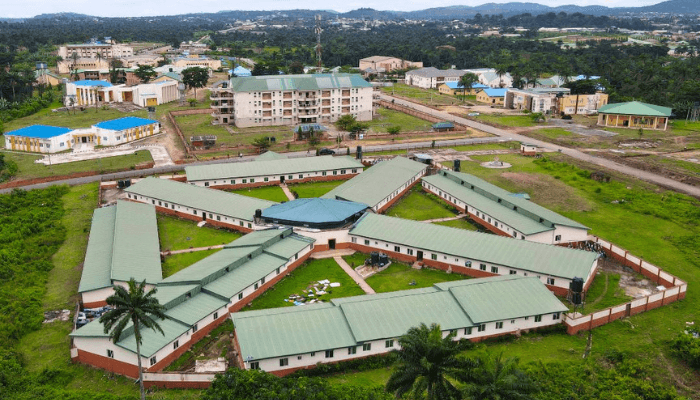
There is a growing interest in student housing as investors enjoy favourable returns across campuses.
The investment interest is driven by about 22 percent return on investment – five times more than the rate on commercial and residential real estates.
Nigeria’s population is estimated at 200 million and the growth rate is put at 2.6 percent per annum. It is also estimated that 70 percent of the population are below 30 years, representing the population that is in school at various levels of academic pursuit.
There are over 100 universities in Nigeria and most of them were built without adequate provision for accommodation. Worse still, the government is no longer investing hugely in education development, forcing private capital into the sector.

“The student housing market is large due to the increase in student population in Nigeria. Over the years, there has been scarcity of this facility, but companies like ours have taken the clarion call and are, therefore, investing in providing, not just the building, but also in the experience,” Abayomi Onasanya, founder/CEO, Student Accommod8, told BusinessDay in an interview.
Munachi Okoye, CEO, MCORE, noted that a widening gap between a growing student population and little or no student housing supply has thrown up opportunity in that market segment, which has the capacity to offer high returns and stable cash flow to investors.
Read also: Student housing: Investor boosts supply with 5000 affordable units in 5 campuses
According to him, “The ability to sign a long lease on land belonging to a higher institution or acquiring land adjoining a higher institution, and charging a ready pool of student off-takers a market rent with 100 percent occupancies, leading to a stable cash-flow, sounds like a real estate developer’s dream.”
Onasanya disclosed that student housing is a high-yielding asset, noting that though it is a long-term investment asset like other real estate investment assets, firms can recoup their investments within three to five years.

“This investment asset gives about 22 percent returns, which is more than double what commercial real estate gives, not to talk of residential real estate which gives 4-5 percent returns per annum. For this reason, we are encouraging other developers to come in,” he said.
Similarly, working with the authorities of universities under a partnership arrangement of Build, Operate and Transfer (BoT), Axial Nigeria Limited has delivered 5000 affordable units.
These are University of Lagos (UNILAG), Federal University of Oye-Ekiti (FUOYE), Obafemi Awolowo University (OAU), Olabisi Onabanjo University (OOU) and College of Nursing Science, Ekiti, located in Lagos, Ekiti, Osun and Ogun states, all in Southwest, Nigeria.
In UNILAG, the developer delivered 1,147 units known as El-Kanemi Halls 1 and 2. In its efforts at growing through digitisation, it has delivered 600-unit investment housing through the online community housing and finance platform popularly known as BREICS.com
At OAU, a total of 1,040 units were constructed for the school’s Centre for Distance Learning, christened Moro Osun State Phases 1 and 2. It also built 412 units for the same university.
Read also: Rivers State: A lesson on public housing
At OOU, Ago Iwoye Campus, Axial delivered 506 units structured in two phases, while FUOYE got 474 units. At the College of Nursing Science, 600 units were delivered in EKSUTH, Ado-Ekiti with a six-month completion period.
“The 5000 units completed serve as proof of our concept and capacity to deliver developments that have direct bearing on human lives and the sector,” Eyitope Ajayi, managing partner at Axial, said.
Ajayi explained that his firm’s decision to delve into student housing was based on identified needs, noting that less than 20 percent of Nigerian students in the various nation’s universities are housed on their campuses. “Governments, at both federal and state levels, have come up with policies that encourage private investors to own and run students’ hostels,” he said.
Continuing, he said, “While the company looks forward to partnering with infrastructure financing entities for lower rates amortised over longer periods for more sustainable expansion into other geopolitical zones, the 5,000 units have conveniently housed over 50,000 residents since completion.”
Onananya noted earlier that student housing is a long-term project like other real estate assets, warning that bank credit is not a good option for financing the projects. “We opt for equity investors because debt is not sustainable in our business because of the long-term nature of our developments and the short-term nature of bank loans with high interest rates. Repayment terms are not sustainable. We stay away from that, but there are other unique ways of financing that we are open to,” he said.
“Our joint venture partners typically bring land or cash and we offer development and management expertise. We also bring our cash. We are open for partnership with universities and private landowners,” he added.