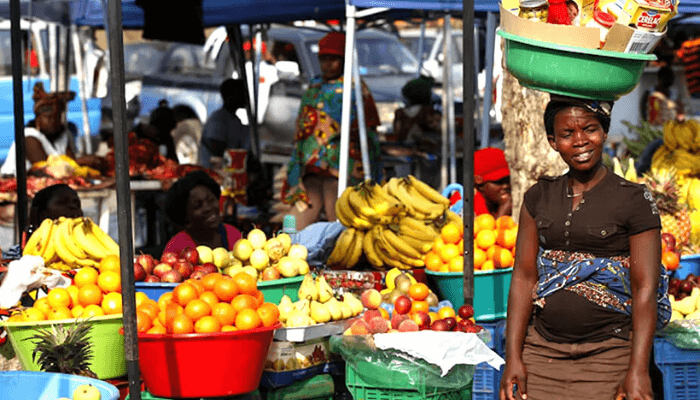
Nigeria works to collect more taxes and raise money for government projects, and the informal sector, which makes up more than half of the country’s economy, has become a key focus.
But for many small business owners, paying taxes is not simple. Instead of clear formulas, tax amounts are often negotiated, adjusted, and collected in layers. This leaves workers unsure how much they owe, why they owe it, or whether the system is fair.
When officials assessed Omolara Bamidele’s hair salon at N150,000, she bargained it to N80,000.
Read also: Lagos urges individual taxpayers to file 2025 returns before the March 31 deadline

She still does not know how the figures were determined.
Her experience reflects a wider pattern of negotiated, inconsistent, and layered levies confronting small operators.
For Bamidele, who has run Tobshe Hair for over nine years, the amount is paid directly to the Lagos State Internal Revenue Service (LIRS) under what operates as a presumptive arrangement; a system designed for businesses that do not keep formal financial records. But like many informal operators, she does not know how the amount was calculated.
Read also: Nigeria moves toward automatic tax assessment as enforcement intensifies
Under Nigeria’s tax laws, presumptive tax allows authorities to assess businesses where proper records are unavailable. Instead of calculating tax based on declared profits, officials assign an estimated amount, often based on business type or scale.

In principle, the system is meant to simplify compliance for small operators. In practice, however, informal workers describe a structure that varies widely across locations and collectors.
Some pay state revenue services. Others deal primarily with local government officials. Many face multiple layers of payments.
For Nneka Eze, who runs a beauty shop in Lagos, payments are split across different bodies.
“It’s a different levy,” she said.
She pays N1,500 monthly for waste collection services, amounting to N18,000 annually, and N10,000 yearly for local government permits. The figures, however, are not always fixed.
“It’s negotiable,” she explained. “They will just write maybe N20,000. You can negotiate with them to N10,000.”
Her second, smaller shop pays between N4,000 and N5,000 annually.
“It depends on the kind of shop you have,” she said.
The variability highlights a central concern: there appears to be no universally visible framework guiding assessments. Payment amounts can differ between similar businesses, sometimes depending on negotiation strength or perceived business size.
Blessing Yohanna, a POS operator in Obalende, says deductions on electronic transactions have increased this year.
“As of last year, when we transferred amounts above N10,000, they deducted N15 or N20,” she said. “This year, they are deducting N20, and on top of that, they still take charges for electricity and stamp duty. Altogether, the total deduction is about N120,” Yohanna explained.
Beyond transaction charges, she pays N500 weekly to enforcement officers who visit roadside operators.
“Like in a week, we give them N500,” she said.
Over a year, that amounts to roughly N26,000, separate from electronic deductions.
Tax experts say presumptive tax does not eliminate other statutory payments.
“They will pay other rates if it applies to their business sector,” said Oluwafemi Odusote, a tax expert familiar with the framework. “If I have a bar where I serve beer, I will still pay my personal income tax. And the local government will still come and tell us to pay licence.”
The implication is that presumptive tax operates as a minimum assessment mechanism, not a consolidation of all levies.
For informal operators, this means payments may stack rather than replace one another.
Across interviews, a common theme emerges: limited clarity on how amounts are determined.
Bamidele negotiated her assessment; Eze describes permit figures as flexible, and Yohanna faces weekly roadside collections alongside transaction deductions.
While each operator’s experience differs, the structure appears fragmented rather than standardised.
Presumptive tax is intended to address the challenge of poor record-keeping in the informal sector. Yet without transparent benchmarks or clear communication, assessments risk appearing discretionary.
As Nigeria debates broader tax reforms and efforts to widen the tax net, the lived experiences of informal operators suggest that the question may not simply be how much they pay, but how clearly the system explains why.