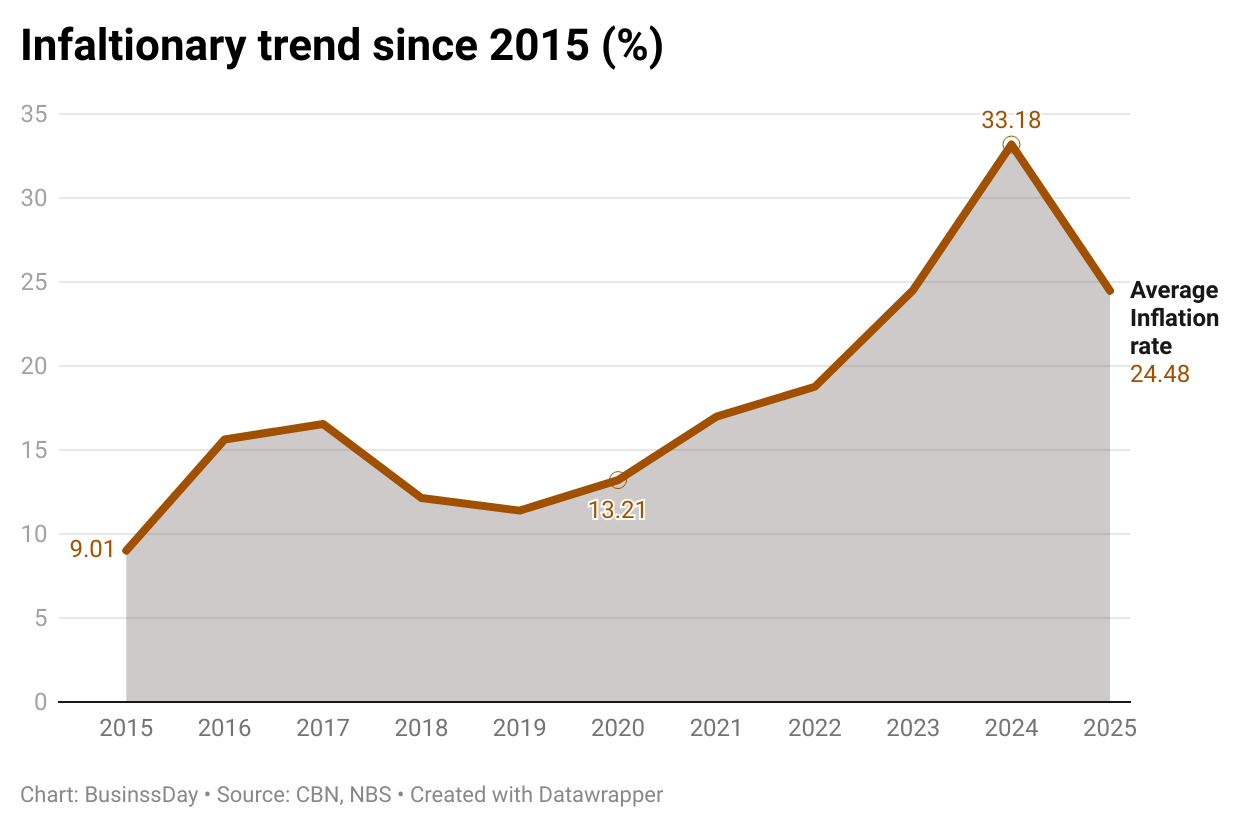
December 2024 was filled with a flurry of projections, all pointing towards a decline in inflation in 2025. Afrinvest Research projected 24.7 percent in a base case scenario, while Bismarck Rewane, CEO of Financial Derivatives Company, projected 25-27 percent by year-end.
However, the 24.48 percent figure reported by the National Bureau of Statistics (NBS) was not just the result of random economic shifts—it was driven by the rebasing of Nigeria’s Consumer Price Index (CPI) from 2009 to 2024.
Let’s assume that economic conditions in 2025 remain as challenging as in 2024. Changing the base year alone would still move the CPI figure downward. For example, the average inflation rate for 2024 was 33.18 percent, meaning prices increased to 133.18.
If the same scenario occurred in 2025 with a 33.18 percent price increase, the new inflation figure would be calculated as 33.18 divided by 133.18, multiplied by 100—resulting in an inflation figure of 24.91 percent.

Interestingly, this recalibrated figure closely matches projections from Afrinvest Research and Bismarck Rewane. It also aligns with what Taiwo Oyedele, Chairman of the Presidential Fiscal Policy and Tax Reforms Committee, explained when he used a similar analogy to illustrate how Nigeria could achieve its 15 percent inflation target.
Understanding the rebased inflation
The rebasing exercise, completed in early 2025, involved updating Nigeria’s consumption basket to reflect current spending patterns. Instead of the outdated 2009 consumption weights, new weights based on the 2023 Nigeria Living Standards Survey (NLSS) were adopted, with the price reference period set to 2024.
For example, food and non-alcoholic beverages, which previously held a 51.8 percent weight, were reduced to 40 percent due to a broader spending distribution. In contrast, transport and accommodation services saw their weights increase to 10.7 percent and 12.9 percent, respectively, reflecting more recent household spending trends.

Arithmetic behind the new figure
The new base year of 2024=100 means that price comparisons are now made against more recent economic conditions, rather than the outdated 2009 reference point. This change ensures that the inflation rate reflects the present-day economy and spending patterns.
To put this into perspective, inflation is calculated by comparing the price level of goods and services now with the price level in the base year. For example, with the rebased Consumer Price Index (CPI), January 2025’s overall index was 110.68. This means prices had increased by 10.68 units from the new base of 100. When compared to January 2024’s index of 88.9, this translates to a 24.48 percent year-on-year increase.
Simply put, this doesn’t mean inflation magically disappeared or slowed down overnight. Instead, the recalibration of the index to 2024 reflects current realities more accurately, capturing today’s spending patterns and price changes.
A closer look at key indices
Food prices increased by 26.08 percent in January 2025 compared to the previous year. Urban inflation stood at 26.09 percent, while rural inflation was slightly lower at 22.15 percent, highlighting disparities in cost pressures across regions.
Excluding farm produce and energy, core inflation was recorded at 22.59 percent, demonstrating price pressures across various sectors.
The rebased CPI provides a more accurate picture of current inflationary pressures. As Nigeria navigates 2025, policy decisions will need to align with this new reality to ensure economic stability and growth.