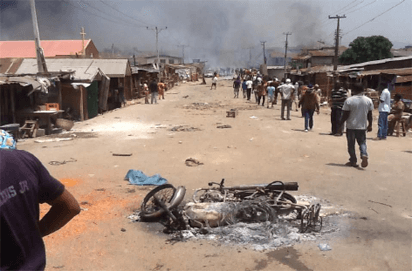
The ancient town of Ile-Ife was recently engulfed in an ethnic clash that resulted in needless loss of lives were lost and properties. Days after the gruesome incidence, the police reportedly combed Ile-Ife and its environs in search of possible perpetrators of the heinous incident. By the time the search was over, 38 suspects out of whom 20 were found culpable were detained for further investigation.
But then, there have been insinuations in certain quarters about the impartiality of the process leading to the arrest of perceived perpetrators. It has been alleged that the process favours a particular ethnic group at the expense of the other. It was, for instance, alleged that the bulk of officers involved in investigating the case are from the northern part of the country and they have been accused of indiscriminate arrest of people of Yoruba origin. It has also been alleged that a high ranking member of the federal cabinet from the northern part of the country made certain biased remarks while on a fact finding mission to Ile-Ife.
In as much as one does not actually have any empirical data to either disprove or endorse these claims, it is, nevertheless, important that authorities concerned, especially security agencies involved in investigating and prosecuting the case, rise above primordial interests, nepotism and other such unpatriotic considerations. Like the Ooni of Ile-Ife, His Royal Majesty, Oba Enitan Ogunwusi rightly affirmed while addressing security officials that paid him a visit in the wake of the distressing event, security agencies should go after the culprits, irrespective of who they are and where they are from, and bring them to book.
This is the least that is expected of law enforcement agencies in such a delicate situation as this. Those that instigated and participated in the deplorable episode are irresponsible and must not go scot-free in order to serve as deterrent to others with similar barbaric instinct. Therefore, resorting to ethnic sentiments and tendencies in this affair would not help the course of justice.

Whatever happened at Ile-Ife on that fateful day couldn’t have been a manifestation of relations between Hausa-Fulani settlers and their host community. Though I am not an indigene of Ile-Ife, I have a fair knowledge of the town. My formative years were spent there and the memories remain part of the most cherished aspects of my life.
In fact, I had my primary education right inside of Sabo, where the Hausa-Fulanis predominantly live in Ile-Ife. I had good friends among them with whom we interfaced like brothers and sisters. They have become part and parcel of the community. I cannot remember the last time that such gory intra-ethnic clash like the recent one occurred in Ile-Ife. The Ifes are particularly accommodating and unproblematic people. I can confidently attest to this. On the other hand, the Hausa-Fulani settlers at Ile-Ife had properly integrated into the community. I know quite a few of their men that had married Ife ladies and vice-versa.
I had taken the pain to go into the foregoing details just to drive home the hypothesis that the ugly incidence should not be unduly tribalized. Irresponsible men and women abound in every race or tribe. What happened in Ile-Ife was an act of irresponsibility and the responsibility of law enforcement agencies would be to fish them out and apply the law as desirable. Arresting or going after innocent people under any disguise would be counterproductive.
The kind of crisis that happened at Ile-Ife has dangerous consequences. For one, it threatens the very existence of our nation, thereby making nonsense of the labour of our heroes past towards nation building. Second, it slows down progress in all dimensions as no concrete development could be attained in an atmosphere of instability. Third, it could lead to a serious dent on the image of the country, whereby some countries might be warning their citizens concerning visiting Nigeria.
It is, therefore, imperative that we collectively make concerted efforts to address current situation in Ile-Ife and other such places. Irrespective of ethnic, religious, cultural, political and other such divisive affiliations, we all have a duty towards maintaining peaceful co-existence in the country. Our leaders need to give every member of the society a sense of belonging by providing equal opportunities to all irrespective of societal status. We need to lay much emphasis on human capital development, especially in places with higher rate of instability. Government at all levels should creatively fashion out security measures that could stem the tide of insecurity across the land.
Finally, we all need to eschew all divisive tendencies and other acts that could further throw the county into crisis. This is not the time for anyone to be making inflammatory remarks, no matter how politically expedient.

Tayo Ogunbiyi
Ogunbiyi is of the Ministry of Information and Strategy, Alausa, Ikeja, Lagos