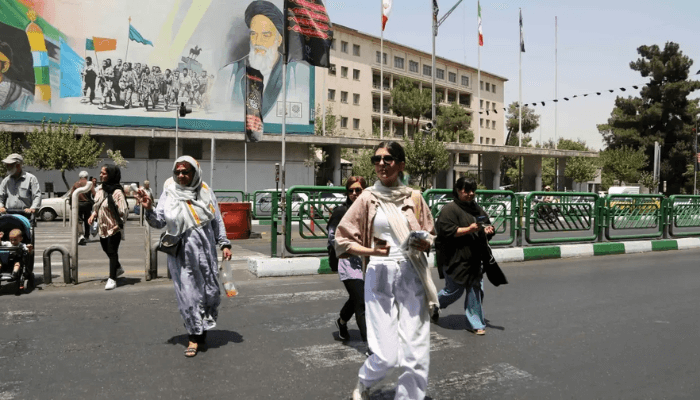
In Tehran, the air still feels heavy — not with smoke or sirens, but with the weight of uncertainty.
After nearly two weeks of relentless bombardment and retaliatory strikes, Iran and Israel entered a fragile ceasefire on Tuesday morning — a deal brokered with the help of the United States. But in the Iranian capital, where flashes in the sky have become more familiar than sunsets, the guns falling silent has brought little peace.
Confusion, caution and an overwhelming sense of disbelief now cloud the mood in Tehran. Many families displaced by the violence rushed back to their homes, praying the truce would hold. Others, like 37-year-old reporter Samaneh, chose to wait — unable to shake the trauma of the night before.
Read also: Iranian missile strikes injure 16 in Israel following US nuclear site bombings

“The last night of the bombing was the worst,” she told Al Jazeera, giving only her first name. “I truly thought I’d never see my loved ones again.” Her voice shook as she recalled the intensity of Monday evening’s strikes — a crescendo in a war that had already shattered her sense of security.
“I know this ceasefire is temporary,” she said. “When [United States president] Donald Trump announced it, I thought it was just another psychological game he was playing with us.”
It wasn’t until Iranian foreign affairs minister Abbas Araghchi confirmed the ceasefire via Telegram, citing a formal message from Oman, that Samaneh felt any sense of calm. But it came laced with other emotions — “relief, sadness, anger, and fear,” she said.
Read also: Iran says it has launched attacks on US base in Qatar
The war erupted on June 13, when Israeli forces launched targeted air strikes on Iranian nuclear and military facilities, as well as densely populated areas in Tehran. Dozens of civilians were killed, alongside several military commanders and nuclear scientists. Iran responded with a barrage of ballistic missiles and drone strikes on Israeli cities.

According to Iranian authorities, at least 610 people have died and 4,746 have been injured. In Israel, the death toll stands at 28, with hundreds more wounded.
In Karaj, a city in the greater Tehran area, 41-year-old history teacher Raha had been abroad when the strikes began. She returned home immediately to be with her family — and now views the ceasefire with suspicion.
“It’s not peace — it’s a pause,” she told Al Jazeera. “How can we trust those who talk of regime change and peace in the same breath?” She fears Israel’s military may use the lull to regroup and strike again. “Just like they’ve done in Palestine and Lebanon.”
Read also: Irans parliament moves to close Strait of Hormuz after US nuclear strikes
Hadi, a 42-year-old civil engineer from Ahwaz, points to the collapse of the 2015 nuclear deal — from which Trump unilaterally withdrew in 2018 — as the trigger for the current crisis.
“As a country, we’ve repeatedly said we were not pursuing nuclear weapons,” he said. “It was Trump’s withdrawal that dragged Iran into the abyss of war.”
Back in Karaj, Raha laments what she sees as the erasure of Iran’s agency in its own future. “The US and Israel erased our voice,” she said. “They talk about women, life, and freedom — then drop bombs on our homes. They’ve killed innocent people, destroyed billions in infrastructure. Our nuclear programme now lies in craters.”
Ordinary Iranians are now left to pick up the pieces — emotionally and physically.
Sirous, a Tehran resident who asked to use a pseudonym for safety, told the BBC: “I believe the whole war was orchestrated. Israel and the US destroyed our sites, Iran launched a few missiles, hit a US base, and both sides are satisfied. But we, the people, are the ones who suffer.”
He is not alone. Arman, another interviewee who withheld his real name, said flatly: “This ceasefire will definitely collapse. Israel hasn’t achieved all its goals… the regime must fall.”
And Kian, also speaking under a pseudonym, dismissed the ceasefire as “a trap to lure [Iranian Supreme Leader Ali] Khamenei out of his hole.”
“This war won’t end with a ceasefire,” he said. “It will end with the fall of this regime. And the regime doesn’t stand a chance.”
Fragile hope, flickering peace
Within hours of the truce taking effect, Israel claimed to have intercepted missiles fired from Iranian territory — a claim Iran swiftly denied. Already, accusations of violations are mounting, fuelling fears that the ceasefire will not survive the week.
For millions of Iranians, including Samaneh, Raha, Hadi, and Sirous, peace remains elusive. And while the world’s diplomats trade statements, Iran’s people are left navigating grief, fury and doubt — clinging to hope as the next chapter waits to unfold.