|
Getting your Trinity Audio player ready...
|
…Hamper nation’s economic growth
…Military laments difficulty in accessing communities
On October 1, 2025, Zephaniah Yako, an indigene of Mubi in Adamawa State, was among the callers in a live radio talk show in Lagos to wish Nigeria well in her 65th Independence Anniversary.
As expected, he wished his country well, but used the opportunity to call on the government to send security agencies to his town and some villages farther away, which are mostly inaccessible due to difficult terrain, bad road network, poor communication services, and have sadly become operational bases of terrorists.

“You live here in the city and when there is an attack, the police or soldiers can still come even if they delay. But in most hinterlands, terrorism attacks can go on for days without notice because of the difficult terrain, lack of communication services and fear,” he said.
“These are farmers and as they die, their farms are shut down, no food and that is why we have high cost of food items in our market today,” Yako pointed out.
His concern is the long stretch of ungoverned areas along the Yola-Mubi route of over 200km, especially the lonely Ganye-Jimeta Federal Road on that stretch.
“From Yola to Jimeta is almost 150km and over 200km farther to Mubi. There are hundreds of kilometers dividing most towns in the state and along the long stretch are many villages and areas that are ungoverned as we speak.
“The terrorists know and take advantage of the vulnerability of these areas, knowing that their difficult terrain will deter security agencies from accessing them and helping the inhabitants when the need arises,” he explained.

As Yako observed, Nigeria, with her 923,7770 sq kilometers landmass, about the same size as California, Nevada and Utah combined (all in the United States of America), also has thousands of kilometers of land that are ungoverned.
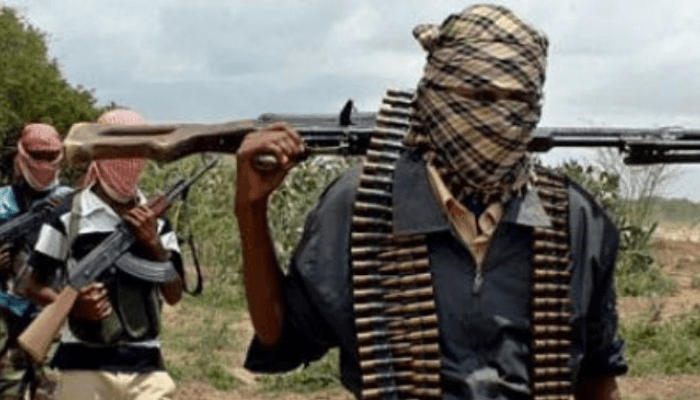
Some of these ungoverned areas have sadly turned to operational bases of criminals and terrorist networks, with the Sambisa Forest as a case of study.
Read also: After Trump threat, Army Chief tells troops to brace up for major offensive against terrorists
Military laments difficult terrains
Speaking with the media recently, an Army chief said that part of the reasons insecurity has continued in some communities was the difficulty in accessing those “hard-to-reach” areas.
Accusing some state governors of not spending the huge allocations they cart away from Abuja every month on the provision of access roads to communities, the officer said: “One of the major problems is that even when you get distress calls, there is no road to access many communities. I challenge some of the governors to begin to open up the communities.”
Theo Adams, a technology expert, told BusinessDaySunday that he began to understand how possible it is for bandits and Boko Haram to finish everybody in a community without anybody hearing about it, when he travelled to Jigawa from Kano.
Adams recounts his experience, thus: “Some years ago, I flew to Kano and continued the journey to Dutse, Jigawa State by road. I found out that there are several kilometers of uninhabited land and possibly ungoverned areas. You will see some hamlets comprising few hut houses after several kilometers. So, I said to myself, how can anybody here escape attack if bandits strike?”
Today, Nigeria, the giant of Africa, is still nursing the wounds inflicted on her by the several attacks of Boko Haram insurgents, launched from the 518-km2 Sambisa Forest in Borno State, the largest ungoverned area in the country.
In his opinion, Bem Hembafan, a retired senior security officer, reechoed the experience of Adams, insisting that the escalating insecurity boils down to the large expanse of ungoverned areas and human factors.
Hembafan, who runs a private security firm that guards top-notch estates in Abuja and Kaduna, noted that security coordination is easier in the southern part of the country due to shorter kilometers between cities and closeness of villages unlike in the northern part with vast expanse of empty land, which are ungoverned and often overwhelming in security coordination.
“I am from Benue. When I drive home, I see the vast expanses criminals can easily hide. From the highway, those hideouts stretch hundreds of kilometers into the forest.
“Fighting in such terrain against an already occupier, and a devilish one for that matter, can be risky, while tracking them along the large expanse of land can be overwhelming. I give it to our security agencies, they are trying, it is not easy risking one’s life out there when insurance is not guaranteed,” he noted.
Toeing the same vein, Onyewuchi Akagbule, a senior university lecturer, noted that the overwhelming vast expanse of land is not just an excuse for the escalating insecurity, but a huge contributor to it.
“If you consider our over 239 million as of November 2025, and a population density of about 261 people per square kilometer, you will discover the gaps terrorists and bandits are taking advantage of because settlements outside the cities are influenced by culture, hence people live far apart, leaving many ungoverned areas, especially in the northern part of the country,” Akagbule pointed out.
Akagbule, who recently concluded a research work across five states, recalled the several kilometers he travelled on land from Kano to Damaturu in Yobe State, despite flying into Kano.
Read also: Terrorists threaten to bomb National Assembly — Reps
“It was my first time travelling far up north. I had two security personnel, a junior colleague, a driver and a local guide.
“We plied through the Kano-Azare-Potiskum Road and the empty vast land kept baffling me kilometer by kilometer.
“I just couldn’t recall how long because some situations came up, which we later overcame, but the reality is that Nigeria has many empty spaces that criminals are converting to their base,” he said.
He noted that securing the many ungoverned areas in the country is still a big challenge as Nigeria falls
short of the United Nations (UN) recommended police-to-population ratio of 1:450 with approximately 1 officer for every 600 to 650 citizens.
“I think we have over 370,000 police officers, over about 300,000 military personnel. Even if we have a combined five million security personnel across all the agencies, that is not enough to secure almost over 230 million people and talk of the ungoverned areas. We all, the government and the people, need to wake up to our security reality and be honest in addressing it,” the senior lecturer noted.
Hembafan also decried that with Nigeria’s population exceeding 220 million, the combined security agencies are stretched thin, even to secure ungoverned areas.
“Every general election day, all our barracks are empty. Imagine a national crisis stretching for days. We don’t pray for that and that is why there is an urgent need for additional security personnel across all the security agencies. But more urgent is the need for systemic reform, without which the numbers will not count in the insecurity fight,” Hembafan warned.
He also decried the huge waste the natural resources have become instead of being used as farms, ranches, game reserves or research areas, they are further wasted by the illegal occupation of terrorists.
“From Gboko to Aliede, I see orange and mango farms that once thrived, but now abandoned because of the fear of attacks by herdsmen and bandits.
“Also, along Jos-Bauchi, Bauchi-Maiduguri, among other areas, there are farms, even owned by retired and serving army generals that have been abandoned, some of the owners have been killed and parts now occupied by terrorists.
“So, that accounts for the increasing food insecurity, job and investment losses,” he decried further.
He noted further that at the peak of insurgent attacks, there were almost no harvests as farmers helplessly watched their oranges and mangoes overripe, fall down and rot, yam and cassava eaten by rodents and some fertile lands uncultivated due to fear of attacks by terrorists.
“You can quantify the losses, economically and especially human lives,” he said.
Also, Idrisu Ocheno, a Kogi State cashew farmer, also noted that activities of bandits have made many farmers to reduce their visitations to the farms as they are easy targets for kidnappers, who are hoping to use them to get huge ransom from the government.
Speaking with BusinessDaySunday recently, a political aide from Enugu State said that before the arrival of the current administration in the state, a lot of state-owned properties- land, buildings and other businesses- had been cornered by certain individuals.
“In some cases, we discovered some transactions that were going into the individuals’ pockets because the previous administrations abandoned such facilities. In fact, in some cases, nobody remembered again that they belonged to the government,” the aide, who spoke on the condition of anonymity said.
In some states, private individuals have taken over palm plantations and mining sites belonging to state governments, because successive governments and administrations abandoned them only relying on FAAC allocation.
Proffering solutions, Idrisu noted that the government can build security bases and not just check points along most the ungoverned areas, reintroduce agricultural extension programmes that will see farm settlements springing up in most of the areas that are ungoverned.
In the case of Benue State, which harvests a large chunk of fruits across the year, Hembafan suggested that the government should encourage the establishment of cottage factories, fruit processing plants and related facilities like preservation, seed banks, fertiliser plants, close to the farms and in some of the ungoverned areas to curb the illegal occupation by terrorists.
Meanwhile, recently, the National Park Service increased the number of parks by approving the upgrade of 10 forest and game reserves to National Parks, bringing the total to 17.
Explaining the rationale for the expansion, Ibrahim Musa Goni, conservator general, National Park Service, said it was aimed at meeting global biodiversity targets, improving internal security, and boosting ecotourism.
While converting the many ungoverned areas to game reserves and national parks may sound good, some critics argued that terrorists still occupy some parts of the parks without being challenged considering that they have sophisticated arms and ammunition.
“I read a magazine that featured Gashaka Gumti National Park as the largest park in West Africa, measuring 6,402 km2. But who visits the park in that far away Taraba State? Our government and tourism people should put infrastructure in place to woo tourism because if these national parks are actively hosting visitors, there will be security to guard visitors and terrorists will run away from our forests,” Dimeji Ayeni, a banker argued.
However, in a related development, Chukwuma Okoli, an associate consultant at Nextier and lecturer, Political Science Department at Nnamdi Azikiwe University, Awka; and Ndu Nwokolo, managing partner, Nextier and an Honorary Fellow, School of Government, University of Birmingham, UK, in their article titled “Insecurity and Statistics: Nigeria as a country of Particular Concern by the U.S.”, published in PolicyWeekly, both noted that the actions and inactions of the Nigerian government in fighting insecurity led to the designation of Nigeria as a ‘Country of Particular Concern’ (CPC) by Donald Trump, president of the United States of America.
Also offering solutions, both noted that while the designation has dealt a great blow to Nigeria’s external image and also has the tendency to polarise the country along religious fault lines, efforts must be immediately put in place by the Nigerian government to reverse the repulsive designation.
According to them, such a timely action, will enable the country to improve on security and to avoid the actualization of the threat by the Trump-led administration.
For them, it is time to squarely face the perpetrators of the heinous crime against fellow humans, hunt them down in their hideouts, regain control of the areas, but not left unoccupied as they terrorists can regroup to repossess the areas.
Hembafan insisted that the government should improve on the provision of social amenities and security across rural areas, where some of the worst attacks happen.
“There are improved federal monthly allocations for local governments now. With the funds, the rural people should feel the impact with more social amenities, health centres and especially security posts. It shouldn’t just be police stations, but military bases in places prone to terrorist attacks,” he said.
On his part, Ayeni suggested that telecommunications companies should work jointly to secure, boost infrastructure and services in the rural areas to ensure better services for the people, which is needed to report developments, especially alerting security agencies on suspicions or activities of the terrorists.
“I know that businesses are set up for profit, but our telecoms should consider pushing their corporate social responsibility to these underserved areas. The government should consider giving them tax rebates on such services because of the impact on security in the long run.
Banks too should help because they keep talking about reaching out to the unbanked population. I guess, it is time to jointly flush terrorists out of our forests and reclaim the ungoverned areas, else the killings will continue and the country will keep getting bashing from the international community. The time is now and for me Donald Trump’s wakeup call is timely,” he said.