|
Getting your Trinity Audio player ready...
|
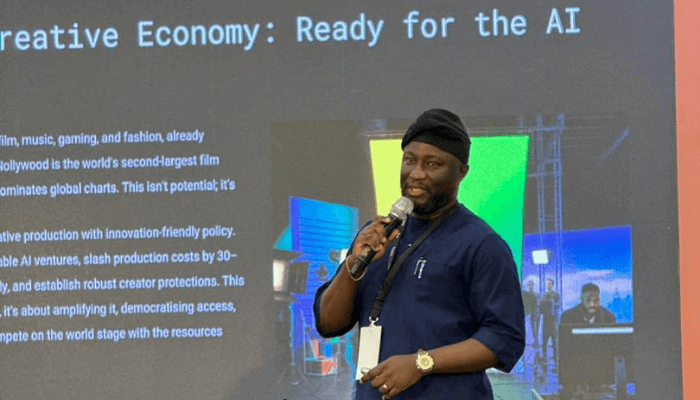
At a World Bank–Eden Venture Group event in Washington DC, Oluwaseun Dania, Nigerian technology entrepreneur and creative economy strategist unveiled what he calls a “studio revolution in a laptop”, an innovation that could redefine how African filmmakers, animators, and digital storytellers create and monetise content in the age of artificial intelligence (AI).
Dania, who leads Alpha-Geek Technologiesand serves as CEO of Crello, introduced the “Indie-Studio-in-a-Box” concept at the Entertaining Change: Next-Generation Media Partnerships for Social Impact and Gender Equality forum, hosted by the World Bank and Eden Venture Group.
The event, themed around AI and social impact, brought together global media innovators and policymakers to explore how emerging technologies can expand inclusion, reshape narratives, and empower creators across developing markets.
A laptop that replaces the studio

For decades, Africa’s creative economy has faced the same structural challenge, talent overflow but capital shortage. Film production, post-production, and distribution remain heavily centralised, often inaccessible to small studios or young creators.
Dania’s “Indie-Studio-in-a-Box” seeks to flip that model. It combines a suite of AI-assisted tools for script development, pre-visualisation, virtual production, post-production, dubbing, and rights management, all operable from a single laptop.
Speaking during the knowledge-sharing session on AI for Entertainment Media Content: Advancing Impact and Research, Dania outlined how artificial intelligence can unlock unprecedented opportunities for creators, researchers, regulators, and development partners across the continent.
According to him, the framework enables small creative teams of five to eight people to execute end-to-end production cycles, from idea to international distribution, at a fraction of traditional studio costs.
In an industry projected by UNESCO to be worth
over $20 billion annually across Africa, such a model could lower barriers for entry-level creators while driving localisation and export of African narratives at scale.

Dania’s presentation challenged one of the most persistent fears in the global creative industry, that AI would replace human imagination. Instead, he argues, AI is the multiplier, not the replacement, of creativity. “Africa’s creative sector already shapes global culture. AI gives our stories reach, scale, and economic force,” he said.
He demonstrated how machine learning tools can support storyboarding, editing, special effects, and language translation, helping African studios produce world-class content without the heavy financial burden of traditional setups.
But Dania’s innovation isn’t just about technology, it is also about ethics. At the forum, he introduced the A.I.R. Framework, a new ethical model for Creative-AI governance built on three pillars: Attribution: ensuring creators, actors, and performers retain consent and credit when their likeness or work is used; Integrity: mandating watermarking and provenance tracing for AI-assisted content and Residuals: establishing smart contracts that automate fair compensation when a creator’s work is reused.
“The creative AI economy must not repeat the exploitation cycles of the past. We need systems that recognise, protect, and reward creative labour, not erase it,” Dania said.
Beyond the studio, Dania called for stronger partnerships between the government, Big Tech, and universities to close the AI literacy gap and reduce algorithmic bias in African creative datasets. He proposed that universities update film, media, and computer science curricula to include modules on AI ethics, generative design, and cultural data representation. “If we want AI systems that understand African faces, voices, and social norms, we must build them ourselves. That starts with research, curriculum reform, and collaboration,” he said.
Dania also urged Nigeria’s National Information Technology Development Agency (NITDA) to establish a Creative AI Sandbox, a regulatory testbed that would bring together the NDPC, NFVCB, NBC, NCC, CBN, film guilds, universities, and development partners.
The sandbox, he argued, would allow creators and regulators to experiment with new AI tools in real-world media environments, balancing innovation with ethical safeguards.