Nigeria needs targeted reforms and fiscal discipline to alleviate debt service pressures that are constraining the government’s resources, hindering the nation’s growth and worsening a poverty crisis in the nation of 200 million people.
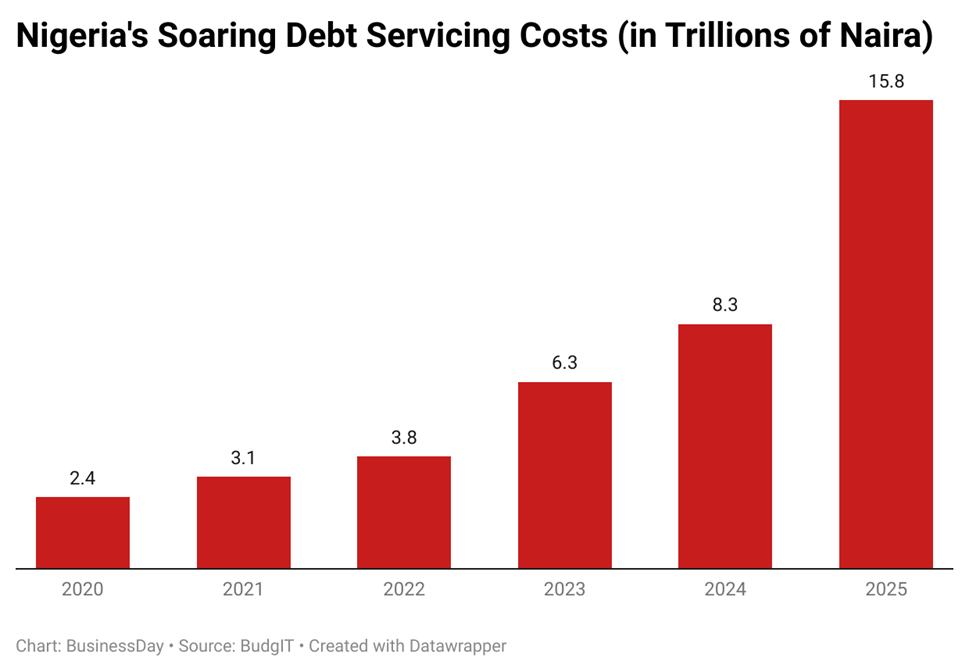
The federal government is faced with a daunting fiscal challenge as debt servicing takes a huge chunk of its proposed N49.7 trillion 2025 budget.
With N15.8 trillion or 45 percent of its projected N34.82 trillion revenue earmarked for debt repayment, Nigeria will spend the single largest bulk of its revenue repaying creditors.
The N15.8 trillion budgeted for repaying creditors surpasses the combined N14.97 trillion earmarked for critical sectors such as infrastructure, education and health.

Nigeria faces limited fiscal space for development spending as debt servicing consumes nearly half of projected revenue.
To address this, experts have argued that the government must implement robust reforms and be more fiscally prudent.
“Reducing immediate fiscal pressures can be achieved by issuing bonds such as Sukuk or Green Bonds and renegotiating existing loans to ensure longer repayment terms or lower interest rates,” Olajide Oyadeyi, a UK-based macroeconomist and researcher said.
Oyadeyi said Nigeria must diversify its streams of revenue including the monetization of state assets through public-private partnerships, privatization, or lease agreements in non-critical sectors.
He added that reducing dependence on costly domestic debt can be achieved by adjusting the borrowing mix to include external concessional loans and multilateral funding sources.

“The burden of foreign debt repayment could be alleviated by improving foreign reserve management and increasing non-oil exports to strengthen currency stability.
“Furthermore, the utilisation of digital platforms to improve the efficacy of tax and non-tax revenue collection can reduce leakages and increase government inflows, thereby promoting fiscal sustainability,” Oyadeyi said.
The Nigerian government, knowing that it has a shortage of revenue and ballooning debt profile, sees proposed changes in its tax laws helping to significantly boost revenues, as the West African nation seeks to control its widening deficit and borrowing costs.
Samuel Sule, the CEO of Lagos-based investment bank Renaissance Capital Africa said there is a strong need for higher revenues and less reliance on deficit financing to ensure the Federal Government is on a more sustainable economic path.
“Tax reforms are a medium term mode of increasing revenues and should be combined with a focus on higher oil production (a source of non-borrowed USD) and lower recurrent government spending,” Sule said.
But the series of reforms have been met with a lot of resistance with many fearing it could stoke inflation and compound their hardships, hence its suspension for wider consultation to finetune the grey areas.
To further ease the country’s debt burden, civil society organisations have asked the National Assembly to reduce the proposed N344.85bn allocation in the 2025 budget for lawmakers and cut down non-essential spending of the executive including, N9.4bn on travels, refreshment/meals, and foodstuff/catering materials for the presidency.
“The proposed huge spending is neither necessary nor in the public interest, especially in the face of the country’s dire economic situation and the level of proposed borrowing to fund the 2025 budget,” the Socio-Economic Rights and Accountability Project (SERAP) said in a letter dated December 21, and addressed to the lawmakers.
While the Nigerian government has been urged to allow fiscal discipline to serve as its watchword in 2025, stable exchange rate and large foreign reserves have been tapped as another sustainable way of easing debt pressures.
“Stabilising the naira is vital to easing the cost of external debt servicing. Boosting foreign exchange reserves, encouraging exports, and attracting foreign direct investment are essential strategies for currency stabilisation,” a monetary economist who doesn’t want to be mentioned said.
“The government must also prioritize economic diversification to reduce dependence on oil revenues. Investments in agriculture, manufacturing, and renewable energy can create jobs, increase exports, and generate sustainable income streams,” the source added.
Easing debt service pressures: which way to go?
Debt servicing is consuming an ever-greater amount of tax revenue needed to keep schools open, provide electricity and pay for food and fuel that will in turn ease the pains of the reforms implemented mid last year.
“Targeted reforms and fiscal discipline are necessary to alleviate debt service pressures. A well-structured communication strategy and robust social safety nets can gradually eliminate inefficient subsidies, such as those on fuel, to free up resources for debt servicing and development expenditure.
“Furthermore, the establishment of a more stable economic environment and the reinforcement of fiscal discipline can be achieved by enforcing a debt ceiling and ensuring transparency and accountability in fiscal reporting through the implementation of more stringent public debt management practices,” Oyadeyi cited earlier, said.
Meanwhile, Nigeria’s expenditure is outpacing its revenues, leading to high debt servicing, according to Adeola Adenikinju, president of the Nigerian Economic Society (NES).
Adenikinju stressed that “Nigeria’s expenditure is marked by high levels of spending on subsidies and debt servicing, limiting investments in critical infrastructure.”
“Rising rigid expenditure, especially debt servicing and personnel costs, undermines the potential for capital investment, constraining fiscal space and hindering long-term economic growth,” he stated.