In early February 2024, when the naira plunged to ₦1,420 per dollar, Abuja-based plastic chair maker Michael faced an impossible choice: either double the price of his products or shut down the business due to soaring production costs. Simultaneously, a professor of medicine at the University of Lagos confronted a different challenge—whether to move his practical classes online or reduce campus visits to once a week in response to skyrocketing transportation costs.
These stories reflect a broader economic crisis sweeping across Nigeria. From small business owners and corporate professionals to educators and manufacturers, people nationwide are grappling with the fallout of a rapidly depreciating naira and a persistent scarcity of foreign exchange. The naira crisis transcends monetary instability—it represents a structural breakdown touching every level of economic life, from household finances to national economic policy.
The character of Nigeria’s economy long defined as a consumption-driven economy, Nigeria’s dependence on imports has magnified the effects of currency depreciation. Oil continues to dominate, accounting for nearly 90% of export earnings and over 50% of government revenue, despite contributing only a small fraction to national GDP. This overreliance on a volatile global commodity makes Nigeria especially vulnerable to fluctuations in global oil prices.
According to the International Monetary Fund (IMF), Nigeria’s informal sector contributes approximately 60% of the country’s GDP and employs nearly 80% of the workforce. Agriculture remains a cornerstone of employment, engaging over 35% of the population, though it suffers from chronic underinvestment, poor mechanization, and vulnerability to climate change and insecurity.

Nigeria faces formidable socio-economic challenges. World Bank data shows that as of 2024, the youth unemployment rate (ages 15–24) stood at 5.05%, with the overall unemployment rate reaching 4.30% by April 2025. With a population estimated at 227.9 million in 2023, the country is home to roughly 87 million people living below the poverty line, representing 38.9% of its citizens.
Inflation and a weakening naira continue to erode purchasing power. As the cost of imported essentials such as food, fuel, electronics, and machinery rises, production costs soar, and profit margins shrink. According to empirical studies from Lagos Business School, firms unable to manage currency shocks risk seeing their margins fall by up to 30%.
Foreign direct investment (FDI) offers another sobering metric. The National Bureau of Statistics (NBS) reports that Nigeria’s FDI fell to just $29.83 million in Q2 2024—only 1.15% of total capital importation—amid growing investor wariness driven by forex volatility and regulatory ambiguity. The IMF’s 2024 Sub-Saharan Africa Outlook further revealed that Nigeria’s real GDP growth slowed to 2.9%, constrained by inflationary pressure and policy inconsistency.
Tracing the Roots of the Crisis
The volatility of the naira is far from a new phenomenon. Its origins can be traced to the oil boom of the 1970s. Prior to that, inflation in Nigeria remained relatively modest. In 1966, however, it surged to 10%, marking Nigeria’s first instance of double-digit inflation. The following year, in 1967, the country recorded deflation, with the annual rate dropping to -3.73%. Over the next decade, this was followed by a sharp inflationary spike fuelled by an influx of oil revenue and unchecked government spending, which flooded the economy with excess liquidity that it lacked the production capacity to absorb—ultimately laying the groundwork for chronic inflation.

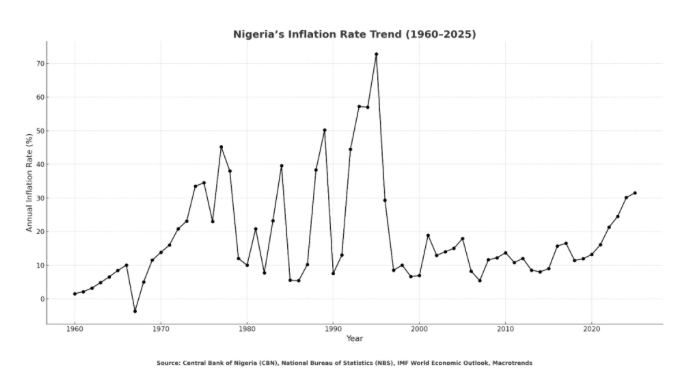
Fast forward to the present, a combination of structural inefficiencies and policy decisions has reignited inflationary pressures. The removal of fuel subsidies the floating of the naira, and ongoing insecurity in Nigeria’s food-producing regions have exacerbated inflation. According to the National Bureau of Statistics, inflation climbed from 21.9% in January 2023 to over 30% by late 2024—its highest level in nearly two decades. By May 2025, it had declined to 24.23% but is expected to rise again to 37.0% by 2026.
The effects are being deeply felt by households, particularly those in low- and middle-income brackets. Basic expenses such as food, shelter, and transportation now consume most of the household income. Families report skipping meals, delaying medical care and cutting back on all but the most essential spending
How Businesses Are Responding
Hedging Against Currency Risk: To mitigate currency instability, some forward-thinking businesses are adopting hedging strategies. These include locking in exchange rates in advance or reallocating reserves into more stable digital currencies. “We now keep 30% of our reserves in digital dollars,” says Emeka, a spare parts distributor in Onitsha. “It’s the only way we can plan ahead without getting hit every day.”
Cost-Cutting and Pricing Innovation: Escalating supply chain costs are compelling businesses to rethink their operations. Common responses include reducing package sizes, introducing lower-cost product quantities, and pegging prices to the U.S. dollar. Household consumer brands such as Indomie and Cowbell have led the way, with smaller retailers quickly adopting similar strategies. “I haven’t bought new clothes or taken a vacation in two years,” says Motunrayo, an officer with the Federal Road Safety Corps. “Every naira now goes toward food and transportation.”
Digital Transformation to Reduce Overhead: Digitization is no longer a luxury—it has become a survival strategy. To reduce fixed costs, businesses are increasingly embracing remote work, online marketplaces, and AI-powered customer service. “Going fully virtual slashed our overhead by 60%,” says Chioma, founder of a media agency in Lagos. Likewise, medicine professor at the University of Lagos has significantly reduced his on-campus presence, shifting most of his lectures to online platforms.
Localizing Supply Chains: Faced with unsustainable import costs, businesses are increasingly looking inward. Adewale, a baker in Ibadan has replaced imported wheat flour with locally sourced cassava flour. In Lokoja, Kehinde has transformed his yard into a mini farm, using over 400 cement sacks to grow yams and offset rising food expenses. Nigerian textile companies are rediscovering domestic cotton, while tech startups are turning to locally manufactured hardware components.
Community Resilience and Shared Logistics: Microbusinesses are increasingly banding together for survival. Collaborative strategies such as group purchasing and shared delivery services are proving essential. “Four of us now share a delivery truck,” says Fatima, a clothing vendor in Kano. “It has cut our transport costs by nearly 40%.” Motunrayo adds, “When going to work, three of us usually share an Uber and split the cost equally.”
Expert Insight: Time for Structural Reform
According to Dr Adeyemi, an economist at Lagos Business School, the current crisis—while painful—could mark a turning point. “The naira’s collapse is forcing businesses to reassess their dependence on imported inputs,” he explains. “This could be the spark for a more self-sufficient and diversified economy.”
On the Ground: The Procurement Perspective
Q: How has the naira crisis impacted procurement?
A: “Prices change weekly, especially for imports. Budgeting has become nearly impossible,” says Tunde Ojo, a procurement manager based in Lagos. “Even local suppliers are increasing prices to keep up with diesel and transport costs.”
Q: What adjustments have you made?
A: “We negotiate bulk deals early and explore local alternatives—even if the quality isn’t perfect. We’re also building partnerships in West Africa to reduce reliance on the volatile Nigerian forex market.”
Despite a flurry of policy changes—including interest rate hikes and limited interventions in the currency market—economists argue that the government’s response has been piecemeal. What is urgently needed is a cohesive, long-term strategy focused on agricultural modernization, manufacturing revival, and SME empowerment.
Fiscal discipline, combined with an industrial policy that prioritizes domestic production, could reduce import dependence and enhance economic resilience. At the same time, improved regulatory clarity and strategic infrastructure investment are essential to restoring investor confidence.
Finally, the naira crisis is not merely a currency issue—it reflects deeper structural weaknesses in the Nigerian economy. Yet within this turbulence lies a transformative opportunity. Nigerian businesses are not collapsing; they are adapting, innovating, and laying the groundwork for a more sustainable future.
If public and private sector leaders can align their efforts, Nigeria has the potential to emerge stronger—transitioning from an import-dependent economy to one that is self-sustaining, digitally driven, and globally competitive.
By Olaoluwa Vincent Ajayi
Economics Correspondent
New Daily Prime