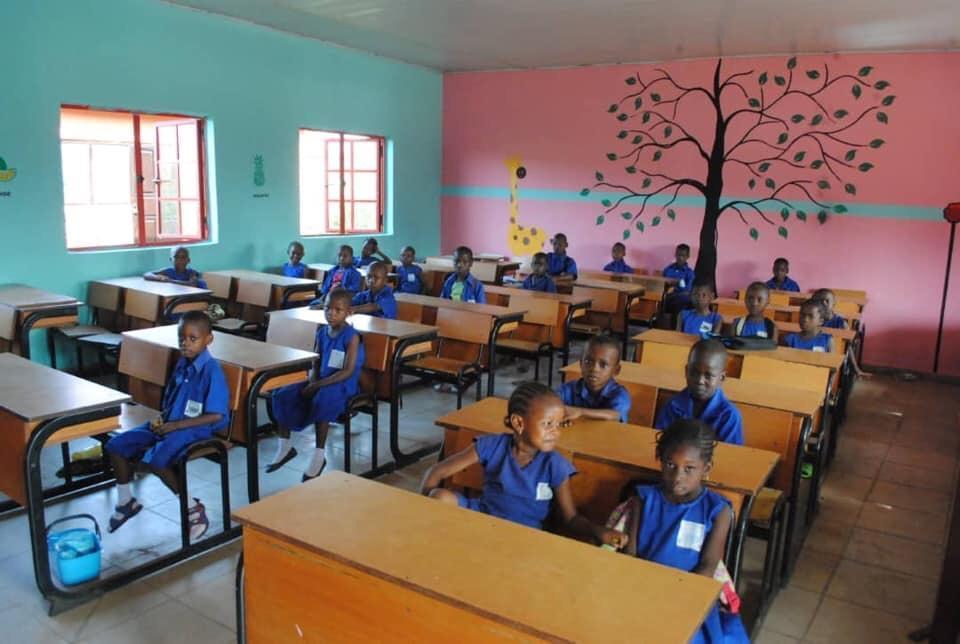
Edo State in Nigeria’s South-South region is reaping the fruits of two years of purposeful investment to transform basic education through the application of electronic technology to teaching and learning as learning has been sustained in the state despite COVID-19.
The outbreak of COVID-19 has led to school closures which have affected an estimated 253 million learners who live in 47 sub-Saharan African countries. The region is facing a major crisis affecting learning and Nigeria is on top of the list, with almost 45 million learners affected nationwide, but Edo State has sustained learning despite the outbreak, according to the World Bank Group’s report titled ‘Learning despite the crisis: the case of Edo State in Nigeria’.
To achieve this, Edo State has been adapting its flagship Edo Basic Education Sector Transformation (EdoBest) programme, which goal is to address the low levels of human capital formation and the high learning poverty, to a home-based version known as EdoBest@Home. The new adaptation of the programme started as a response to COVID-19.
“The state is incorporating digital self-study activity packages that are distributed online (with zero data internet access) and via applications such as WhatsApp,” Martín De Simone, education specialist, Aisha Garba, education specialist, Gloria Joseph-Raji, senior economist, Joan Osa Oviawe, executive chairperson of the Edo State Universal Basic Education Board, Alex Twinomugisha, senior education technology specialist, and Andrew Ragatz, said in the report. “These packets contain hundreds of practice problems for all grades for different thematic areas and answer keys with feedback for parents or caregivers.”

Since its inception in 2018, EdoBest was conceived as a whole-system reform approach that leverages modern digital technologies backed by the science of learning to improve teaching and learning processes, by providing continuous teacher support and real-time monitoring of learning inputs, attendance, and learning outcomes.
The programme sought to transform the learning outcomes of 300,000 children across 1,500 public primary and junior secondary schools in the state. This was to be achieved through the retraining and support all 15,000 government teachers, novice and experienced.
EdoBest initiative is based on four big critical teaching and learning skills: following the teachers’ guide to deliver effective lessons; checking on every child’s learning; responding with feedback that accelerates learning outcomes, and motivating students towards good behaviour and academic effort.
Multiple factors have contributed to the success of EdoBest and its extension EdoBest@Home. According to the report by De Simone, Garba, Joseph-Raji, Oviawe, Twinomugisha and Ragatz, there are at least three features that seem relevant and might be applied in other locations.
There has been a strong government leadership and ownership of the programme. Through the Edo State Universal Basic Education Board, the government showed a high commitment that in fact preceded the COVID-19 crisis and was reflected in the design of the EdoBest programme, which aims to transform the public education system and improve the learning outcomes of a generation using technology.

Edo State was in a unique position to quickly pivot towards remote learning because the government had been building its resilience for several years. The learning materials and lessons plans were already digitised and teachers were familiar and comfortable with the use of digital technologies, showing that investments in education technology might pay off in the least expected moments.
Public-private partnerships have been essential, and the programme is benefitting from a strong alliance between the government, the private sector, and the World Bank. The private sector has brought its expertise in education governance, teacher development, instructional design, community projects, and educational technology.
The government provides its resources and its ground presence in more than 1,500 public primary and junior secondary schools. The World Bank is supporting the programme with technical assistance and results-based financial resources.
The programme is marked by a high degree of context-specificity. Edo State suffers from limited internet access, and in many cases, parents are not fully equipped to act as primary teachers. Data from the Demographic and Health Survey shows that only 46 percent of households possess a radio, 69 percent television, but 91 percent have a mobile phone. The percentage of households with access to at least one of them is presumably higher. The multi-channel structure of the programme under implementation considers those constraints.
Subsequent extensions of the programme with World Bank support will enable the Edo government to scale up EdoBest to cover both primary and secondary education and to integrate the EdoBest@Home programme so that students can learn anytime, anywhere. In blending learning at school and learning at home using digital technologies, Edo State is at the forefront of reimagining education, the report said.