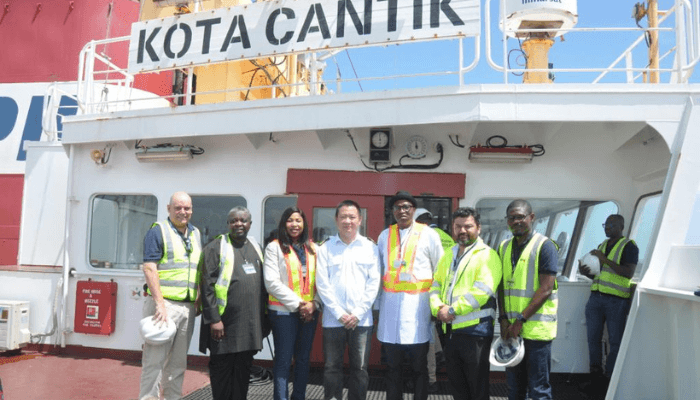
Over the weekend, APM Terminals Apapa, operator of Nigeria’s busiest container terminal, received the biggest containership to ever call at the Lagos Port Complex (LPC) Apapa.
Named Kota Cantik, the Singapore-flagged ship, which is operated and managed by Pacific International Lines (PIL), has the capacity to lift about 6,606 Twenty-foot Equivalent Units (TEUs) of containers.
Built with a draught of 11.6 meters, a length overall (LOA) of 300 meters, and a beam of 40 meters, the vessel graced Nigerian waters after two ships of a similar size called Tin-Can Island and Lekki Ports.
“We are excited at this historic achievement. We thank the Nigerian Ports Authority for maintaining the channels and for professionally piloting the vessel to the port. Without the effort, support, and approval of NPA, this would not have been possible,” Steen Knudsen, terminal manager of APM Terminals Apapa, said during the reception of the ship.

He said one of the advantages of bigger vessels is economies of scale through lower slot costs for consignees.
“Carrying a higher number of containers per vessel would translate into lower capital and operating costs per container, thereby reducing the transportation cost per unit. Also, since bigger vessels consume less fuel per container transported, the emissions per TEU are lower than smaller vessels. Thus, bigger vessels like the Kota Cantik are more environmentally friendly and contribute to lower the total emissions of the shipping industry,” Knudsen said.
Read also: Shippers Council gets commendation for sanitising ports, improving efficiency
Kevin Taylor, the managing director of PIL Nigeria, said consignees and the Nigerian economy will benefit from the vessel call.
“The customers in Nigeria have more opportunities to get cargoes in Lagos and also for competitive exports,” Taylor said.

On his part, Charles Okaga, port manager of Lagos Port Complex Apapa, said he was excited about the vessel’s berthing, barely two weeks into his resumption at the port.
“The port is the major trade facilitation platform and when vessels of this type berth, it reduces the cost of shipping and consumer goods. But if you pay less for shipment and logistics, the landing cost will also reduce, and that reduces inflation while strengthening the ability of people to afford consumer goods,” Okaga said.
Daniel Osiakagum, harbour master of Lagos Pilotage District, said the milestone had put the Nigerian Ports Authority on the map of nations with the capacity to handle 300 meters and above.
“We are ready for 350 to 400-meter vessels in Lagos Pilotage District. This means that waiting time will be reduced outside and Nigerian Ports Authority will make more revenue for the government,” he added.
Karan Tariyal, head of Operations at APM Terminals Apapa, expressed delight at the berthing of the containership at the terminal.
He also commended the management of the Nigerian Ports Authority (NPA) and the NPA Harbours department for their approvals and professional handling of the ship.
Also speaking, Temilade Ogunniyi, the commercial manager of APM Terminals Apapa, said, “The bigger the vessels you berth, the lower your cost and this leads to economies of scale. It also improves the pace of the operations at the terminal, leads to efficiency, reduces waste, and delivers a faster turnaround time of vessels, which is a huge benefit to the economy.”