… President of all Africa SMEs leads experts at Wider Perspectives 10th SME Conference to seek a new boost to the economy
Africa must find a financing and lending template to boost the small and medium enterprises (SME) segment of its economy to dream of joining continents that create growth of their economies.
This is as stakeholders and financial experts have agreed that SMEs must be supported to scale up and grow if the continent wished to experience development because, there can be no economic development without growth.
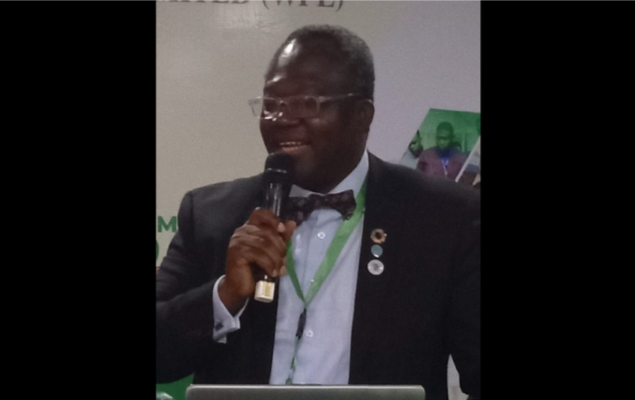
Ebiekure Jasper Eradiri, President of the All Africa SMEs, who was keynote speaker at the Wider Perspectives 10th SME Conference in Port Harcourt, made it clear that the way out for Africa is to find a lending method and boost critical areas of the economy such as agric, entertainment, tourism, ICT, and challenge what banks say to deny loans to businesses.

Above all, he said, Africa must invest in growth of SMEs to boost African economy because trade and investment are important in the Africa Continental Free Trade Agreement (AfCFTA) era when countries would need to think wider and better.
Eradiri, who was pioneer secretary-general of the All Africa Association of SMEs, once a senior special assistant to a governor in Bayelsa State, south-south Nigeria, reminded the stakeholders of the existence of 100m SMEs in Africa with Nigeria accounting for 40m, and West Africa for 50m. He said this shows that Nigeria and West Africa accounts for 50% of SMEs in Africa.
He said Wider Perspectives group is doing well by focusing on promoting and building up SME capacities in Nigeria. He said definition of who is a small or medium business is very important because it informs what you can do for SMEs. “We crave for an Afrocentric model of financing which will recognize the informal sector in Africa as the main sector.”
He said the challenge is that the existing template for financing businesses is from the colonial masters and is not suitable to African needs. It is rigid, he stated, saying; “If you want to help Africa to develop, then create an Africa-focused template.”
The good news, he revealed, is that “We now have an African definition of what an SME is. In 2024, some 55 African countries ratified what an SME is in Africa. SMEs form 80% of African economies.”

Eradiri said the African template shows that micro business is less than $1m annual turnover; small business is between $1m and $5m; and medium business is between $5m and $20m. “There is need to look at the economic importance of SMEs in Africa. For instance, bankers insist on credit history of the borrower but our rural businesses do not have this history or even collateral.
“We must simplify loan template in Africa. For instance, why can’t we use the degree certificate of a graduate to grant loan so he/she can start off a venture? Loan conditions must be reviewed.”
He also observed that most regulations stop businesses instead of being an enabler. He mentioned access to market as an issue. On investment opportunities in Nigeria an Africa, he said it is about collaboration, integration, and cooperation. “Banks consider SMEs as high risk but SME contribution to GDP is high. Jumia is a good case study in Nigeria. At the beginning, many people doubted it, but now, it has recorded 81,000 buyers and sellers.”

South-South and BOI funds – Irabor
An engineer who is now a financial expert, Pacqueens Irabor of the Bank of Industry (BOI), shook the SME Conference when he disclosed figures to show there is money for Rivers people and South-South to lift for businesses.
Irabor, who was business development manager for BOI in the south-south said by 2020 when he came, the entire south-south got less than N4.4bn as loans. Now, he said, the zone has hit N20bn.
He said Rivers in 2020 got N2.3bn but now in 2025 has hit N7bn with N1.5bn so far disbursed by May 2025. He said in SME products, Rivers got N4bn through RIMA (Rivers Micro Finance Agency) partnership. “The scheme is doing well. They have another product called RAPID. It focuses on rural businesses. It has 40% grant component but you will get it when you repay the 100% loan, then we give you back 40%.”
On the N75bn MSME fund, he said it is part of the N200bn loan fund. “Over 20,000 persons have got the loan at 9% interest rate. As long as you have registered business, you are eligible. The fund is waiting. Tell your people.”
Irabor noted that the SME Conference is very important because the most powerful resource still remains the word. When men gather and speak, things happen, he stated.
He revealed that BOI works with Wider Perspectives group. “We must make it clear that you do not scratch the surface and get gold. You must dig deep. Businesses must have wider perspectives to think broadly and understand all perspectives to take accurate financial and business decisions. You need to look for wider markets. When you do a business plan, let it connect to the aspirations of the wider society such as a link to at least one of the MDGs.”
Proper perspectives:
Giving proper and wider perspectives of the SME Conference, Chamberlain Peterside, a former commissioner for finance in Rivers State who is the director-general of the Rivers State Investment Promotion Agency (suspended due to state of emergency), laid a path on the back of Kalada Apiafi, chairman of the Wider Perspectives group, for doing so much for SMEs as a visioner.
Peterside, who is the CEO of Xcellent Capital, said all businesses including the likes of Apple started as an SME, noting the SMEs were regarded as very important. He said RIPA prioritises SMEs, and so set up one-stop-shop (virtual yet). He said Rivers State is fertile ground for businesses and investments.
“We have been working with Port Harcourty city Chamber and Wider Perspectives, etc. “We focus on SMEs because big companies are comfortable, they do not need much help. Its SMEs that come for help. RIMA, the Rivers State Micro Finance Agency, is back, giving out about N4bn loans to SMEs. Testimonies abound. Life must go on despite state of emergency.”
In his goodwill message, the managing director of RIMA, Jonathan Tobin, said the N4bn loan scheme was going on. “We encourage entrepreneurs to come up with business proposals. State of emergency has not stopped us. We are giving and recovering loans despite it. Keep pushing ahead. The micro business space is tough. Get close to us. The BOI/RIMA partnership is working.”
PHCCIMA beckons more SMEs on:
Chinyere Nwoga, first female president of the Port Harcourt Chamber of Commerce, Industry, Mines, and Agriculture (PHCCIMA), represented by Emeka Ezekwe, head, professionals trade group, showed how much they have helped SMEs, saying the conference package was very good.
In his own personal remark, Ezekwe said in Nigeria, businesses survive by luck, not by plan. He said support system is not there, but that PHCCIMA helps with business-to-business linkage especially abroad. He urged businesses to be resilient.
Presenting Nwoga’s address, he said: “SME is the engine of society and when an enterprise crashes, society loses because people suffer. So, let all of us help SMEs as the MD of WPL advocated.
“Government should partner with the PHCCIMA to do more. We urge business owners to join PHCCIMA to push for better economic policies. SMEs matter. They account for 84% of all employments in Nigeria.”
For Rivers State, he said more entrepreneurs need training. “They engage more in the agric, entertainment and tourism sectors, but insecurity and instability are affecting SMEs. Poor access to funds, bureaucracy, etc, are part of the setback.”
She said PHCCIMA will continue to support SMEs and that they are ready even for economic evangelism or door-to-door advocacy to convince more Rivers people to join entrepreneurship. “We call on government to provide security, training, business incentives, diversification, etc.”
On the way forward, she mentioned diversification, ICT support, tech hubs, PPP, business incubator, etc, needed but that they are doable because “You choose your best future.”
Target for SME drive – Apiafi
In tracing the history of SME advocacy, Kalada Apiafi, chairman of the board of Wider Perspectives group, said the target is to make the SME value chain a vibrant segment of the Nigerian economy as it is in most other countries.
He said: “We need to press on with advocacy, and need to press on with creating enabling environment for SMEs to thrive such as roads, trains, security, etc. Tax reforms came through advocacy which was started by Faith Foundation with Policy Dialogue series. Let us not be too quiet. Insist on getting the kind of country we want.
Apiafi, who is known as the ‘SME Visioner’, said his journey in SME vision began with a book he read in 1983 which he said inspired him. “I have been involved in preparing feasibility studies but I have found that feasibility studies rather deter startups by scaring away SME dreamers. We began at a time there were no many support agencies for SMEs other than a unit in the Ministry of Commerce. Then, the Small and Medium Enterprises Development Agency of Nigeria (SMEDAN) was born. This added to the places one could go to for SME matters.
“We fought it from policy support objectives, pressing the FG and state governments to do what can support SMEs. We helped in the creation of ‘One-LGA-One-SME’ policy, believing that if each of the 774 LGAs in Nigeria develop one SME, it will boost the economy.
“We helped the NDDC come up with its Master Plan in the SME section. Transformation has been going on. No economy develops without enabling economic environment.
“We all complain about tailors and their failure to meet dates given to their patrons (customers). Business environment includes support services which SMEs provide. A tailor abroad would never fail you on the date he gave. No stories. He will give you the first date to test the cloth, then give you final date when you surely will collect it. In Nigeria, the Obalande tailors are catching up. They have found a way of meeting mass orders at short notice. No stories.”
He said the SME conference series came to solve the problems they identified such as Finance, Capacity building, Tech, Access to market. “Now, we bring solving agents together including the regulatory agencies to look for solution.
“We are aware that entrepreneurs hate regulators while public sector people see private sector operators as crooks. We in the middle know that it is not always so. (Abia seems most advanced in SME matters because the SMEs have a bit of self-regulation).
“We pushed on and it was Abia that first caught the vision, then much later, Akwa Ibom, later Rivers, now Bayelsa. That is the power of partnership.”
He appealed to governments to allocate budget to SMEs. “That is the challenge we have noticed. The Ministries partnering us usually complain they do not have provision in their annual budgets for SME matters. So, we hereby call on state governments to provide for SMEs such as their events in their annual budgets.
“Japan understands the power of SMEs and does everything possible to push them and help them scale up. They even do feasibility studies for them free and also guarantee their loans. These things help water the SME environment in their countries.
“Nigeria seems different. We also understand why loans are now difficult in Nigeria. This is because most of those who took loans from industrial funds in Nigeria never intended to pay back.”
For the sake of the economy, Apiafi said, “We need to decentralize Nigeria. We are not practising true federalism, so it’s better we allow regions develop at their own paces. States should be allowed to compete and let LGAs copy from each other. Now that we have created a BAAR states zone, people now willingly come from faraway states to participate in our economic development programmes.
“We appreciate corporate bodies and individuals that have supported the SME vision and the SME Conference series over the past 10 years.”
He agreed that state of emergency should not be the end of businesses: “We are private sector operatives. The economy has to move on. It is not easy to operate in the private sector.”
How WPL boosted 5000 SMEs – Hanson
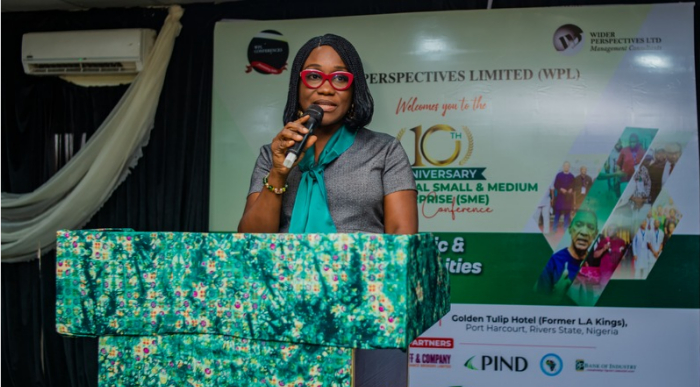
Edughom Hanson, the managing director of Wider Perspectives Limited (WPL), said the Small and Medium Enterprise (SME) Conference was founded on a singular, transformative vision: to serve as a vital catalyst for the robust development of SMEs across Nigeria. “Our core belief has always been that thriving SMEs are the true engines of economic growth, job creation, and sustainable national development.
“The concept for the SME Development initiative stemmed from the insights gained from an International Labour Organization (ILO) book on SME Development Policies and Programmes. During our participation in the World Bank and Nigerian Investment Council’s MSME Programme (BDS Programme), we observed the potentials of SMEs. A significant gap, a lack of structured platforms for knowledge sharing, capacity building, effective mentorship, and inter-state business collaboration. This observation led to the birth of our first SME conference in Abia State.”
She went on: “Our primary objective expanded beyond mere education to actively fostering business linkages, creating networking platforms, enhancing access to finance, and facilitating wealth and job creation for SMEs. These conferences were strategically focused on the contiguous states of Bayelsa, Abia, Akwa Ibom, and Rivers collectively identified as the BAAR states. These regions, while possessing substantial entrepreneurial drive, often faced limited access to broader markets and collaborative opportunities. Our aim was to dismantle geographical silos, creating a dynamic ecosystem where SMEs across the four states could connect, exchange ideas, form partnerships, access new supply chains, and identify new regional markets. This strategic focus on linkages was designed to amplify the individual strengths of businesses by leveraging collective opportunities.”
From its inception, she said, the conferences primarily operated across the four BAAR states. “Our inaugural event, the “Abia State Small and Medium Enterprise (SME) Investment Forum,” took place in October 2013. This was followed by the “Akwa Ibom State Small and Medium Enterprise (SME) Roundtable” in November 2015, the “Business Linkages Forum Port Harcourt” in October 2016 (in collaboration with the Foundation for Partnership Initiatives in the Niger Delta (PIND) and the Port Harcourt Chamber of Commerce, Industry, Mines and Agriculture (PHCCIMA)), and the “Business Linkages Forum Yenagoa” in November 2018 (in partnership with the Bayelsa State Government and the Yenagoa Chamber of Commerce, Industry, Mines and Agriculture (YECCIMA)).
“These conferences were systematically rotated across the BAAR states to maximize accessibility and localized impact.
In 2024, the conferences evolved, merging these four distinct state-focused events into a unified annual “WPL SME Conference.” The first of these consolidated events was hosted in Akwa Ibom State, and June 2025, it is being hosted here in the heart of Rivers State, carrying forward that original vision.
Over the past decade, we have had the privilege of hosting over 50 conferences, welcoming more than 20,000 participants, both physically and virtually.
“Our initiatives have yielded tangible results:
187 Micro, Small, and Medium Enterprises (MSMEs) have accessed ₦224 million in funding; 493 new employment opportunities have been created through our interventions; we have built the business capacity of over 4,983 SMEs; and over 293 MSMEs have been successfully linked to markets.
“The remarkable journey and success of the SME Conference are a testament to the collective effort of the dedicated WPL Team, our esteemed partners, and generous sponsors who believed in our vision. Our initiatives have directly contributed to the establishment and significant growth of thousands of SMEs, fostering entrepreneurship, facilitating crucial knowledge transfers, creating invaluable networks, driving job creation, promoting innovation and resilience, and contributing significantly to local economies.
The conference has truly become a beacon for entrepreneurs, empowering them not just to grow their individual businesses but to contribute to a more integrated and resilient regional economy. Testimonials from participating SMEs consistently highlight the direct benefits of connections made at our conferences, leading to new distribution channels, successful joint ventures, and the sharing of best practices that have undeniably propelled their businesses forward.
In essence, the SME Conference has evolved into a cornerstone event for SME development, successfully uniting the entrepreneurial spirit of the BAAR states and cementing valuable business linkages that continue to drive regional prosperity.
Conclusion:
The bell for regional economic integration and convergence seems to have sounded in Port Harcourt but is Port Harcourt ready, with all the State of Emergency and absence of organized governance to continue where the Rivers Economic and Investment Forum stopped and where the RIPA was about to launch? The hint from the WPL 10th SME Conference is that the BAAR states are about to fly: Abia has taken off, Akwa Ibom has joined, Bayelsa seems eager to fly, but when will Rivers wake up and free itself from the chains.