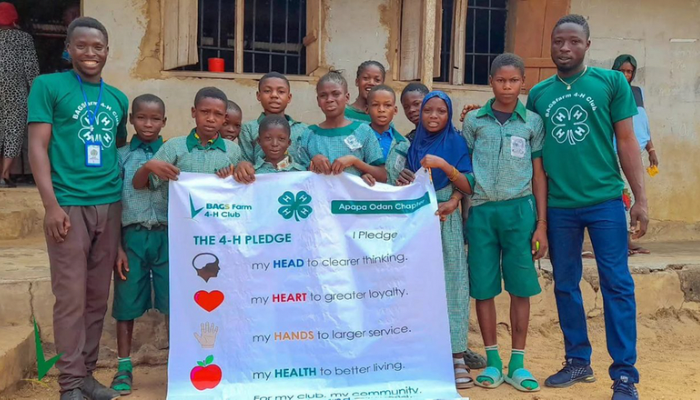
Adeoti Adebayo, the founder of Bani Agribusiness Solutions (BAGSfarm), shares his inspiring journey and the transformative work his organisation is doing to promote agricultural education, rural development, and youth empowerment in Nigeria. In a recent interview with Chinwe Michael, he shares how BAGSfarm is not only enhancing food security but also fostering economic development and creating opportunities for youth and smallholder farmers.
What inspired you to pursue this path?
Growing up in Nigeria, he witnessed firsthand the challenges faced by rural farmers: limited access to education, outdated farming techniques, and a lack of support for youth interested in agriculture. Despite agriculture being a major source of livelihood, many rural communities lacked the knowledge and resources to maximise their potential. This realisation fueled his passion for agricultural education and rural development.
Adebayo’s journey officially began during his undergraduate studies in Agricultural Extension and Rural Development at the University of Ibadan. where he actively engaged in community projects focused on agricultural training and youth empowerment. In 2018, he registered BAGSfarm and began operations. Seeking further knowledge, Adebayo pursued a Master’s degree in Agricultural and Extension Education at New Mexico State University, where he expanded his research to study the impact of 4-H and FFA programs on local food systems in the U.S. Inspired by these models, he knew he wanted to bring similar initiatives to Nigeria to equip young people with agricultural skills and foster rural development.

Can you give us an overview of Bani Agribusiness Solutions?
Bani Agribusiness Solutions is an agricultural enterprise dedicated to developing rural communities through agriculture. Our mission is to empower rural dwellers with agricultural education, innovative solutions, and practical training that enhances food security and economic development. We believe that agriculture is more than just farming—it’s a tool for transforming lives.
Through our initiatives, we aim to bridge the knowledge gap in rural communities, promote sustainable farming practices, and create opportunities for youth and smallholder farmers to thrive in the agricultural sector.
Since its inception, how has BAGSfarm grown, and what key milestones have you achieved?
Since our establishment in 2018, BaGSfarm has made remarkable strides in empowering rural communities. One of our proudest achievements is the launch of Nigeria’s first 4-H Club in a rural primary school. We introduced the 4-H School Enrichment Program at Apapa Odan Community Primary School in Ibadan, providing students with practical agricultural education. This initiative aims to expose young learners to modern farming techniques and agribusiness opportunities, fostering a new generation of agricultural innovators.

Beyond education, we have expanded our agribusiness activities to include commercial farming of peppers, cassava, and maize. We also offer consultancy services to farmers and agribusiness startups, helping them navigate the challenges of modern agriculture. Another milestone is the development of a sustainable agribusiness model that includes a palm wine distribution network, event catering services, and a logistics arm to facilitate efficient farm-to-market transport.
Building strategic partnerships has been instrumental to our growth. We collaborate with local educators, agricultural extension officers, and international networks to enhance our agricultural education programs.
What strategies have you employed to sustain and grow the business?
Our sustainability strategy is built on four key pillars: diversification, community engagement, leveraging technology, and training.
Diversification allows us to maintain multiple revenue streams by operating across various agricultural sectors, including education, consultancy, logistics, and agribusiness services. This approach reduces risk and ensures business continuity.
Community engagement is at the core of our work. We believe that empowering rural communities through training programs fosters long-term partnerships and builds local support. Our training initiatives not only enhance farming skills but also create opportunities for youth and smallholder farmers to thrive.
We also embrace technology to drive growth. Digital platforms play a crucial role in disseminating agricultural knowledge, while innovative farming techniques improve productivity. Our logistics arm uses technology to streamline the farm-to-market supply chain, ensuring that produce reaches consumers efficiently.
Additionally, we invest in capacity building by educating the next generation of farmers and agripreneurs. This commitment to training ensures the long-term sustainability of the agricultural industry and helps us stay ahead in a rapidly evolving sector.
Can you explain the 4-H Program and its significance to your work?
The 4-H Program is a globally recognised youth development initiative that focuses on hands-on learning in agriculture, leadership, and life skills. Originating in the United States, 4-H empowers young people through experiential learning, helping them develop practical skills and a sense of responsibility.
The program’s core objectives are embodied in four key areas: Head, Heart, Hands, and Health. “Head” emphasises enhancing knowledge and problem-solving skills, “Heart” focuses on fostering responsibility and leadership, “Hands” encourages practical, hands-on experiences, and “Health” promotes well-being and sustainable living.
In Nigeria, we introduced the 4-H Program to rural primary schools to bridge the knowledge gap and inspire a new generation of agricultural leaders. Through the program, students gain early exposure to modern farming practices, agribusiness opportunities, and leadership skills. This initiative is transforming how young people perceive agriculture, turning it from a subsistence activity into a viable career path.
How does BAGSfarm leverage technology to drive growth?
Technology is revolutionising agriculture by making it more efficient, sustainable, and profitable. We utilise digital platforms to share agricultural knowledge and engage with farmers, this approach not only extends our reach but also allows us to provide real-time solutions to agricultural challenges.
Our logistics arm leverages technology to optimise the farm-to-market supply chain, ensuring that produce is transported efficiently and with minimal losses. We are also exploring innovative farming techniques, such as precision agriculture, to improve yields and reduce waste.
What is the long-term vision for BAGSfarm, and how do you plan to contribute to Nigeria’s agricultural development?
Our vision is to transform rural communities through agriculture, empowering people with the knowledge and resources to improve their livelihoods. We are committed to expanding the 4-H Program and agricultural education initiatives to more schools across Nigeria. By equipping young people with practical skills, we aim to inspire the next generation of agricultural leaders and innovators.
We also plan to establish agribusiness training centers to provide hands-on education for young farmers. These centers will focus on sustainable farming models, helping to promote food security and create employment opportunities. Furthermore, we are committed to building strong partnerships with stakeholders to improve agricultural policies and foster a supportive environment for smallholder farmers.