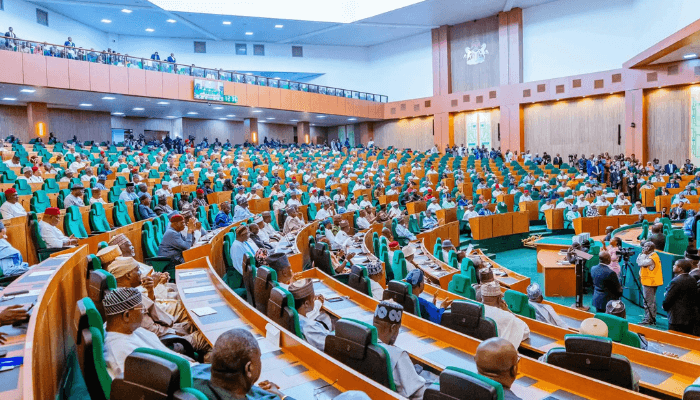
Political analysts and governance experts have criticised a proposed bill in the House of Representatives seeking to impose an age limit on political officeholders. According to them, the move is unnecessary, irrelevant, and does not address the real issues affecting leadership in the country.
The proposed legislation is titled, “A Bill for an Act to Alter the Constitution of the Federal Republic of Nigeria, 1999 to Review the Requirements that Qualifies a Persons to be Elected as President and Vice-President of the Federal Republic of Nigeria, Governors and Deputy Governor of a State of the Federal Republic of Nigeria and for Related Matters (HB.202), was sponsored by Ikeagwuonu Ugochinyere.
The Bill which is one of the dozens of constitutional amendment bills that scaled second reading last week at the Green Chamber, proposes amendments to Sections 131 and 177 of the 1999 Constitution (as amended), raising the minimum educational qualification from a Senior Secondary School Certificate (SSCE) to a bachelor’s degree from a university. It also introduces an upper age limit of 60 years for candidates.
Read also: Nigeria’s resource control bill sparks debate on political stability, regional disparities

Analysts and Nigerians applauded the minimum education standard, but however argue that while vibrant leadership could come with some advantages, leadership should however be determined by competence, experience, and character rather than age. They knocked lawmakers that they clearly have nothing better to do, but waisting resourced on a bill that is dead on arrival as the president and governors will not endorse it.
Weighing in on the matter, Chinedu Obi, director-general of the Inter-Party Advisory Council (IPAC), described the bill as lacking substance and a distraction from the real issues affecting governance.
“Lawmakers want energetic leadership, but what we should be concerned about is qualification. We should define the criteria for leadership instead of focusing on age,” Obi said. “In states like Delta and Kogi, governors in their 40s have been elected, yet we cannot directly link their performance to their age in terms of delivering the dividends of democracy.”
He further noted that globally, older politicians have successfully led their nations. “Donald Trump and other world leaders are well above 60, yet their age has not hindered their governance. There is no correlation between age and performance. What truly matters is capacity, competence, integrity, and track record,” he added.
Political and economic analyst Bakkare Al-Majeed criticised the bill as poorly thought out and unrealistic.

“The legislative process should be more strategic. Laws cannot be retrospective—many politicians are already over 60. Would state assemblies pass a bill that disqualifies their governors? Would President Tinubu, who is over 70, assent to a law that effectively excludes him? That would be political suicide,” Al-Majeed argued.
Read also: Reps rescission on immunity bill seen as shield for corrupt leaders
He suggested that if an age limit were necessary, it should be set at 75 or 80 to accommodate experienced leaders. “We should be more concerned about a leader’s mental state and capacity r ather than an arbitrary age cap,” he added.
Abuja-based politician Innocent Awuzie echoed similar sentiments, stating that mental acuity and health should be the primary considerations.
“Globally, many leaders above 60 govern effectively. While the motivation behind this bill may be to create space for younger politicians, we must recognise that many older individuals are still mentally sharp and capable of handling the pressures of leadership. Wisdom comes with experience, while youth brings energy—it’s about striking a balance, not setting an unnecessary limit,” Awuzie said.
Imonokha Enakhena, political economist said, noted that while some might argue that an upper age limit ensures that officeholders are physically and mentally fit for the demanding roles of presidency or governorship, a constitutional argument would typically favor evaluating an individual’s capability rather than using chronological age as a strict cutoff.
“The debate also touches on broader questions about representation and the value of experience. Many would contend that political wisdom and expertise often come with age, and a rigid age cap might unjustifiably exclude seasoned leaders from contributing to national governance”, he said.
Read also: Bill for same-day presidential, governorship elections passes second reading in Senate
Nigerians also expressed their views on social media, a user with the handle ‘Allshop ‘ wrote on X , “Yahaya bello way that is the Youngest Governor, Betta Edu, the youngest minister, minister of humanitarian affair how far. Is changing our mindset, not changing age. Age has nothing to do with leadership infact the older the wiser”.
Adebayo Ayorinde also wrote, “Age limits on elective political positions. What is this ? You guys are not busy at all.”
Michael Emiabata wrote that age limit was just mere discrimination., and that, “There are important things to disuss in the Chamber but not this.”
John Imare believes that, “There is no evidence that age influences bad leadership.”