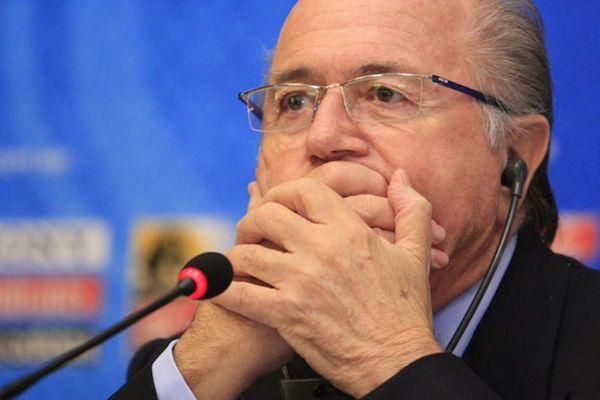
Embattled FIFA president, Sepp Blatter on Tuesday June 2, 2015 resigned, four days after being re-elected to a fifth term in office. The 79-year old announced the decision at a news conference at the FIFA headquarters in Zurich, Switzerland.
Blatter governed the biggest sport franchise on Earth for nearly two decades, for years untouched personally by allegations of corrupt practices, but never admitted to any wrong doings.
He manipulated football and never responded to public outcry. He surrounded himself with core loyalist, many of whom he raised from obscurity to lead powerful national and regional federations. He put them in control of billions of dollars for TV contracts, endorsements of national teams and where the biggest tournaments were held.
Over the last few years, he replaced many of his deputies who were indicted for scandals and took credit for helping clean up the mess.

After 17 years of reign and bringing the biggest game events to new heights, the pressure became too much. The world’s largest football nations were in open rebellion and discussing an alternate tournament to the World Cup. Sponsors from the world’s most-popular soft drink to best-selling video game questioned their ties to FIFA.
On Tuesday, Blatter said he plans to resign and admitted he had lost too much support to remain in office, a decision he hastily announced. But did not take responsibility for the huge corruption scandals under his watch.
He declared he was now free from constraints and could clean up the game the way he has wanted to.
As FIFA thrived through allegations of bribery, vote-buying and World Cup ticket scams, 79-year-old Blatter built a strong base of support by bolstering the sport in developing countries and brought the first World Cup to Africa.
On May 27, US prosecutors issued indictments against 14 current or former football officials – including seven arrested in raids at a luxury Zurich hotel. The Swiss also opened a criminal investigation into votes awarding the World Cup tournaments to Russia in 2018 and to Qatar in 2022.

Even though he was not implicated in those investigations, Blatter faced calls for his resignation that came from some of his harshest critics in the game as well as from political leaders.
His re-election to a fifth, four-year term last Friday was a reflection of the support he enjoyed by giving each of FIFA’s 209 member federations a basic yearly sum of $250,000, plus bonuses and project funds from World Cup profits.
FIFA’s revenue was about $560 million in 1998 when Blatter took over and $5.7 billion last year, boosted by huge increases in media and marketing rights sales.
FIFA had 137 members in 1970 and 190 when Blatter succeeded Joao Havelange, and 19 have been added – for the most part small nations that lack economic might and football pedigree.
Blatter used the revenue to build football in underdeveloped countries and boost support for himself. According to FIFA’s website: “The organisation has given nearly $11.9 billion in financial assistance, and has helped fund 698 projects under its Goal Programme and 3,844 technical activities.”
Even when scandals polluted FIFA’s prestige and image, most of the officials stuck by Blatter, particularly from small nations in Africa and Asia.
Since 2010, executive committee members Amos Adamu (Nigeria), Chuck Blazer (United States), Vernon Manilal Fernando (Sri Lanka), Mohammed bin Hammam (Qatar), Reynald Temarii (Tahiti) and Jack Warner (Trinidad and Tobago) were suspended. Nicolas Leoz (Paraguay) and Ricardo Teixeira (Brazil) quit following corruption allegations.
Current executive committee member Jeffrey Webb (Cayman Islands) and expiring member Eugenio Figueredo (Uruguay) were suspended last week along with executive committee member-elect Eduardo Li (Costa Rica) after they were indicted in the US on racketeering and money laundering charges along with Warner and Leoz. Blazer pled guilty to 10 counts.
Shortly before his last re-election in 2011, FIFA was rocked when Hammam, his only challenger pulled of the presidential election, and Warner was suspended because of bribery allegations in what was described as the organisation’s worst scandal in its history.
“Crisis? What is a crisis? Football is not in a crisis,” Blatter said before he won a one-man election that was mocked as a coronation.
Blatter devoted more than half his life to working at FIFA, as technical director, chief executive and, since 1998, as president.
He learned a lot from Havelange. The imperious Brazilian presided over FIFA for 24 years – last 17 with Blatter as chief administrator. During that time, sports marketing became as a booming industry that could be bent to the will of federation leaders.
The decisions to hand the World Cup hosting bids in 2018 and 2022 to Russia and Qatar caused much controversy relating to the various human rights issues raised throughout the two host nations. Blatter insisted that there were no grounds for the decisions to be reviewed, even after widespread illegitimate practices were unearthed by FIFA’s own anti-corruption investigation.
After Qatar was handed the rights in December 2010 to host the 2022 World Cup, the Swiss was asked what might be done about the nation’s ban on homosexuality. His response was unconvincing in the least. “I’d say they should refrain from any sexual activities,” he replied, attracting the ire of the LGBT community and beyond.
Blatter’s inability to judge the mood of the modern world regarding every day social issues was again highlighted when he was asked to make a comment on the issues surrounding Luis Suarez’s ban for racially abusing Patrice Evra in 2011. “There is no racism, but maybe there is a word or gesture that is not correct. The one affected by this should say ‘this is a game’ and shake hands.”
Also, Blatter said gay visitors to the 2022 World Cup should “refrain from any sexual activities” while in Qatar because of the Gulf nation’s strict laws against homosexuality. He later apologised.
In 2004, Blatter said women should consider playing in “tighter shorts” to bring more attention to the game. He told the Swiss newspaper SonntagsBlick, “In volleyball the women also wear other uniforms than the men. Pretty women are playing football today. Excuse me for saying that.”
Anthony Nlebem
@AnthonyNlebem