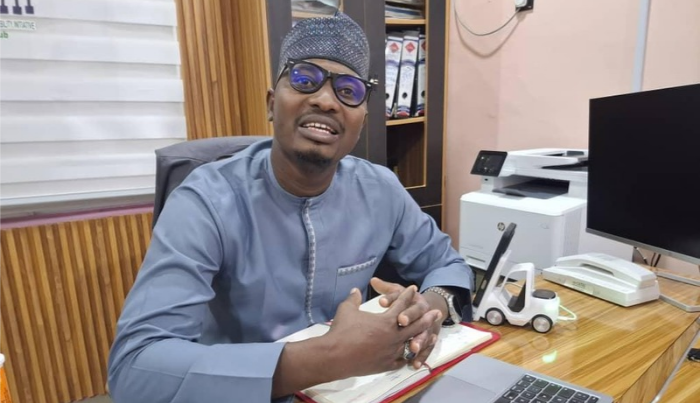
Abubakar Sadiq Mua’zu is the executive director Centre for Advocacy Transparency and Accountability Initiative (CATAI), Global Malala Education Champion, and accountability crusader. In this interview with OLATUNJI OMIRIN, he spoke on youths’ participation in governance and other critical issues around nation building. Excerpt:
Kindly tell us how you ventured into the accountability and transparency initiative?
The journey has been rough, tough, a lot of sacrifice, determination, focus have been the key things that make us to be consistent in what we do. Particularly, if you get to see this, you will realise that when we started as national organisation. The issue was; did you have the money to intervene? Did you even have the skills to act or to change the life of people, but we changed the narrative to show to people that it’s not about the resources, not about the money, but about the little knowledge that you’re going to put into use for people to believe in you.
So, these are key things that we have been working to see that we document evidences to the need of people. We document all of these key issues affecting our society to show to the greater world that these people need help. I can recall times without number that I go to trainings without even having transport fare, just to learn and understand how this humanitarian space work so as to add value to the life of this children and people in needs. So, these are key things that we have been doing. These are key things that have been happening over the past period of years within the journey. And today, I can tell you that I’m glad that we have quite a number of amazing young people within the organization adding value across Borno, Yobe and Adamawa states, close to 120 people. Aside from volunteer staff that are working under us and this showcase that when local partners, when nationals, raise up to their responsibility, they can complement the effort of government. We believe we are just out there to compliment the effort of government.

As government collect taxpayers’ money, it is their responsibility to provide services, but most importantly, what you need to understand or what you need to do as citizen is, how can you complement the effort of this government so as for people to have access to some of these needs, especially in humanitarian context.
So, accessibility is a major thing, that even when you have the humanitarian items that a response that you want to provide, you cannot have the access thereby worsening the humanitarian crisis of livelihood of people; shelter as well as water sanitation and hygiene and education.
In recent months the scale of humanitarian response in BAY states has slowed down due to USAID funding cut. What is your take on this?
Exactly, the impacts USAID funding cut is huge but we must device a means to sustain the lifesaving intervention. The government must rise to the occasion, they should fill in the gaps in absence of these US fund cuts; so, the government needs to strategically come in by conducting a huge level of resource mobilisation, through mobilising more resources, even via taxpayers’ money and putting effective accountability framework that will account for the resources that we are being mobilized. So, as it to add value to the people in need, you can’t collect tax without being accountable to the money that you have collected. So, I want to encourage the governments, even if they are increasing the values of taxes, the values of everything to mobilise resources must be for the betterment of the life of people, they should develop an accountability framework that will showcase how the utilisation of those funds that were being collected is to be accounted. With this, government can conveniently fill the vacuum created by USAID funding cut.
Could you describe how difficult for citizens demanding accountability in Nigeria?

It is extremely difficult.
Can you explain?
It is extremely difficult in the sense that a lot of duty bearers tend not to feel they should be accountable to citizens that even brought them to office; extremely difficult in the sense that duty bearers that provide service tend to think they are helping you or assisting you. Rights are turned to help when right supposed to be right. So, I believe institutions that are set out there that are supposed to do the work need to intensify effort to be accountable for citizens, not just be answerable to the leaders that brought them into the public office.
Since you started accountability and transparency campaign, have you received any threat whatsoever?
Well, threats come in different ways.
Threats can even come from the citizens that you are amplifying and advocating for their rights. Yes, I have received threats on different occasions. People need to be well aware of their rights as citizens. Some of them even feel that the representative that is giving them N10,000 or N5,000 that you are asking them to hold him accountable is doing them a favour. And sometimes, you experience threat of you shouldn’t come to my office. If you do, the security shouldn’t let you in.
Read also: Nation building requires perseverance, patriotism – Tinubu
So, how could you describe a level of awareness in terms of demanding transparency from public office holders in Nigeria?
I think with the Open Government Partnership that put funds to the table of a lot of state governments and agencies, it has been a bit open in terms of access to information, unlike before. We need to do much more better. Transparency and accountability in Nigeria are something that any administration is coming with new plan, but the implementation has been a difficult one. So, it is time to re-write the wrong to see that policies or system that were being put in place are not just to hunting opposition or hunting people that are not the favorite of the government, but the government to do the right thing.
Your organisations recently released annual reports. What inform your decisions to do so?
Well, for us, we believe we are accountable to the people that we serve. That is why we need to be accountable with all the resources that we have to ensure that these people to know what given to us is being accounted for. We release our annual report to showcase what we have done, to showcase the challenges that we have encountered, and as well, to propose and align to citizens to understand what we need and what we are going to do in the coming year. So it has been a difficult right, a roller coaster right for the past year, in terms of 2024 with different set of disasters, both humanitarian disasters, and the flooding that happens in the north east, particularly in Borno, where huge level of displacement happened to quite a number of people that once upon a time, host other displaced persons in their homes also became displaced persons; it has been difficult; we try to mobilise resources and provide the needed support to the people in needs.
You are one of the people who are calling for action plan for proper response to natural disaster mitigation. Can you shed more light?
Yeah; so, I believe for us as an organisation, we have been advocates towards disaster response management in Nigeria; we even set a task team and a youth group that we had a dialogue on the post-flood response that happens so as for young people to contribute their input to the frameworks that need to be developed. So, we are advocating for government to see young people as partners in progress, not young people as threat and keyboard wireless. Because young people to some extent, have been relegated to just becoming media aides in different administrations of government, only few administrations and responsible governments realise the potential ideas and the value young people have. I believe it’s high time for various stakeholders, particularly elected officials, to understand that everything without them is not for them. So, everything without young people is not for young people. Young people need to champion the cost of governance. I’m excited whenever I recalled how young and amazing, passionate people that contributed significantly in state like Kaduna becoming head of agencies at 28 or 29 which is very rare to find across some of states.
These young people will go to bring knowledge without those bureaucratic bottlenecks to fill in those gaps. It must surprise you to know that you may be at the ministry to spend almost three four months without understanding what is being functioning. So, it is time for us to start thinking what those innovations are. How can those innovation be put in a proper perspective to add value to the life of people? Young people need to be given the platform. So, for us, we are always advocating and amplifying the voices of these young people to see this thing is being done rightly.
What are the challenges youths have been facing in the northeast?
Sometimes, when you meet with people before you speak, they look down on you, but by the time you open your mouth and start speaking, it tends to be the eye opener for them and the door opener for us to start the conversation. So, the challenge is not just about limited skills or limited capacity, but our people in those positions don’t believe young people and what value youths can add to the system.
People tend to believe that lack of resources by young people is one of impediment that works against young people. Do you agree or disagree?
To some extent, the way the country is being programmed, I agree with that lack of resources can be an impediment, but availability of the skills can be an opportunity for youths to go up. That is why you see a whole lot of young people that have the skills and potential that can work remotely, or that are leaving the country. We need to build our capacity in terms of accessing the opportunity and platforms. I believe young people need to form coalitions. Young people need to form groups. Young people need to come together to amplify for their course. Young people need to mobilize resources for their needs.
Young people need to form together to mobilise resources. Nobody can give you power without fighting for it; there is nobody in Nigeria in an elective position that can drag your hand as a young person to say that, oh, I’m bringing you to give you the power as a young person, you need to work for it. You need to fight for it. You need to look for how best you can promote and be sure that the interest of young people is there. To the young people, to the young generation, we should all stand up collectively to be the change we want to see, to build a society that will be a better one for the upcoming generation and also to be the shoulder for each and every one of us that we can lean on, so as to promote, to collaborate, and to ensure that we get things done rightly. Young people in the BAY states they have suffered.
You claimed young people in BAY states have suffered. How?
The 15 years of insurgency have affected the growth and development of young people in BAY State. Despite the crisis, they are resilient. It’s something that needs to be imbibed or to be learned upon the young people in other parts of Nigeria. They are resilient people even with ugly situations they working hard, they are doing their businesses, in promoting their initiatives and in promoting good things that will add value to the society. To the young people in North East, it’s a moment to appreciate their resilience and continue to build that trust with the old generation to make the society a better one.