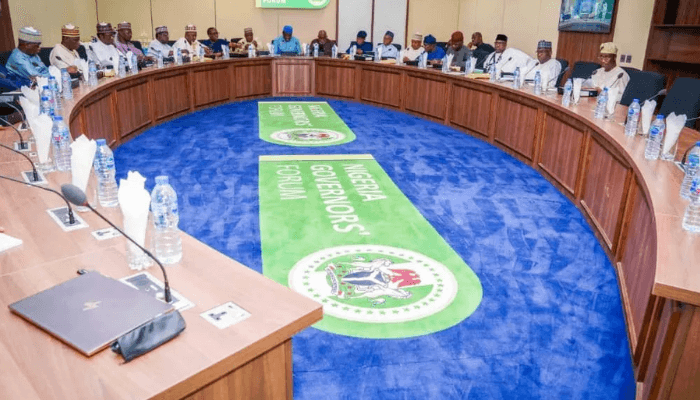
The Nigeria Governors’ Forum (NGF) says all 36 states have raised their 2025 education budgets to ₦3.6 trillion, reflecting a 53 per cent increase from 2024.
NGF Chairman, Gov. AbdulRahman AbdulRazaq of Kwara, disclosed this at the opening of the Nigeria Education Forum in Abuja on Tuesday.
He described the development as “a strong commitment to sector reform,” according to remarks delivered on his behalf by the Forum’s Director-General, Dr Abdulateef Shittu.
He said Nigeria’s youthful population created “an extraordinary opportunity for strategic and systemic investment” if states maintained consistent policy direction.

AbdulRazaq noted that states spent ₦1 trillion on education in 2022, rising to ₦1.6 trillion in 2023 and ₦2.4 trillion in 2024.
He said the 2025 budget growth was driven by “a 69 per cent rise in capital allocations,” signalling deeper investment in infrastructure.
He warned that weak execution remained a major concern, citing “₦800 billion in unspent capital funds in 2024.”
He said six states, comprising Lagos, Kano, Enugu, Kaduna, Katsina, and Abia, were projected to spend ₦1.8 trillion on education in 2026.
He added that Kano, Enugu, Kaduna, and Abia planned to allocate up to 32 per cent of their 2026 budgets to education.

“We expect two-thirds of the states to meet the global 15 per cent benchmark for education spending in 2026,” he stated.
He said heavy debt servicing continued to limit some states’ ability to hire teachers, strengthen Technical and Vocational Education and Training (TVET) systems and upgrade tertiary institutions.
He warned that failure to address this gap could undermine the long-term sustainability of education reforms across the federation.
Minister of Education, Maruf Alausa, said education transformation “is underway” under the Nigeria Education Sector Renewal Initiative (NESRI).
Alausa, represented by Minister of State, Suwaiba Ahmad, said policy gains had been recorded but structural challenges remained.
He listed persistent gaps in access, equity, infrastructure and teacher development as issues demanding coordinated intervention.
He said NESRI was established to deliver system-wide reforms under President Bola Tinubu’s Renewed Hope Agenda.
He said reform efforts were advancing across six priority areas, including Science, Technology, Engineering, Mathematics, Medicine (STEMM) education, TVET and quality assurance.
Alausa said 202,000 schools had been digitised on the national EMIS platform, with 21 states uploading complete datasets.
He added that 35,000 out-of-school children had been reintegrated into formal schooling through collaborative programmes.
Read also: Analysing the impact of low education budget allocations on future generations
He said 5,600 TVET teachers were trained, 479 programmes accredited and 250,000 students enrolled in certified institutions.
He said the AGILE project provided scholarships to 577,863 girls, while LUMINAH 2030 supported second-chance learners in 12 states.
Alausa said 482,342 students received NESRI scholarships, while over 828,000 applications were processed nationwide.
He noted that ₦9.7 billion had been disbursed to 12,434 students through bursary schemes across the federation.
He added that ₦4.05 billion was awarded to 8,535 students under federal scholarship programmes.
The minister urged states to accelerate alignment with NESRI and address gaps limiting transitions to secondary school.
He said the data showed “a frightening pattern,” with only 10 million of 30 million pupils reaching Junior Secondary One.
He said the collapse was driven by shortages of junior and senior secondary schools and long distances in rural locations.
Alausa also cited cost barriers, insecurity and inadequate state investment in foundational learning at community level.
He said government was partnering with states to expand infrastructure and enforce 12 years of compulsory basic education.
He added that states were urged to develop alternative learning pathways and strengthen teacher deployment in underserved LGAs.
He said the reforms sought to “build a resilient system capable of supporting Nigeria’s long-term human capital ambitions.”