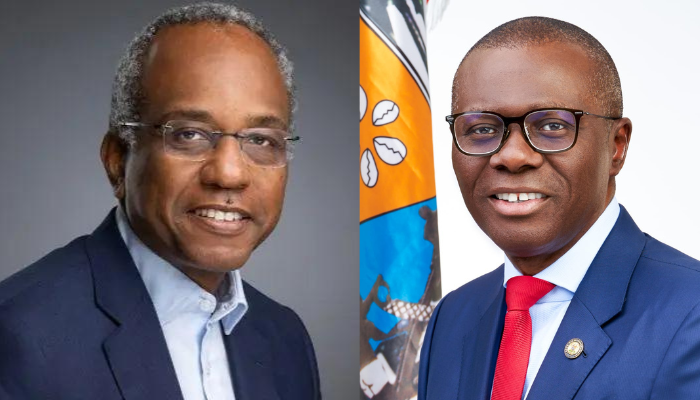
Funso Doherty, former Lagos gubernatorial candidate, has raised alarm over the reported 54.3% failure rate among the state’s public school students in the 2024 West African Senior School Certificate Examination (WASSCE), describing the figure as a “deeply troubling” indictment of the state’s governance over the last two decades.
In an open letter dated April 26, 2025, addressed to Governor Babajide Sanwo-Olu, Doherty cited revelations by the state’s commissioner for Basic and Secondary Education during a recent ministerial briefing that 31,000 out of 58,188 students who sat for the exam in Lagos State public schools failed.
“This figure is deeply troubling,” Doherty wrote. “In a state with a predominantly youthful population, it serves as a harsh indictment of governance outcomes over the past 26 years, spanning the current and previous administrations since 1999. It reflects a disconnect between the priorities of government and the pressing needs of the less-privileged majority.”
He further warned that the poor academic outcomes signaled “a failure of leadership to safeguard the future of the most vulnerable” and posed a serious threat to the state’s long-term development goals.

Criticising the government’s focus on revenue generation without corresponding improvement in citizens’ welfare, Doherty stated, “Governance must be measured not just by revenue growth but by how those resources improve lives.”
To address the crisis, Doherty outlined an eight-point urgent action plan, including calls to:
Double the budgetary allocation to education from 7% to at least 14% within the next two to three years;
Expand investments in primary education to strengthen foundational learning;
Scale up technical education to equip students with workforce-ready skills;

Improve teacher quality and availability through competitive pay and consistent monitoring;
Introduce standardized testing to benchmark learning progress;
Provide free and accessible transportation for students in uniform up to secondary school;
Develop strategies to reduce the number of out-of-school children;
Introduce tracking mechanisms to measure the effectiveness of reforms.
“Let us be clear: though long in the making, this is an emergency,” Doherty emphasised. “If we fail to address it, the long-term social and developmental consequences will be severe and far-reaching. We must act now.”