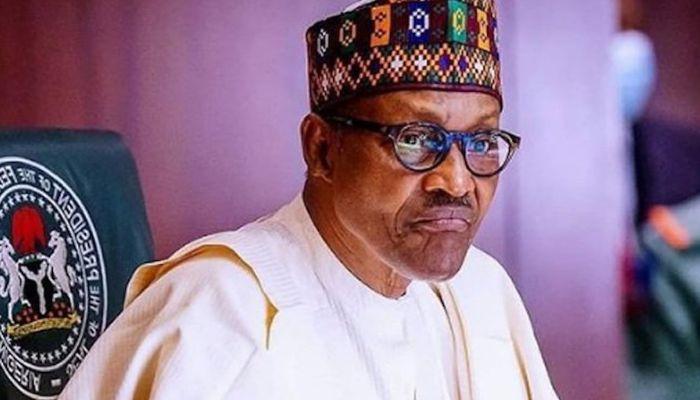
Muhammadu Buhari, Nigeria`s President between 2019 to 2023, and former Military Head of State, has been committed to mother earth in his home town of Daura, Katsina State, North West Nigeria.
Buhari, a retired General of the Nigerian Army, former state military governor of old Borno state, and commissioner for petroleum resources, was committed to the earth after a full military compliment, in a state funeral concluded at his residence, located in GRA, along Mai ‘Adua, in Daura, on Tuesday.
The former President was lowered into his grave at his residence, at exactly 5.53pm, with a 21 Gun salute by a detachment of military personnel, after his citation was read by General Christopher Gwabin Musa, the chief of defence staff.
The lowing of the corpse of the late President into grave was presided by President Bola Tinubu, and the Vice-President Kashim Shettima, and the family members, and Governor of Katsina state, Dikko Radda.

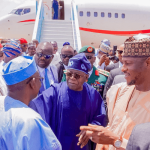
Before his interment, President Tinubu had led his family members, top dignitaries, including serving, and former governors, serving, and former senior government officials to receive the body of the late president, at his residence in Daura.
Read also: Buhari’s body lands in Daura for burial
The corpse was conveyed to his residence from Katsina in Nigerian Army `s Ambulance, and was pulled to the graveside by the Pallbearers, constating of Generals of the Nigerian Armed Forces, at 5.27pm, where President Tinubu, and Vice-President Shettima, were on hand to receive it.
After the corpse was willed to the graveside of the Generals of the Armed Forces, Senior Security Chiefs, top dignitaries, and family members, including the son of the late President, Yusuf Buhari, formed a ring around the body wrapped in national flag.
The chief of Defence Staff, General Musa, then read the citation of the late leader, and prayers, where said for the repose of his soul, and on completion of the citation, the national colour used to wrap the corpse, was folded, and it was handed over to President Tinubu, who in turn hand it over to one of the late President Family members.

Earlier, a one-rakat an Islamic prayer led by the Chief Iman of Daura, was said for the repose of his soul of the late President at the Palace of the Emir of Daura, Farouk Umar Farouk.
Former President Buhari joined the Nigerian Army in 1961 when he was admitted to the Nigerian Military Training College, Kaduna. He underwent the Officer Cadets training at Mons Officer Cadet School in Aldershot, England from 1962 to 1963, and was commissioned as Second Lieutenant in January, 1963. He attended the Nigerian Military College, Kaduna for the Platoon Commanders’ Course from 1963-1964.
He was then appointed Platoon Commander of the Second Infantry Battalion in Abeokuta. In 1965, he attended the Mechanical Transport Officers’ Course at the Army Mechanical Transport School in Borden, England. Further military trainings included the Defence Services Staff College, Wellington, India in 1973, and the United States Army War College, from June 1979 to June 1980.
As a highly regarded officer, President Buhari held several key command and staff, as well as political appointments during his illustrious military career. These included Military Secretary; Member, Supreme Military Council; Military Governor of the North Eastern State; Federal Commissioner of Petroleum Resources; Chairman, Nigerian National Petroleum Corporation; General Officer Commanding, 4thInfantry Division and General Officer Commanding, 3rdArmoured Division.
Read also: Katsina stands still to receive Buhari’s body
The military coup of December, 1983 led to the emergence of General Muhammadu Buhari as Head of State and Commander-in-Chief of the Nigerian Armed Forces, a position in which he served until August 1985.
General Buhari was appointed Executive Chairman of the Petroleum Trust Fund (PTF) by the Abacha administration in 1994. The main consideration in appointing him to this position was his strict discipline and incorruptibility.
The PTF under General Buhari intervened directly in six major areas: Construction/maintenance of roads; water supply; supply of educational materials and rehabilitation of educational infrastructure; health; food supply; and other projects. The impact of this interventionist agency was felt across the entire nation in its four and a half years of existence.
Driven by a profound sense of patriotism and commitment to national service, General Buhari entered politics in 2003, following Nigeria’s return to a democratic dispensation in 1999. He joined the All-Nigeria People’s Party (ANPP) and contested the presidential election on its platform that year.
He lost to the presidential candidate of the People’s Democratic Party (PDP) Olusegun Obasanjo. Undaunted by defeat, Buhari continued his political struggle, and on December 18th, 2006, he emerged as the consensus presidential candidate of the All-Nigeria People’s Party for the 2007 elections.
His main challenger in the April 2007 presidential polls was the ruling PDP candidate, Umaru Yar’Adua. In the election, Buhari officially scored 18 percent of the total votes cast, against 70 percent for Yar’adua. Buhari rejected the results and in a post-election statement, Yar’Adua affirmed that the polls were indeed less than free, fair and credible. After Yar’Adua assumed office, the ANPP agreed to join his purported government of national unity, but Buhari denounced the agreement.
In March 2010, Buhari left the ANPP and formed, with some of his supporters, the Congress for Progressive Change (CPC). General Buhari was nominated as the CPC presidential candidate on April 16th, 2011 for that year’s general election.
He ran against the then incumbent, President Goodluck Jonathan of the ruling PDP, Mallam Nuhu Ribadu of the Action Congress of Nigeria (ACN), and Ibrahim Shekarau of the ANPP, and other candidates of smaller parties. Using the platform of the CPC, a newly formed party without much finance and essential party structures in the states, Buhari was able to garner 12, 214, 853 votes, coming second to Goodluck Jonathan of the PDP, who polled 22, 495, 197 votes.