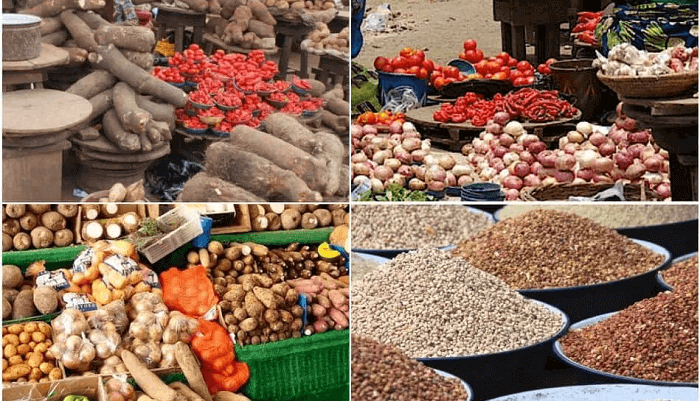
Amid an increase in food supply across Abuja’s markets, prices—though lower than last year—remain high for many residents struggling to afford basic staples.
A market survey shows that the cost of a 50kg bag of local rice, which sold for as high as N75,000 in 2024, has decreased to between N63,000 and N65,000, while a small bucket (‘mudu’) now sells for N2,200, down from N2,500.
Similarly, a bag of foreign rice now sells for N80,000–N85,000, with the cost of a ‘mudu’ ranging between N2,000 and N3,500.
The downward adjustment extends to other major staples. A bag of white beans now costs N95,000, while brown beans sell for about N110,000, both reflecting notable decreases from last year’s prices of N130,000–N140,000.

Read also: Why food prices are dropping
BusinessDay checks show that cooking oil prices have also eased slightly, as a 25-litre keg of groundnut oil now sells for around N73,000, while palm oil goes for about N65,000.
But while the federal government is claiming success, some traders said it is too early to celebrate, as Nigerians are yet to feel the effect of such positive development
Aliyu Abdullahi Sabi, minister of state for Agriculture and Food Security, credits the drop to improved local production and government intervention programmes.
“From 2023, we went into massive production through the NAGS Agro-Pocket Programme. We injected almost 500,000 metric tons of wheat and similar volumes of maize, cassava, and other crops. This ramped-up production is what’s responsible for the drop in food prices,” Sabi said.

However, traders say the reduction is minimal and has not translated to real relief for consumers.
“We still buy at high prices from suppliers because everything has gone up — diesel, transportation, and even packaging,” lamented Musa Garba, a grain dealer at Dutse Market.
According to the National Bureau of Statistics (NBS), Nigeria’s headline inflation rate eased slightly to 20.12 percent in August 2025, attributed partly to declining staple food prices nationwide. Yet in Abuja, market rates still exceed the national average by as much as 20 percent, reflecting persistent cost pressures in the capital.
“The prices are getting better, but they are still high compared to what people earn,” said a trader in Wuse Market.
For many households, the slight decline offers little comfort. “Before, I could buy a ‘mudu’ of rice every two days, but now I have to manage what I buy for a whole week,” said Aisha Abdullahi, a mother of four in Kubwa.
Read also: ADC accuses FG of manipulating food prices, weaponising poverty for political gains
Farmers warn of unsustainable costs
Peter Dama, national chairman of the RIMAN-Rice Millers Association, noted that farmers are still under pressure from high input and logistics costs.
“Farmers are producing at very high costs, yet they are being asked to lower prices without negotiation or subsidy,” Dama said. “If production costs are not addressed, asking us to reduce prices means operating at a loss.”
He called for greater stakeholder involvement, warning that top-down directives may not yield lasting results. “If the government sits with associations, we can work out realistic strategies. But imposing policies without support measures won’t solve the problem.”
Daniel Onyejuwa, an economist, argued that the president’s recent call for price reductions is not sustainable without tackling deeper structural issues.
“Inflation in Nigeria is largely cost-driven — tied to production challenges, forex volatility, labour costs, and poor infrastructure,” Onyejuwa told BusinessDay.
He noted that the high cost of transportation remains a key factor pushing food prices upward. “Transportation and logistics costs directly affect food prices. When trucks spend days on bad roads, it adds to the final cost borne by consumers,” he said.
Onyejuwa also cited poor road networks, inadequate storage facilities, and low productivity as major obstacles. “Most farm produce are perishable. When yields are high, farmers rush to sell before spoilage, but the cost of moving goods from farms remains steep due to bad roads and fuel prices.”
He further observed that the rice import embargo continues to limit supply relative to demand. “Local production is improving, but still far below consumption needs. Until that gap is closed, prices will remain relatively high.”
While the government celebrates signs of moderation in food prices, both farmers and consumers remain cautious.
“The farmer carries the heaviest burden,” Dama reiterated. “Without addressing input costs — fertilisers, transport, and labour — prices may drop temporarily but won’t stay down.”
Read also: FG attributes drop in food prices to boost in local production
Onyejuwa described the president’s push to crash prices as “well-intentioned but more political than economic.”
“He’s showing empathy for the masses, but real relief will only come when the root causes — energy costs, infrastructure, and production bottlenecks — are fixed,” he said.
For now, Abuja’s residents remain caught between government optimism and market reality — paying slightly less than before, but still too much for comfort.
As Nigeria enters another harvest season, stakeholders say inclusive dialogue, targeted subsidies, and infrastructure investment will be key to turning temporary relief into lasting food affordability.