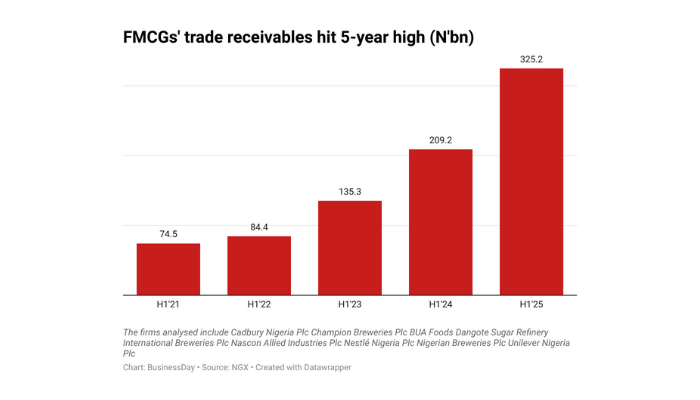
Nigeria’s fast-moving consumer goods (FMCG) sector’s half-year credit sales hit a five-year high on the back of inflationary pressures, weaker consumer spending, and changing household buying patterns.
Recent figures show that credit sales in the sector climbed to N325.2 billion in the first half of the year, a 55.4 percent increase from the N209.2 billion reported in the same period of last year, underscoring how companies are relying on extended payment terms to keep products on shelves and sustain market share.
Among the surveyed firms, International Breweries Plc reported the highest credit sales during the period, amounting to N123.3 billion, followed by Nigerian Breweries with N119.2 billion and Nascon Allied Industries Plc with N37.4 billion.
Others include Dangote Sugar Refinery (N27.6 billion), Cadbury Nigeria Plc (N7.7 billion), Nestlé Nigeria Plc (N4.59 billion), Unilever Nigeria Plc (N4.16 billion), Champion Breweries Plc (N963 million), and BUA Foods (N251 billion).

“Credit sales are now a survival tool for the sector,” said Uchenna Uzo, professor of Marketing at Lagos Business School. “It helps manufacturers keep products in circulation while giving retailers breathing room, even though it exposes companies to higher risks of defaults.”
He added that consumers are not buying in large volumes, as more people are choosing to buy in smaller packs than before.
Ayodeji Ebo, the managing director/chief business officer at Optimus by Afrinvest Limited, said demand for producers’ goods is low as a result of shrinking demand or a constrained consumer wallet.
“The reduction in the availability of credits to manufacturing companies has also made them reduce their credits to their own consumers through their distributors,” he added.
Analysts say the growth in credit sales reflects a sector adapting to consumer realities. Rising prices have forced many distributors and retailers to lean more heavily on credit to sustain stock levels, while manufacturers have been reluctant to tighten supply lines for fear of losing volumes in a competitive market.

Read also: FMCG firms eye sustained recovery from FX losses in H2
Weak consumption and the sachet economy
According to data from the Nigeria Buy Now Pay Later Business Report 2025, the BNPL payment market in Nigeria is expected to grow by 13.8 percent on an annual basis to reach $1.62 billion in 2025.
And by the end of 2030, the BNPL sector is projected to expand from its 2024 value of $1.42 billion to approximately $2.61 billion, the report said.
At the same time, the purchasing behavior of Nigerian consumers continues to evolve. Households are down-trading to smaller pack sizes, cheaper brands, and promotional offers, ensuring that demand remains resilient but skewed towards affordability.
The Nigerian Bureau of Statistics (NBS) report on “Nigerian Gross Domestic Product Report (Expenditure and Income Approach) (Q1, Q2 2024),” published in July 2025, the data reveal a troubling trend: real household consumption expenditure has been declining since Q3 of 2023.
Specifically, household consumption expenditure fell by -42.28 percent in Q1 2024 and -61.18 percent in Q2 2024, reflecting lower rates compared to the same quarters in 2023.
Kalu Aja, a financial expert, said this sharp decline in consumption is one reason many foreign multinationals are exiting Nigeria; Nigerians today struggle to afford anything priced in dollars, including imported PMS (Premium Motor Spirit).
“Consumption is weak due to stagnating wages and rising inflation. Companies attempt to stimulate sales by repackaging 500g items into 50g sachets. This sachet economy traps consumers in a cycle of inflation, making it impossible for them to bulk buy and escape rising prices,” he added.
Inflation eases, sector profitability improves
What is different today, however, is the operating environment. Inflation, while still high, has eased from record peaks, and the naira has shown signs of stability after months of steep depreciation.
Nigeria’s headline moderated to 21.88 percent year-on-year in July, down from 22.22 percent recorded in June, data from NBS disclosed.
According to analysts at FBNQuest, the easing in July’s inflation reading was driven by a high base effect and improved stability across key inflationary drivers.
The report showed that at the divisional level, the three major contributors to the headline inflation were food and non-alcoholic beverages (8.75 percent), restaurants & accommodation services (2.83 percent), and transport (2.33 percent), while the least contributors were recreation, sport, and culture (0.07 percent), alcoholic beverages, tobacco, and narcotics (0.08 percent), and insurance and financial services (0.10 percent).
Read also: Five FMCG firms post turnaround profits in Q1 amid recovery hopes
The naira has been largely stable and remained unwavering even in the face of global crises that saw emerging market currencies weaken against the dollar. Naira has been within 1500/1550 per `dollar bandwidth, boosting earnings of businesses exposed to foreign exchange.
At the Nigerian Foreign Exchange Market (NFEM), the naira fell slightly by N1.6 as the dollar closed at N1,535.47 on Friday, August 28, compared to N1,537.07 quoted the previous day, according to data from the Central Bank of Nigeria (CBN).
Despite these challenges, FMCG companies have managed to sustain topline growth this year, though much of it has been driven by price adjustments rather than volume expansion.
Data compiled by BusinessDay revealed that eight listed consumer goods firms reported a combined after-tax profit of N481 billion in the first six months of the year, compared to N140 billion reported in the same period of last year, as local sourcing of raw materials has also helped to cushion the impact of foreign exchange volatility, reducing some of the cost pressures that plagued the sector in previous years.
Nigerian Breweries and Nestle Nigeria reported the highest after-tax profit, amounting to N88 billion and N51 billion after years of losses.
Uzo added that many consumer goods companies are now better positioned to navigate macroeconomic headwinds, as market conditions have become relatively more stable than last year.
“However, it’s not that consumers are buying significantly more,” he explained, “but firms have implemented price increases, which have, in some cases, led to a doubling of profits.”
According to the latest Stanbic IBTC Purchasing Managers’ Index (PMI) report. The headline PMI climbed to 54.0 in July, up from 51.6 in June, marking a three-month high and signalling a solid improvement in business conditions.
The PMI has now remained in positive territory for eight consecutive months, with readings above 50.0 indicating expansion.
“Improved customer demand, partly due to softening inflationary pressures and the launch of new products, supported the uptick in business activity,” the report noted.