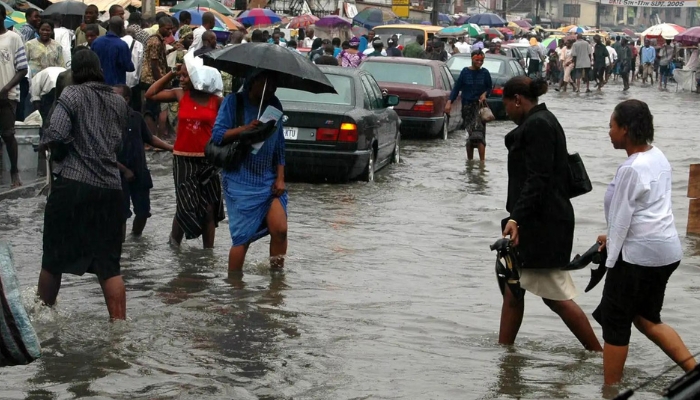
When torrential rain swallowed parts of Lekki and Victoria Island last July, homeowners waded through waist-deep water and watched their property values sink almost as fast. In Nigeria’s commercial capital, where a plot of land can cost as much as ₦400 million, each flood leaves more than puddles; it erodes confidence, investment, and the illusion of permanence. What once looked like prime real estate is now a case study in climate risk.
Across Lagos and other economic hubs, the impact of flooding on property values is no longer hypothetical. It is measurable, material, and market-moving. The Nigerian Meteorological Agency (NiMet) estimates that Lagos alone lost over ₦200 billion to flooding in a single year. Meanwhile, property analysts report that homes and commercial buildings in flood-prone areas, once the pride of Nigeria’s urban expansion, are seeing stagnant or even declining values, as investors and buyers begin to factor in repair costs, rising insurance premiums, and the unpredictability of the weather.
But the real issue runs deeper than heavy rain. It lies in the fragile infrastructure that fails to protect the most expensive square miles of real estate in West Africa. Lagos is not short of buildings; it is short of drainage. Decades of poor planning, unregulated construction, and clogged waterways have left vast portions of the city vulnerable to every downpour. When key roads and bridges flood, businesses grind to a halt. During the 2022 rainy season, Lagos State reportedly lost over ₦100 billion in transport costs due to damaged infrastructure. That figure represents more than inconvenience; it’s a direct hit to productivity, logistics, and investor confidence.
For investors, this is not just an environmental story; it is a valuation story. Floods are now silently rewriting the rulebook of property pricing. Areas that once commanded premium rents are losing their appeal. The Lekki–Ajah corridor, for instance, still boasts glossy billboards and luxury marketing, but the reality on the ground tells a more sobering tale. Landlords complain of recurring losses, while tenants, wary of damage to property and vehicles, are opting for safer, drier alternatives in parts of Ikoyi, Yaba, or even mainland suburbs with better elevation.

Read also: NEMA to adopt data management, early warning to mitigate flood disaster
This trend is reshaping investment logic. Developers who once focused solely on location and aesthetics must now think like environmental engineers. Drainage, elevation, and soil absorption capacity are fast becoming as critical as granite countertops. The new question in every property deal isn’t just “How much is the return?” but “Will it flood?”
Globally, this shift is already mainstream. Major investment firms now use climate-risk assessment tools to model flood probability and heat exposure before buying property portfolios. In markets like Singapore, Dubai, and South Africa, urban planners integrate flood-resilient infrastructure into city blueprints, from elevated roads to permeable pavements. Nigeria, however, remains behind this curve, often treating flooding as an annual inconvenience rather than a capital risk.
This attitude has consequences. Investors who fail to factor in environmental resilience may find themselves holding stranded assets, properties that look impressive on paper but have no sustainable market value. On the other hand, developers who prioritise sustainability stand to gain a long-term advantage. Firms such as Lomel Homes Ltd, for instance, are showing what a data-driven approach to real estate looks like: studying soil composition, drainage patterns, and terrain before construction begins. Their model aligns with a growing global consensus that sustainability is not a luxury; it is a survival strategy.
Government policy must catch up to this new reality. Lagos and other state governments need to embed environmental risk metrics into land allocation, permitting, and building approvals. Infrastructure resilience should be a precondition for development, not an afterthought. The National Infrastructure Master Plan offers a good starting point, but its ambitions will only matter if cities implement local drainage and waste management reforms. Equally important is private-sector participation, through Public-Private Partnerships (PPPs), in financing flood-resistant roads, canals, and energy systems.

Investors must also adjust their due diligence frameworks. Before purchasing land or funding developments, they should insist on flood-risk maps, environmental audits, and infrastructure assessments. What seems like an extra cost today could prevent catastrophic losses tomorrow. Property valuation firms, for their part, need to integrate climate-adjusted valuation models, aligning Nigeria with global best practices that treat environmental risk as financial risk.
The truth is that flooding is no longer a seasonal nuisance; it is an economic disruptor. And like inflation or exchange rates, it now demands a place in every investor’s calculation. If we keep ignoring the link between environmental degradation and property value, we risk turning our cities into billion-naira liabilities.
Lagos may be the test case, but the warning is national. From Port Harcourt to Benin City and Abuja, urban flooding is steadily eroding not just roads and homes but the credibility of our growth narrative. Nigeria cannot aspire to become a trillion-dollar economy while allowing its infrastructure to crumble under rainwater.
The way forward lies in intentional urban planning, resilient infrastructure investment, and data-led decision-making. The investors who understand this and adapt will not only preserve their assets but also define the next phase of Nigeria’s real estate evolution. Because in the property market of the future, the smartest investment won’t just be location. It will be an elevation.