|
Getting your Trinity Audio player ready...
|
The implementation of the Micro, Small and Medium Enterprises Development Fund (MSMEDF) continued with the disbursement of a total of N87.28 billion so far to beneficiaries.
The CBN launched the MSME Development Fund on August 15, 2013 with a share capital of N220 billion. The Fund was established in recognition of the significant contributions of the Micro, Small and Medium Enterprises (MSME) sub-sector to the economy and the existing huge financing gap.
The CBN’s half year economic report show that in June 2017, a total of N1.59 billion was disbursed compared with N16.53 billion in the corresponding period of 2016. The financial institutions that participated in the programme were six banks, three Microfinance Banks (MFBs), six non-governmental organisations microfinance institutions (NGO-MFIs) and 12 cooperative societies. In addition, one state government accessed funds under the programme in the review period.
The total sum disbursed from inception in 2012 to date was N87.28 billion, with N63.19 billion (72.4%) to state governments, while the micro, small and medium enterprises (MSMEs) collectively accessed N24.1 billion (27.6%). The total sum of N15.39 billion was repaid in the review period. The sum of N23.51 billion had been repaid from inception to end of June 2017.

The CBN hosted the Alliance for Financial Inclusion (AFI) – a global network of policy makers/regulators instrumental to developing and promoting financial inclusion strategies in member-countries. Delegates from Mozambique, Senegal, Lesotho, Seychelles, Sierra Leone, and Bhutan attended the 5-day programme to understudy the Nigerian financial inclusion strategy development & implementation processes.
Although, according to the World Bank’s Global Findex Database released 19, April 2018, Nigeria was left behind in global rising financial inclusion, and as such the country is in need of financial inclusion champions to help quicken access to financial services by its populace.
“Financial inclusion is on the rise globally, accelerated by mobile phones and the internet, but gains have been uneven across countries,” the World Bank said in a statement.
Nigerian adults who are 25 years and above with bank accounts declined by 5 basis points from 49 percent in 2014 to 44 percent in 2017.
This was not different with account holders over 15 years, as their numbers fell 4 percentage points from 44 percent in 2014 to 40 percent in 2017, as compiled from the latest World Bank’s Global Findex Database.

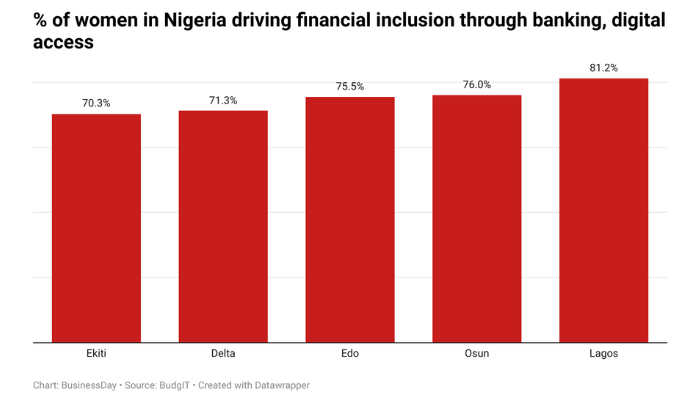
The data shows that 51 percent of Nigerian males had a bank account in 2017 compared to the 27 percent recorded for females; this brings the gap between the male and female to 24 percentage points.
This is however a bigger than the 20 percentage points gap that was recorded in 2014 when the total male with an account was at 54 percent with females at 34 percent.
In 2011, just 30 percent of Nigerian’s who are 15 years and above had an account with a financial institution; however there was an improvement with 44 percent in 2014, while in 2017 it falls to 40 percent.
HOPE MOSES-ASHIKE