|
Getting your Trinity Audio player ready...
|
Lateef Fagbemi, the Attorney-General of the Federation and Minister of Justice, has disclosed that the Federal Government (FG) is working on a National Alternative Dispute Resolution Policy framework to harmonise ADR standards across Nigeria.
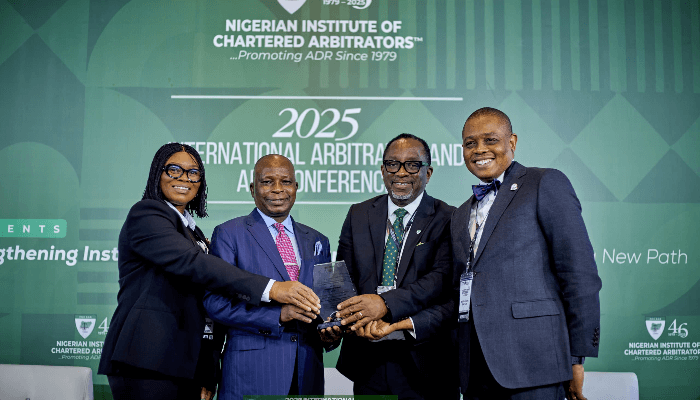
Fagbemi made this known in Lagos during the 2025 International Arbitration and ADR Conference, with the theme, ‘Strengthening Institutional Arbitration and ADR in Africa: Charting a New Path.’
According to him, the policy framework will deepen arbitration by accrediting practitioners to promote sector-specific dispute mechanisms in industries such as oil and gas, construction, and finance.
He also promised expanded judicial training, mentorship programmes for young arbitrators, and increased opportunities for women, stressing that Africa must not only participate in global arbitration but lead it.

“Government will lead by example,” Fagbemi said, indicating that there is a need to deepen institutional collaboration. According to him, the future of arbitration rest on the quality of training, while credibility depend on enforcement,
The AGF also disclosed that Africa is on the brink of transformation, emphasising that sophisticated businesses required strong dispute-resolution mechanisms, particularly under the African Continental Free Trade Area (AfCFTA). “Arbitration and ADR are engines of stability and the foundation for inter-regional trade.”
Babajide Sanwo-Olu, Lagos State governor, stated that the Lagos state government has been deliberate in placing ADR at the core of commercial conflict resolution, especially with the Lagos Court of Arbitration and the Lagos Court of Commercial Contracts as models of institutional strength.
Represented by Lawal Pedro, Lagos State Attorney-General, Sanwo-Olu questioned why African disputes were often sent to foreign jurisdictions despite the continent’s wealth of skilled arbitrators, reputable institutions, and modern facilities.
“For decades, Africa has been a centre of global investment, yet the mechanisms for resolving the disputes arising from these transactions are not always reflected on our continent. Investors want predictability, fairness, efficiency, and credibility. African disputes can be resolved at home with dignity, fairness, and global standards.”

Afam Osigwe, President, Nigerian Bar Association (NBA), urged lawyers to commit to resolving more cases through ADR, stressing the need for Nigeria to retain commercial disputes locally rather than losing huge revenue to foreign jurisdictions.
He warned that Nigeria risked losing its credibility as a commercial hub unless lawyers, arbitrators, and institutions took urgent steps to strengthen decisional efficiency and reduce reliance on prolonged court litigation.
“Many approach arbitration with the same adversarial mind-set as litigation, which defeats its purpose. The Arbitration and Mediation Act 2023 provides a modern framework, but its success depends on how responsibly we use it.”
Fabian Ajogwu, President/Chairman of Council, Nigerian Institute of Chartered Arbitrators (NiCArb), called for a continent-wide overhaul of arbitration and ADR systems. According to him, Africa must take ownership of its destiny in commercial dispute resolution.
“Africa does not lack expertise; what it seeks is coherence. We must move from fragmented excellence to institutional cohesion if we are to lead in global arbitration,” Ajogwu said.