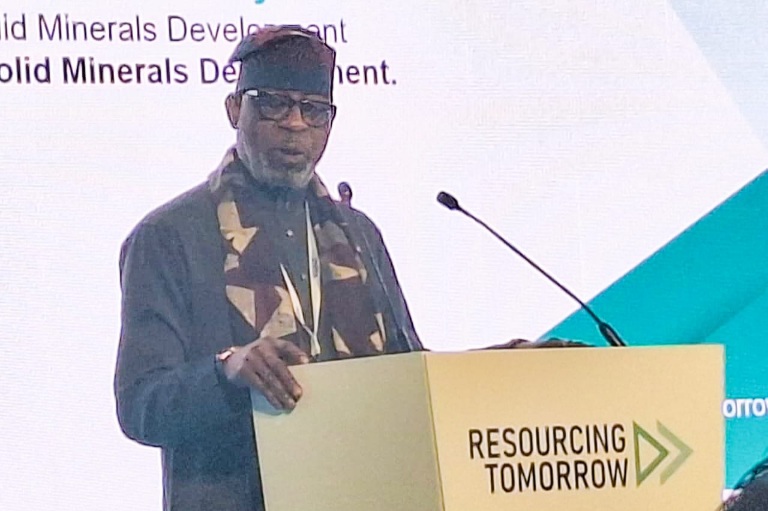
Nigeria pitched a new package of investor incentives to global mining companies in London, offering seamless profit repatriation and duty waivers on imported mining machinery as it seeks to accelerate capital inflows into the solid minerals sector.
The incentives were announced by Dele Alake, minister of solid minerals development, at the Resourcing Tomorrow exhibition and conference, a major global gathering of mining investors and operators, according to a statement by the ministry on Tuesday.
Alake told participants that Nigeria was now positioned as an investment ready destination, citing more than $2 billion in foreign capital committed to lithium and rare earth minerals projects within the last two years.
Read also: Chinese firms invest over $1.3bn in Nigeria’s lithium processing projects – Alake

He linked the inflows to the administration’s value addition policy, which prioritises domestic processing over raw mineral exports, the statement added.
Data presented at the forum showed that companies including Canmax Technologies, Jiuling Lithium, Avatar New Energy Nigeria Limited and Asba Group have invested over $1.3 billion in lithium processing facilities across the country. A $50 million lithium processing plant is currently under construction near Abuja, with plans for additional industrial clusters in Nasarawa, Kogi, Kwara and Ebonyi states.
Nigeria has also commenced development of a $400 million rare earth processing plant promoted by the HASETINS Group, which is expected to be completed within 15 months. In addition, preparations are underway for a multibillion dollar iron ore to steel project using advanced processing technology.
To address investor concerns around security and regulatory compliance, Alake said the government had created a specialised Mining Marshals unit to enforce mining laws and protect licensed operators.
He added that the security framework is being strengthened with satellite based monitoring to track mining operations nationwide.

The minister introduced the Nigeria Solid Minerals Company as the government’s preferred joint venture vehicle, structured to co-invest with private partners using mineral assets inherited from the defunct Nigerian Mining Corporation. The structure is designed to reduce exploration risk and support downstream processing.
He further disclosed that the Nigerian Geological Survey Agency, working with private exploration firms, has completed geological mapping of more than 80 percent of the country, significantly improving the availability of bankable data for investors.
Nigeria has also finalised its Solid Minerals Export Guidelines, aligning exports with international traceability, environmental and governance standards in response to tightening global supply chain requirements.
Beyond Nigeria, Alake said African mining ministers are advancing a continent wide push for local beneficiation through the Africa Minerals Support Group, arguing that in country processing offers a more resilient global supply model.
He noted that several Nigerian states now operate mining companies and that 427 community development agreements have been signed between host communities and mining firms, embedding environmental social and governance principles into sector operations.
The pitch was delivered to more than 1,000 industry participants, as Nigeria moves to position solid minerals as a major non oil growth driver.